





By Emmanuel Adeleke
As part of efforts to tackle food insecurity across Nigeria, the 36 state governors have agreed to work closely with the Federal Government to harmonise levies, eliminate illegal checkpoints, and enhance the free flow of goods across states.
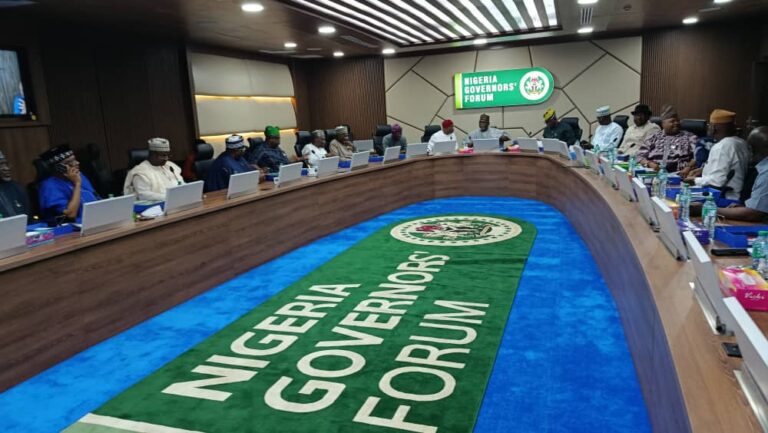
The governors, under the aegis of Nigeria Governors鈥� Forum (NGF), after a meeting with the National Security Adviser (NSA), Nuhu Ribadu, and other key stakeholders on Thursday, said widespread checkpoints, unlawful levies, and inadequate infrastructure are major factors driving food inflation and disrupting the food supply chain.
In a communiqu茅 read by the Lagos State Governor, Babajide Sanwo-Olu, the the governors expressed concern over World Bank鈥檚 failure to fulfill its funding commitments under the Nigeria Community Action Recovery and Economic Stimulus ( NG-CARES) programme.
鈥淭he Forum received a briefing from the National Security Adviser (NSA), Nuhu Ribadu, accompanied by the Honourable Ministers of Defence, Agriculture, Livestock Development, and Transportation, on the rising cost of food and livestock transportation across the country.
鈥淭he presentation revealed that the proliferation of checkpoints, illegal taxation, and poor infrastructure are key contributors to price inflation and inefficiencies in the food supply chain.
鈥淭he NSA noted that a high-level inter-ministerial committee has been established to address these concerns and has submitted its recommendations for the endorsement of the forum.
鈥淕overnors acknowledged the urgency of the matter and expressed commitment to collaborate with federal authorities to streamline levies, dismantle unauthorised checkpoints, and improve the movement of goods across states,” the communique read
Sanwo-Olu disclosed that states have collectively invested more than $2.2 billion through the NG-CARES programme.
鈥淭he Forum received a presentation from the World Bank on the Nigeria Community Action Recovery and Economic Stimulus (NG-CARES) programme.
鈥淭he bank highlighted that states have made significant investments totalling over US$2.2 billion through the NG-CARES delivery platforms, with verified impacts reaching over 17 million direct beneficiaries.
鈥淕overnors expressed concern over the non-fulfillment of funding pledges by the bank under NG-CARES 1.0.
鈥淭he forum emphasised the need for an amicable resolution between the World Bank and participating states to conclude the first phase of the programme before advancing to NG-CARES 2.0, which is designed to build long-term resilience for vulnerable households and enterprises,” he said.