









Akinwande Soji-Ojo
The Federal Government has officially scrapped the 2022 National Language Policy, which made the mother tongue or language of the immediate community the medium of instruction from early childhood to primary six.
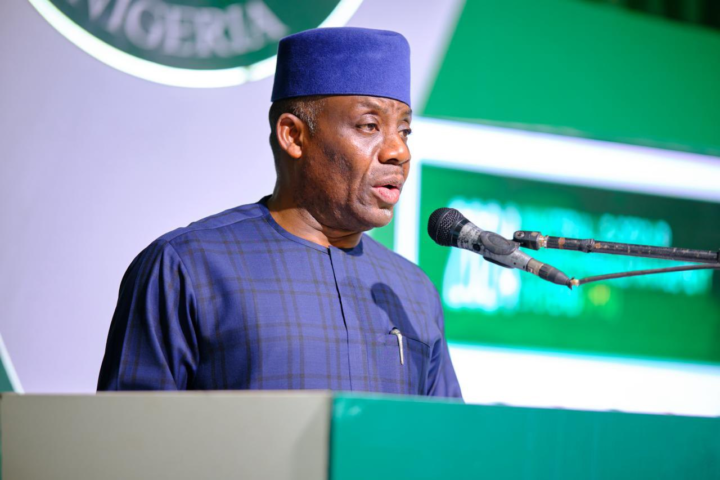
Minister of Education, Dr. Tunji Alausa, announced the reversal on Wednesday in Abuja at the opening of the Language in Education International Conference 2025, organised by the British Council.
Alausa said that English will now serve as the language of instruction across all levels of education, from primary to tertiary, stressing that the former policy had severely undermined learning outcomes.
鈥淭he National Policy on Language has been cancelled. English is now the language of instruction in our schools, from primary 1 to tertiary levels.
鈥淎s you know, one of the most important and powerful things in education is language. That鈥檚 how the role of language instruction is going to be developed in all subjects,鈥� the minister declared.
He said evidence-based research carried out by the Ministry of Education showed that teaching in the mother tongue contributed to the poor performance of Nigerian students in public examinations.
鈥淲e reviewed the data available to us. Is teaching in the mother tongue really working for us? The unanimous outcome of our review, which is evidence-based, data-driven, and combined with real-life situations in the geopolitical zones, shows overuse of mother tongue from primary 1 to primary 6, and even from JSS 1 to JSS 3.
鈥淲e鈥檝e seen total destruction of Nigeria鈥檚 system, where children graduate up to JSS 3 or even SS 3 without learning anything. They go on to sit national exams 鈥� WAEC, JAMB, NECO 鈥� and fail,鈥� the minister stated.
Alausa said the mother tongue policy had become impractical in a linguistically diverse country like Nigeria.
鈥淭he language policy in Nigeria states that mother tongue will be used in the early stage of primary school, primary 1. But we鈥檝e seen significant over-supervision into geopolitical zones of the country, and no use of that policy in other zones.
鈥淓xams are conducted in English, but we taught these kids through their mother tongue. In Borno State, the mother tongue is Hausa, but many speak Kanuri. In Lagos, areas like Ajegunle have predominantly southeastern populations, but 90% of teachers are from the South West. This diversity requires a unified approach to language instruction,” he said.
The minister noted that English, as a unifying language, would now be the standard for teaching across all schools to ensure consistency and better learning outcomes nationwide.
Earlier, the Country Director of the British Council, Nigeria, Donna McGowan, said the conference would provide a platform for stakeholders to improve English Language proficiency and develop new approaches to teaching and testing.
鈥淭he conference brings together policymakers, educators, researchers, and partners from across Africa, South Asia, and the UK to explore how language can support inclusion and improve learning outcomes across education systems,鈥� she said.
The 2022 National Language Policy was introduced to promote indigenous languages and preserve Nigeria鈥檚 cultural heritage, recognising over 600 local languages 鈥� 29 of which are already extinct.
However, its implementation faced challenges, including inadequate teaching materials, lack of trained teachers, and the country鈥檚 vast linguistic diversity.