









Akinwande Soji-Ojo
The African Democratic Congress (ADC) has criticised the Chairman of the Independent National Electoral Commission (INEC), Professor Joash Amupitan, over his comments on the party’s planned congresses and convention.
The opposition party said Amupitan’s remarks during an interview on Arise TV amounted to a misinterpretation of a Court of Appeal directive to maintain the status quo in the ongoing leadership dispute within the party.
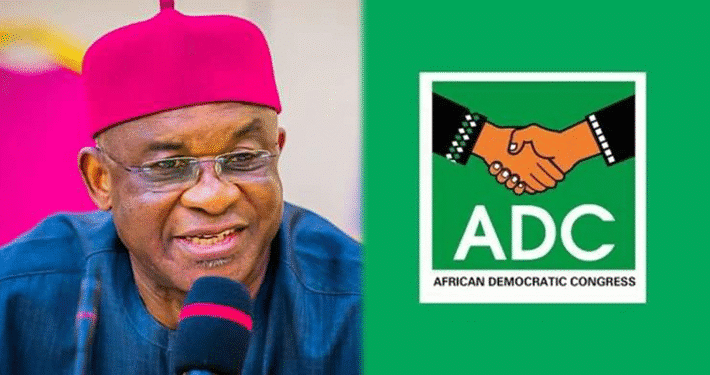
On Wednesday, INEC announced that it would no longer recognise the factions of the ADC led by David Mark and Nafiu Bala after reviewing a Court of Appeal judgement.
A day later, the party’s National Publicity Secretary, Bolaji Abdullahi, said the ADC would proceed with its congresses and convention despite INEC’s position.
In a statement on Friday, Abdullahi said the party rejects the claim by Amupitan that proceeding with its planned congresses could violate court orders, accusing the INEC chairman of acting beyond the commission’s supervisory role.
“The African Democratic Congress (ADC) has carefully reviewed the recent interview granted by the Chairman of the Independent National Electoral Commission (INEC), Professor Joash Amupitan, and finds it necessary to respond in order to correct several legal and factual misrepresentations.
“While the commission seeks to present its position as one anchored in law and neutrality, the substance of the chairman’s own statements reveals a fundamental misapplication of both constitutional principles and judicial directives.
“The question before Nigerians is not whether Nigeria remains a multi-party state in theory, but whether the actions of INEC in practice are undermining the ability of opposition parties to freely organise and function,” he said.
He also faulted Amupitan’s interpretation of the Court of Appeal’s directive on maintaining the “status quo ante bellum.�
“This interpretation is both selective and legally flawed.
“The preservation order, by its nature, is intended to prevent actions that would irreversibly alter the subject matter of litigation, not to paralyse the internal functioning of a political party,� the ADC spokesperson said.
According to him, INEC does not have the authority to determine what constitutes the status quo in the case.
“The chairman’s attempt to define the ‘status quo’ by tracing the controversy to internal party developments in July 2025 is an administrative interpretation that INEC is not empowered to make.
“That determination lies strictly within the jurisdiction of the courts, not the commission.
INEC cannot determine validity of congresses,” he said.
Abdullahi added that holding congresses or conventions does not invalidate ongoing judicial proceedings.
“Internal party processes, conducted in line with the party’s constitution and the Electoral Act, do not extinguish or prejudice pending judicial proceedings.
“Democratic continuity within a political party is presumed under the law unless expressly restrained by a competent court,� he added.
The ADC spokesperson emphasised that INEC’s role is limited to monitoring party activities when notified and does not extend to determining their validity.
“A party’s decision to proceed with its internal processes does not depend on INEC’s participation.
“By conflating its monitoring function with the validity of the processes themselves, INEC effectively places itself above the law,” he said.
Abdullahi also dismissed comparisons with past electoral cases, including those in Zamfara State.
“Those cases involved clear and established failures to comply with mandatory legal requirements for primaries.
“In contrast, the ADC has demonstrated its commitment to conducting its processes in strict accordance with its constitution and the Electoral Act
“The law does not permit administrative bodies to curtail constitutional rights on the basis of speculative future outcomes,� he said.
He reaffirmed that the party would proceed with its activities in line with the law.
“The ADC will therefore proceed with its activities in full compliance with the law and urges INEC to confine itself strictly to its constitutional and statutory mandate,� Abdullahi added.