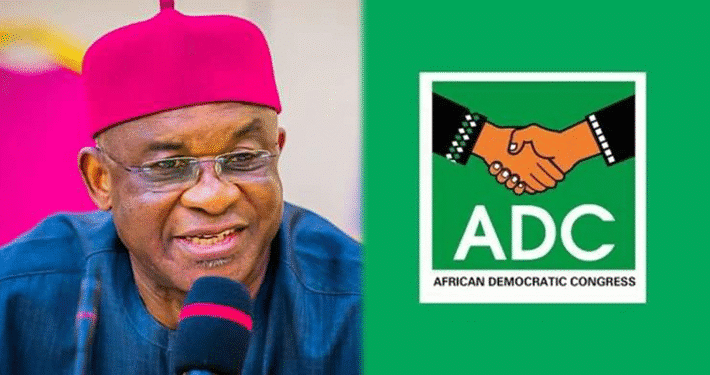





The African Democratic Congress (ADC) has accused the Nigerian Bar Association (NBA) of selective justice and political bias over its decision to refer a lawyer, Kalu Kalu, to the disciplinary panel for his comments about a Federal High Court judge, Justice Peter Lifu.
The party questioned the NBA鈥檚 decision to initiate disciplinary proceedings against Kalu, arguing that the association had failed to demonstrate similar concern when the Court of Appeal criticised the conduct of Lifu.
In a statement on Saturday, signed by its National Publicity Secretary, Bolaji Abdullahi, ADC warned NBA against allowing itself to be drawn into the political crisis involving the opposition.
While expressing support for professional restraint and respect for institutions, the party described the association鈥檚 reaction to Kalu鈥檚 remarks as selective.
鈥淲hy is the NBA only now finding its voice because a politician, who also happens to be a lawyer, has said something that some people find uncomfortable?
鈥淲hat has Kalu Kalu said about Justice Peter Lifu that the Court of Appeal has not already said?鈥� it asked.
The ADC referred to a June 2026 Court of Appeal ruling which, according to the party, described Lifu鈥檚 conduct as the 鈥渉ighest form of judicial impertinence.鈥� It also cited a Supreme Court precedent which characterised such conduct as judicial rascality.
The party questioned why the NBA had remained silent when the appellate court raised concerns about the judge鈥檚 conduct.
鈥淲e respect the NBA for its noble history in the defence of democracy and the rule of law.
鈥淗owever, the Association must be careful not to allow itself to be perceived as throwing its hat into the political ring on the side of a ruling party that already boasts openly of hijacking our judicial institutions and the Nigerian Bar,鈥� the statement read.
The ADC maintained that personal attacks against judicial officers should not be encouraged but argued that the NBA should also address conduct capable of undermining public confidence in the judiciary.
It accused the association of focusing on Kalu鈥檚 comments rather than addressing what it described as alleged misconduct within the legal profession and the judiciary.
鈥淭his is what should concern the NBA, rather than victimising a brave lawyer like Kalu for expressing his political views,鈥� it added.
The party further argued that respect for the courts should not prevent lawyers from speaking out against perceived injustice.
鈥淭he NBA cannot demand respect for the judiciary while appearing indifferent to conduct that brings the judiciary into disrepute.
鈥淩espect for the courts must never become a requirement for silence in the face of injustice,鈥� Abdullahi read.
The ADC said although lawyers should exercise restraint, they should not be expected to remain silent when confronted with wrongdoing.
鈥淲e agree that lawyers must exercise restraint. But there is no respectful way to address evil, and the NBA cannot teach us one,鈥� it said.
Kalu, an ADC member and lawyer to former Vice President Atiku Abubakar, had described the judge as a 鈥渃oconut judge鈥� while discussing the November 5 Federal High Court judgment on the party鈥檚 leadership crisis.
During the programme, Kalu disputed interpretations that the judgment had effectively ruled Atiku out of the 2027 presidential race, insisting that the decision did not invalidate his candidacy.
His remarks about the judge prompted Okinbaloye to interrupt him and caution him against using the television platform to disparage a sitting judicial officer. The presenter subsequently asked him to withdraw the remark.
Kalu eventually responded, 鈥淏ecause of time, I do withdraw it.鈥�
The NBA had in a statement on Friday petitioned the Legal Practitioners Disciplinary Committee (LPDC) over comments Kalu made about Lifu during the November 11 edition of Channels Television鈥檚 Politics Today, hosted by Seun Okinbaloye.
NBA President, Oyinkansola Badejo-Okusanya (SAN), said she had referred the matter to the disciplinary committee alongside the relevant broadcast materials.
She maintained that lawyers had the right to scrutinise judgments, challenge judicial reasoning and identify errors but should do so through legal arguments rather than personal attacks.
Badejo-Okusanya said Kalu would have an opportunity to respond to the petition, while the committee would determine whether his conduct amounted to professional misconduct and the appropriate sanction, if any.