





Efa Sunday
Nigeria鈥檚 inflation rate eased to 21.88 per cent in July 2025 from 22.22 per cent in June, according to the latest Consumer Price Index (CPI) released by the National Bureau of Statistics (NBS).
The decline, according to NBS, was largely due to the change in the base year, which lowered the year-on-year figures compared to July 2024.
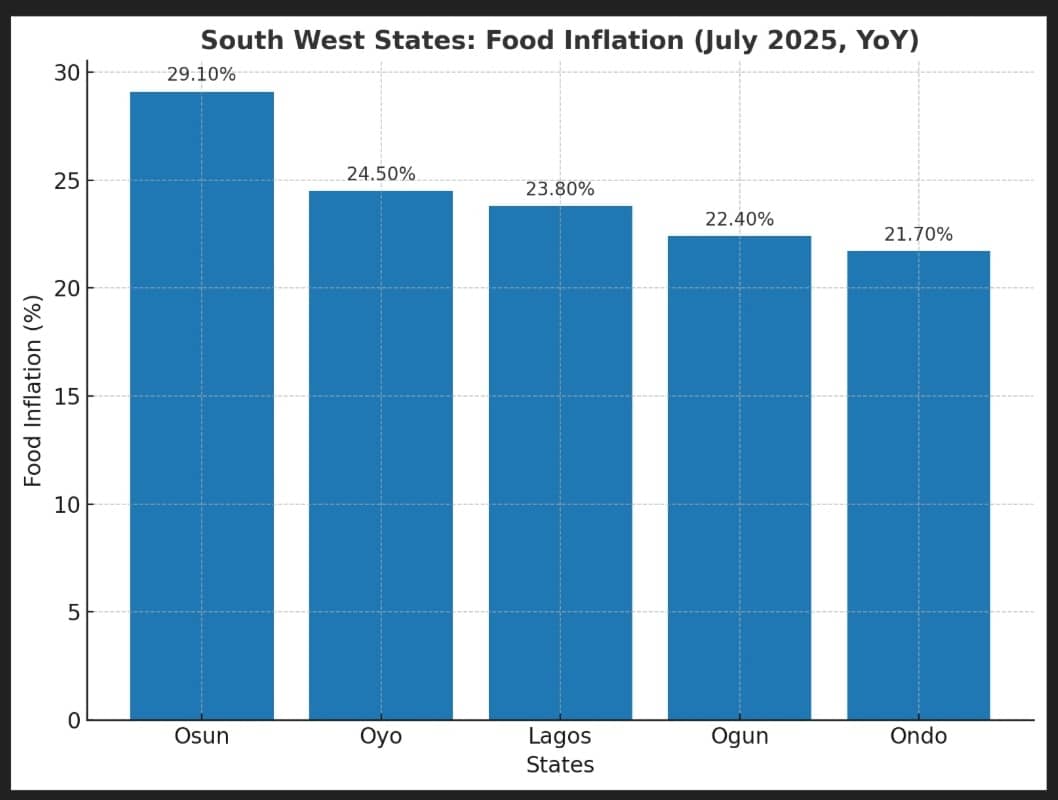
However, despite inflation slowing down nationally, households in the South West are still grappling with steep food prices. Osun, Oyo, Lagos, Ogun and Ondo States recorded some of the highest food inflation rates in the region, with Osun among the top three nationwide at 29.10 per cent.
Food inflation nationally stood at 22.74 per cent year-on-year, down from 39.53 per cent in July 2024, but month-on-month it remained high at 3.12 per cent, showing that prices of basic staples continue to rise.
In Oyo and Lagos, residents said the cost of rice, yam, beans and garri has doubled within the last year, forcing many families to cut back on portions. Traders in Ogun and Ondo attributed the persistent increases to rising fuel costs, poor storage facilities, and insecurity disrupting supply chains.
Core inflation, which excludes volatile agricultural products and energy, eased to 21.33 per cent year-on-year in July compared to 27.47 per cent in the same period last year. Urban inflation was 22.01 per cent, while rural inflation stood at 21.08 per cent.
At the state level, headline inflation was highest in Borno (34.52 per cent), Niger (27.18 per cent), and Benue (25.73 per cent), while Yobe (11.43 per cent), Zamfara (12.75 per cent), and Katsina (15.64 per cent) recorded the lowest. For food inflation specifically, Borno, Osun and Ebonyi topped the chart.
The data underscores the burden on South West families, where rising food costs overshadow the national slowdown in inflation. For many households in Oyo, Osun, Lagos, Ogun and Ondo, the relief on paper is yet to reflect in daily market prices.