






Akinwande Soji-Ojo
Six candidates seeking to become the next United Nations(UN) Secretary-General will take part in a televised debate on Thursday, one week before the formal selection process begins for the organisation’s top job.
The 90-minute debate, to be held in the UN General Assembly Hall, will feature questions from diplomats, UN staff and civil society representatives. The event, scheduled to begin at 5:00 p.m. (2100 GMT), will be broadcast by Bloomberg.
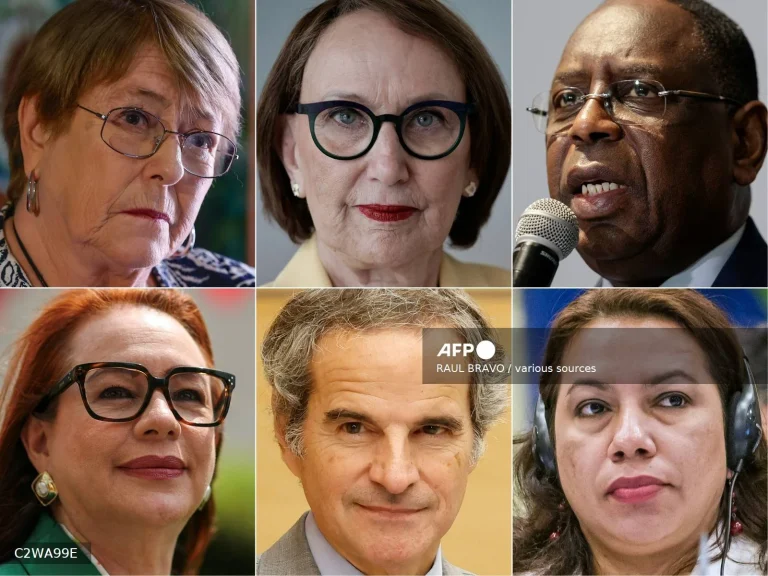
The candidates are former Chilean President, Michelle Bachelet; former Ecuadorian Foreign Minister, Maria Fernanda Espinosa; Director General of the International Atomic Energy Agency, Rafael Grossi of Argentina; Costa Rican economist, Rebeca Grynspan; former Guyanese Foreign Minister, Carolyn Rodrigues-Birkett; and former Senegalese President, Macky Sall. They are vying to succeed outgoing Secretary-General, Ant贸nio Guterres.
General Assembly President, Annalena Baerbock, said the debate would give the global community an opportunity to assess the candidates’ vision for the organisation.
“This UN town hall will provide a rare opportunity to engage with the ideas, priorities and leadership vision of the candidates for one of the world’s most important positions.
“In an increasingly fragmented world, the United Nations needs not only an exceptional chief administrator who will make the organisation fit for the 21st century, but also a leader with the integrity and courage to vigorously defend the UN Charter and its three pillars,” Baerbock said.
The debate comes as the United Nations grapples with financial challenges and a crisis of confidence.
The administration of United States President, Donald Trump, has accused the organisation of overspending, expanding beyond its core mandate and failing to deliver expected results.
While the United States has called for the UN to refocus on peace and security, many member states insist that human rights and development remain equally important pillars of the organisation.
Despite the significance of the race, analysts say the campaign has lacked the excitement of previous contests.
International Crisis Group analyst, Richard Gowan, said the race had been notably cautious.
“The race does seem short on energy compared with the livelier 2016 campaign, which had more candidates and lots of intrigue before Guterres was ultimately selected.
“Everyone agrees that the race is incredibly important for the future of the UN, but the contest itself has been quite cautious. There is a sense that the candidates are treading carefully to avoid offending the US and other veto powers,” Gowan said.
The candidates have already undergone three hours of questioning by representatives of the UN’s 193 member states.
On July 30, the 15-member Security Council is expected to hold its first closed-door straw poll to gauge support for the candidates. Additional rounds of voting will continue until one candidate secures at least nine votes without a veto from any of the council’s five permanent members.
The successful candidate will then be recommended to the General Assembly for formal appointment and will assume office on January 1, 2027.
Although several diplomats said many countries have yet to decide whom to support, Gowan described Grossi as the most frequently mentioned frontrunner while noting that Grynspan and Rodrigues-Birkett also enjoy strong backing.
“Grossi is still the most frequently mentioned front-runner, but he has not locked up the race. Other candidates like Grynspan and Rodrigues-Birkett also have significant numbers of admirers,” he said, adding that “a dark horse candidate could still emerge.”
According to AFP, speculation also continues over other possible contenders, including FIFA President, Gianni Infantino, whom the New York Post reported is favoured by Trump for the role.
While Latin America is pressing for the position under the UN’s informal regional rotation tradition, many member states are also advocating for the appointment of the organisation’s first female Secretary-General.