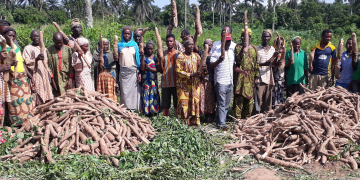










Resource-poor farmers who are participating in the demonstration farms being organized by the IITA-led Cassava Weed Management Project (CWMP) have said that the project intervention is making life easier for them. According to them, the project is a 鈥渂urden lifter.鈥� They said they have 鈥渟uffered over the years, seeking solutions to weed management in cassava farming systems.鈥�
For farmer Fortunatus Okeke, the IITA-CWMP is perhaps the best thing to have happened to farmers in recent times.
鈥淚t was a 鈥榥ew normal鈥� to hand weed and face drudgery. But now, IITA has brought solutions to control weeds. We are glad for this,鈥� he said.
Another farmer, Abu Ogundapo who is based in Abadapo village, said that the yields from the demonstration farm were unprecedented. 鈥淲e have never had it so good like this,鈥� he said, while admiring his cassava harvest.
Farmer Esther Ayangbade from Otuu village said, 鈥淭his project has made cassava farming easier. I am glad to be part of this.鈥�
Responsible for between 50 and 80 percent of yield losses in cassava farming systems, weeds rank high among the constraints to cassava production in Africa, limiting the yield of the root crop to less than 10 tons per hectare in Nigeria.
Farmers plant cassava to the extent to which they can control weeds, notes Dr Alfred Dixon, Project Leader of the IITA CWMP. For women, who contribute up to 90 percent to weeding labor, it is a 鈥渘ightmare鈥� imagining the emergence of weeds and having to clear them. In some cases, children of school age are withdrawn from schools to support weeding operations, a practice that undermines the future of this vulnerable group.
With the interventions of the IITA-CWMP using integrated weed control, farmers are heaving a sigh of relief from the 鈥榶oke鈥� of weed infestation in cassava.
The integrated weed management package comprises the use of best-bet agronomic practices plus the use of safe and environmentally friendly herbicides.
Using this approach, Prof Friday Ekeleme, Project Investigator for the IITA-CWMP, has reported that farmers are now doubling the national yield average of cassava鈥攃rossing the 20 tons per hectare mark to 32 tons per hectare in some cases.
Participating farmers in the demo farms interviewed said they were willing to adopt the weed management practices, a signpost that the intervention is relevant.