









Akinwande Soji-Ojo
The Development Agenda for Western Nigeria (DAWN) Commission and stakeholders from the six South West states have called for the harmonisation of State Social Registers (SSRs), increased funding for State Operations Coordinating Units (SOCUs), and stronger inter-agency collaboration to improve social protection and ensure government interventions reach genuinely vulnerable households.
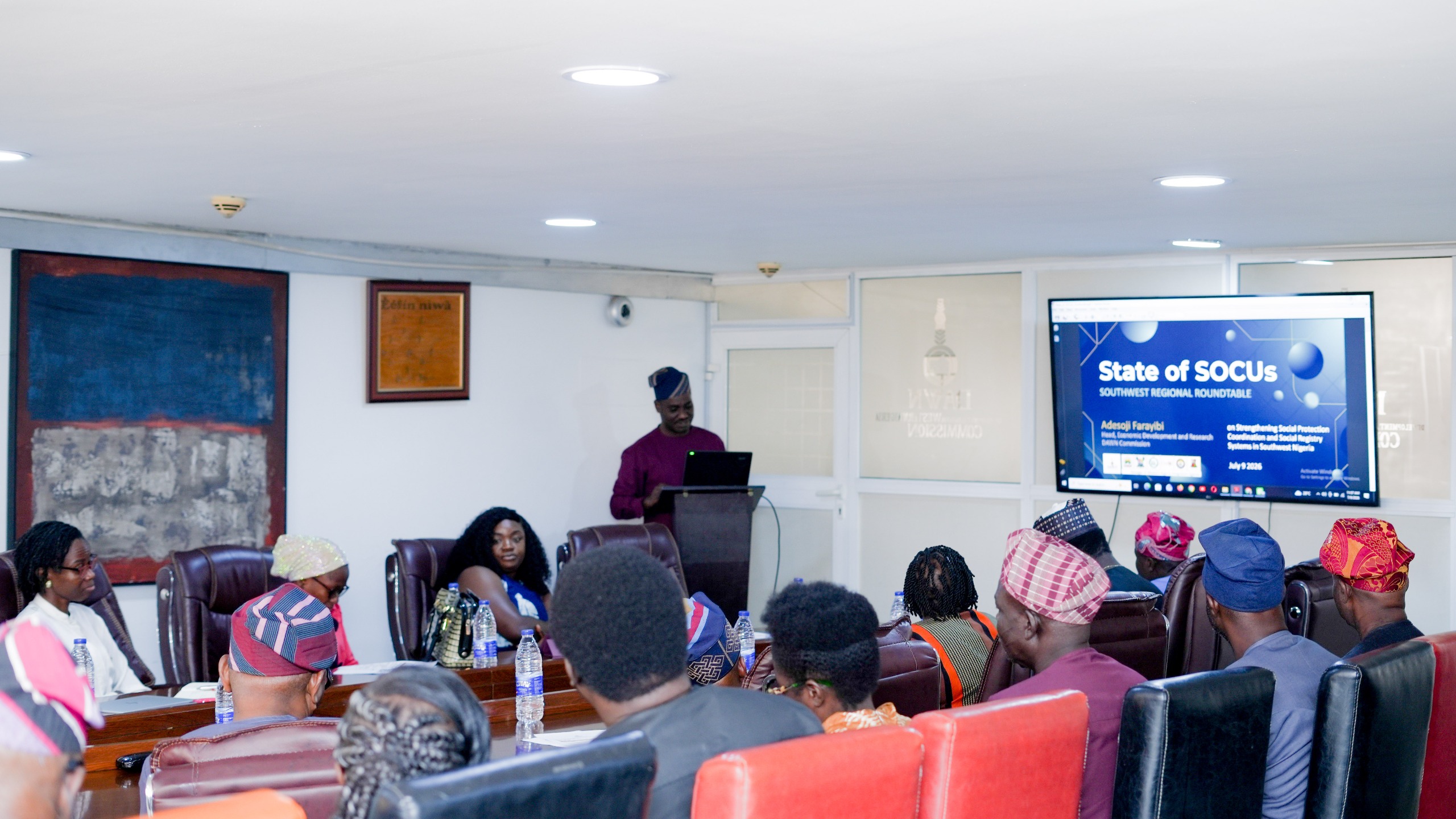
The resolutions were reached on Thursday at the South West Regional Roundtable on Strengthening Social Protection Coordination and Social Register Systems, organised by the DAWN Commission at its headquarters in Cocoa House, Ibadan.
The meeting brought together Permanent Secretaries, SOCU chairpersons and coordinators from the six South West states, representatives of the National Social Safety Nets Coordinating Office (NASSCO), National Identity Management Commission (NIMC), UNICEF, state health insurance agencies and other development partners.
The stakeholders agreed that reliable and up-to-date data remain the foundation of effective social protection programmes, saying governments cannot adequately plan, monitor interventions or deliver targeted support without credible social register data.
In his welcome address, the Director-General of the DAWN Commission, Dr. Seye Oyeleye, said the roundtable was convened to strengthen regional collaboration and build a more coordinated social protection system across the South West.
According to him, while all six states have established SOCUs, there are still significant disparities in funding, operational capacity, technology, data quality and institutional support.
Oyeleye noted that many of the units continue to grapple with funding constraints, fragmented data systems, inconsistent updating of registers and limited interoperability with other government databases.
The Director-General said the South West must begin to view the State Social Register as more than a database for distributing social intervention benefits.
“The State Social Register should evolve from being viewed solely as a database for social intervention programmes into a strategic asset for evidence-based planning across sectors.
“Imagine a future where every social intervention, every targeted subsidy programme, every vulnerable household requiring health insurance coverage, and every emergency response draws from one credible, continuously updated and trusted register,” he said.
Oyeleye urged participants to use the meeting to identify practical solutions that would strengthen the operational effectiveness of SOCUs and position them as permanent institutions within the governance structure of each state.
Setting the tone for the discussions, the DAWN Commission’s Head of Economic and Research, Mr. Adesoji Farayibi, traced the evolution of SOCUs from the World Bank-supported Youth Employment and Social Support Operation (YESSO) to the National Social Safety Nets Project (NASSP).
He explained that the initiative has grown into one of the world’s largest social protection databases, with the National Social Register now covering over 19 million households and more than 70 million individuals across Nigeria.
Farayibi, however, identified inadequate funding, outdated records, weak interoperability and the slow integration of the National Identification Number (NIN) as major challenges limiting the effectiveness of the system.
Speaking during the roundtable, the DAWN Commission’s Head of Research and Data, Dr Omolara Ejiade, said data quality remains central to effective planning and the transparent delivery of government interventions.
“Data is highly important in preventing duplication and exclusion, stressing that planning without reliable data will always produce poor results. We must invest in data collection, harmonisation and regular updating if we truly want effective social protection,” she stated.
Participants observed that previous reliance on phone numbers for registration made the system vulnerable to fraud and multiple registrations, stressing that integrating the National Identification Number (NIN) would significantly improve data integrity.
According to them, “With NIN, people can register from the comfort of their homes within minutes. It reduces duplication, improves verification and strengthens transparency.”
The stakeholders also stressed the need for regular updates of the State Social Register, describing it as “a living document” that should continually reflect changes in the socio-economic status of households.
They urged state governments to institutionalise SOCUs by making them part of annual state budgets instead of depending largely on donor-funded projects.
The participants also advocated the development of a harmonised South West Social Register framework that would promote uniform data standards, improve interoperability among states and strengthen evidence-based planning across the region.
They further recommended stronger collaboration among government agencies, the integration of the Social Register with state health insurance schemes, wider use of vulnerability assessment tools and improved monitoring of internal migration.
The stakeholders warned against political interference in social intervention programmes, insisting that beneficiary selection should be based on verified data rather than political considerations.
“We must separate governance from politics. Politicians should support the system but should not politicise it. Agencies must work together, eliminate unnecessary competition and strengthen synergy,” they said.
They also called for legislation to institutionalise the Social Register and guarantee its continuity beyond political administrations.
At the end of the meeting, participants agreed on five priority areas for the South West: improving data quality through regular updates, accelerating NIN integration and interoperability, leveraging the Social Register for health insurance enrolment and targeted government interventions, promoting regional collaboration and peer learning among the six states, and ensuring the sustainability of SOCUs through stronger institutional support and dedicated state funding.
They also resolved to develop a South West framework for social register management, establish a regional community of practice for continuous knowledge sharing, engage grassroots stakeholders in identifying verified vulnerable households and sustain regular reviews of the register to improve its accuracy and effectiveness.
The stakeholders expressed confidence that implementing the resolutions would strengthen data-driven governance, improve transparency in social protection programmes and enhance service delivery to vulnerable households across the South West.