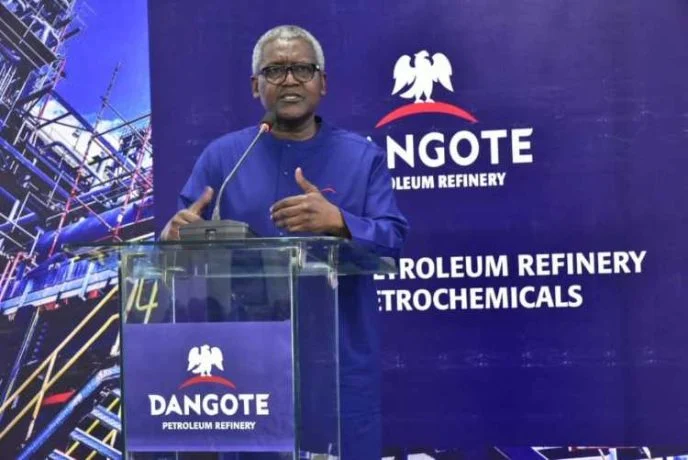










The President of Dangote Petroleum Refinery, Aliko Dangote, has said the plant currently imports about 10 million barrels of crude oil from the United States and other countries every month.
Speaking on Tuesday during his keynote speech at the West African Refined Products Pricing and Markets Development Conference in Abuja, Dangote said International Oil Companies (IOCs) have been the most difficult part of the refinery鈥檚 journey.
He said when the construction of the refinery was completed, one of the first commercial shocks encountered was crude feedstock sourcing.
鈥淎t the project inception, it was reasonable to assume that in a country producing about 2 million barrels per day, securing crude would be the least of our worries. But we were wrong,鈥� Dangote said.
The billionaire said instead of buying crude directly from Nigerian producers at competitive terms, the refinery had to engage with international trading companies who are buying Nigerian crude and reselling it with hefty premiums.
鈥淒ue to the continent’s limited domestic refining capacity, Africa imports over 120 million tonnes of refined petroleum products annually, at a cost of approximately $90 billion,鈥� he said
He appreciated the Management of the Nigerian National Petroleum Company Limited (NNPCL), for making some cargoes of Nigerian crude available from start of production to date.
“As we speak today, we buy 9 – 10 million barrels of crude monthly from US and other countries. I must thank NNPC for making some cargoes of Nigerian crude available to us from start of production to date.
鈥淭hey have done very well. But it鈥檚 been very, very difficult with the IOCs. IOCs have been the most difficult part of our journey,鈥� the businessman said.
Dangote further stated that despite producing around 7 million barrels of crude oil per day, Africa only refines about 40% of its 4.3 million barrels daily consumption of refined products domestically.
“So, while we produce plenty of crude, we still import over 120 million tonnes of refined petroleum products each year, effectively exporting jobs and importing poverty into our continent. That’s a $90 billion market opportunity being captured by regions with surplus refining capacity. To put this in perspective: only about 15% of African countries have a GDP greater than $90 billion. We are effectively handing over an entire continent’s economic potential to others-year after year,” he said.
He said another challenge was encountered during crude transportation.
鈥淟ifting schedules were constantly shifted by upstream operators, and we were hit with excessive port and regulatory charges.
鈥淪kyrocketing port charges made up about 40 percent of the total freight cost, meaning it cost two-thirds as much as chartering a vessel with the crew, insurance, and fuel included,鈥� Dangote said
He said refiners in India, despite sourcing crude from farther distances, enjoy 鈥渓ower freight charges than we do right here in West Africa because they are not saddled with exorbitant port charges鈥�.
鈥淚n terms of port charges, it is currently more expensive to load a domestic cargo of petroleum products from Dangote refinery as customers pay both at the loading point and also at the discharge point.
鈥淏ut when they load from Lome, that competes with us, they pay only at the port of discharge.鈥�
The businessman said this is 鈥渟imply unfair and unsustainable鈥�.