






Akinwande Soji-Ojo
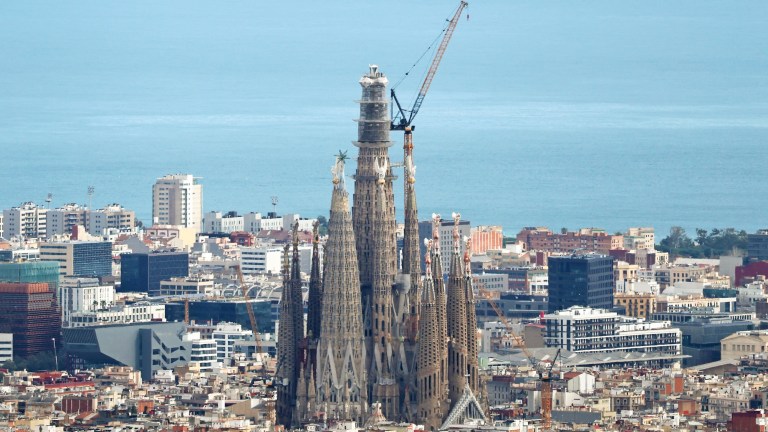
After more than 140 years of construction, the exterior of the Sagrada Fam铆lia in Barcelona, Spain, has finally been completed, marking a historic milestone for what is now officially the world鈥檚 tallest church.
On February 20, workers installed the nearly 15-foot upper arm of a cross atop the Tower of Jesus Christ, bringing the basilica鈥檚 height to 566 feet.
The new apex surpasses Germany鈥檚 Ulm Minster, making the Sagrada Fam铆lia the tallest church on the planet. The basilica is also recognised as a UNESCO World Heritage Site.
Construction of the iconic church began in 1882 under the visionary guidance of Catalan architect, Antoni Gaud铆, whose distinctive blend of Gothic and Art Nouveau styles transformed the project into one of the most ambitious architectural undertakings in history.
According to , Gaud铆 devoted more than four decades to the basilica, spending the last 15 years of his life exclusively on the project. When he died in 1926, less than a quarter of the structure had been completed. The installation of the cross coincides with the centenary of his death.
The newly erected cross, crafted from glass, ceramic tiles, and Catalonian stone, was assembled in sections by artisans in Germany before being transported to Spain for final installation. Large enough to house a spiral staircase, it was designed to fulfill Gaud铆鈥檚 vision of a cross that would shine day and night over Barcelona.
Progress on the basilica has continued largely through private donations since 1940, though the project faced major setbacks during the Spanish Civil War, when parts of the structure and many of Gaud铆鈥檚 original plans were destroyed. Architects and engineers relied on salvaged materials, historical interpretations, and modern computer modeling to continue the work.
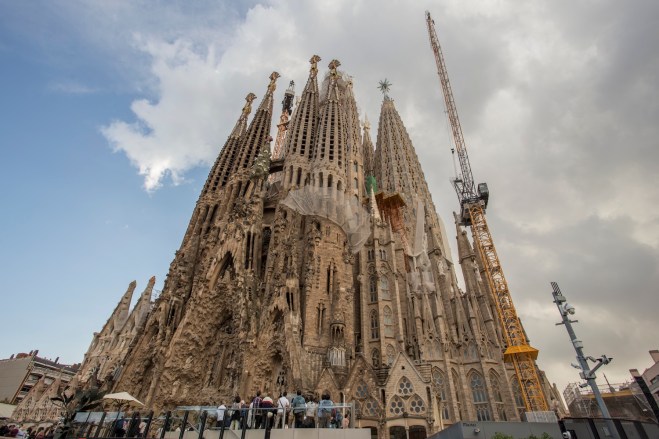
A view shows the ongoing construction of the Sagrada Familia, designed by Spanish architect Antoni Gaudi, in Barcelona, Spain, on October 17, 2025. Credit:聽
The Sagrada Fam铆lia鈥檚 design remains unlike any other church in the world. Its 18 soaring spires symbolise the 12 apostles, the four evangelists, the Virgin Mary, and Jesus Christ.
Gaud铆 even conducted acoustic studies to ensure that the wind-driven tubular bells inside the towers would channel sound into the church below.
Not everyone has admired the masterpiece. English author, George Orwell, once described it as 鈥渙ne of the most hideous buildings in the world鈥� in his memoir Homage to Catalonia, written during the Spanish Civil War.
Despite the completion of its exterior, work on the interior continues. Decorative elements, including an Agnus Dei (Lamb of God) sculpture by Italian artist, Andrea Mastrovito, are still underway.
The suspended glass artwork will hang beneath the cross within a geometric structure known as a hyperboloid.
If current timelines hold, the Sagrada Fam铆lia is expected to be fully completed in 2034鈥�152 years after construction began.
Gaud铆, aware of the enormity of his vision, once quipped when asked about delays: 鈥淢y client is not in a hurry.鈥�