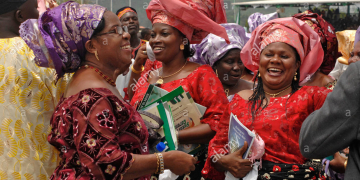







Only women who have a track record of grassroots work and activism in women鈥檚 and civil rights issues should represent women in Local Governments, Houses of Assembly, Representatives and Senate.
This declaration was made on Wednesday by Prof. Abiola Ojejide, Emeritus Professor and member of the Women’s Research and Documentation Centre (WORDOC), Institute of African Studies, University of Ibadan.
The professor was the keynote speaker at the opening ceremony of the 30th anniversary conference of the centre founded by renowned聽historian, Prof. Bolanle Awe.
Speaking on the theme, 鈥淲hat do women want, what should women want?鈥�, Prof. Ojejide lamented that the quality of female representation in the Nigerian parliament was聽below par and needed improvement.
She said: 鈥淲hen we get good quality representation, we can begin to ask our delegates, 鈥淗ow many gender bills have they introduced? How much success have they had in supporting and pushing through executive bills related to gender issues? I do not recall any sizable number of strong female voices in the Federal Houses canvassing such bills. Rather, it was the Civil Society Organisations and professional groups that were most vocal. Is it that party allegiance and fear of allegation of 鈥榓nti- party activities鈥� which often result in the loss of plum positions hamper vociferous voices and cross- party collaboration?鈥�
She stressed that there was also a strong need to keep drumming support for the reintroduction of the Gender Equality Bill and all pro-women legislation.
The erudite scholar chided President Muhammadu Buhari for the low inclusion of women in his cabinet.
Her words: 鈥淭he immediate past President, Goodluck Jonathan appointed women to 33% of cabinet positions, up from 10% in President Obasanjo鈥檚 government. Now, under the current government, women鈥檚 representation has gone down further and both verbal pronouncements and the body language of our leaders indicate a lessening of the importance of the critical roles of women to the growth and health of our country鈥�.
鈥淭he enforcement of the provision in the National Gender Policy which sets the benchmark for women鈥檚 seats in Parliament at 35% is still on the table. We need to keep canvassing for internal party democracies and quota seats for females in each party, and engendering party structures and operations to make them gender-friendly. We need to keep pressing for the passing of the Child Rights Act by the remaining eleven states鈥�.
Regretting the mediocre or sometimes non-existent contribution of women to critical issues, Prof. Ojejide urged women themselves to help their own cause聽and lend their voices to global and national issues.
鈥淚 listen to Nigerian radio phone in programmes quite a lot and I鈥檓 struck by the preponderance of men鈥檚 views on trending critical issues in Nigeria, such as the issue of restructuring, devolution of powers, marginalization and resource allocation, These voices often range from those of professionals, experts in the field, social analysts and political commentators to those who do not understand the issues but have a lot of zeal.
鈥淚n contrast, I rarely hear women contributing to the debate, not for lack of expertise but I guess, on account of our acculturation about not being heard in the public space. Rather, women phone in on a lot on bizarre stories of juju at work, on relationships, and light hearted programmes. In effect, I am saying we must move from the outskirts of politics but to fundamental issues which can make or mar the future of this nation. We need to court the media in setting our agenda and put the social media to good use.
鈥淚n this regard, we need to work more strongly with the media, especially the broadcast media on eliminating disparaging representations of women in the media, in particular, the trivializing of gender based violence, (especially rape) on the indigenous languages soft news.
She also advocated for 鈥済reater collaboration with Civil Society Groups, Organisations on Reproductive health, Professional women鈥檚 groups like FIDA and NAWOJ, to make our voices forceful鈥�.
Founder of WORDOC, Prof. Bolanle Awe, in her remarks, expressed gratitude to those who have supported and stood by the Centre in the past 30 years. She paid particular respect to deceased members and supporters.
She urged leaders and members of the centre to step up their activities because 鈥渋t looks as if we are slacking鈥�.
“After 30 years, it is time to take stock. It had not been only stories of success; like any human institution, there have been setbacks and we must give WORDOC a new energy as far as the issue of gender is concerned”. she said.
She stressed there was need to carry local and uneducated women along in the struggle for gender equality. According to her, most of the women at the grassroots do not understand the points being made by the elites.
In that light, she commended the idea of a village square meeting slated as part of the events mapped out for the two-day anniversary conference
Co-ordinator聽of the centre, Dr. Sharon Omotoso, took time out to appeal for financial and material to aid WORDOC’s聽research and documentation projects.
The ceremony, chaired by Prof. Kikelomo Osinusi, was held at the Gamaliel Onosode Hall, International Conference Centre, University of Ibadan.
It聽witnessed the honouring of some notable supporters of WORDOC and women鈥檚 issues, among whom are former Vice Chancellor of UI, Prof. Ayo Banjo; Director of the Ibadan School of Governance and Public Policy (ISGPP), Dr. Tunji Olaopa; the MacArthur Foundation and a host of others. Prof. Awe was also decorated.
The anniversary conference covered two days – Wednesday, October 18 and Thursday, October 19 – with panel discussions held at the Institute of African Studies.
The village square meeting, according to Dr. O.I Pogoson, Director, Institute of African Studies, will witness discussions with non-western cultured and educated women.
Also present at the ceremony were the Commissioner for Women and Social Affairs, Oyo State, Mrs. Atinuke Osunkoya; Executive Assistant to Governor Abiola Ajimobi on political matters, Dr. Moronkola Thomas; Former Majority Leader House of Representatives, Hon. Mulikat Adeola, represented by Mrs Sade Ajala, former UI Registrar, Mrs Moji Ladipo and a host of dignitaries from the academia and civil society groups.