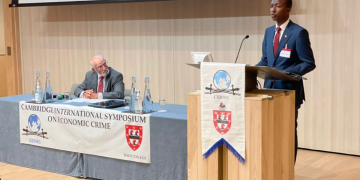







The chairman, Economic and Financial Crimes Commission (EFCC), Abdulrasheed Bawa, has said advancement in digital assets such as cryptocurrencies increasingly portends huge risks to the economy of the world.
Bawa, stated this on Monday while delivering his keynote address at the 38th Cambridge International Symposium on Economic Crime, themed, ‘Economic Crime-Who pays and who should pay?’
The event was organised by the Centre for International Documentation on Organised and Economic Crime (CIDOEC), Jesus College, University of Cambridge, United Kingdom.
The commission’s spokesperson, Wilson Uwujaren, who captured some highlights of the event in a statement, quoted Bawa as saying the development was partly because many criminals now play significant roles in cryptocurrency markets, adding that the virtual currencies had become their preferred mediums of exchange.
“The developments in new technologies and the growth of cryptocurrencies portrays a far greater danger to the world economy than ever before with many criminals playing significant roles in cryptocurrency markets.
“Criminals now elect to transact or receive illegal monies (such as ransom money) for cyber-attacks in cryptocurrencies with Bitcoins and Ethereum as the most commonly used mediums for these exchanges.
“The sophistication and complexity that defines the dynamics of economic crime in the 21st Century continues to evolve, spurred by technological advancement in the global economy that has become borderless and transnational.
“Inevitably led to the prioritisation of law enforcement action on crimes that drive Illicit Financial Flows (IFFs) across the globe.
“Economic crimes which are largely illegal acts committed for private gain affect the vital structures of global economies, causing significant damage to the Global Financial System and depriving developing nations of the needed resources for sustainable development,â€� the EFCC boss said.
He noted that developed countries are not immune to the scourge, which, according to him, has “magnified with the proliferation of cyber-crimes which threatens the stability of Global Financial Institutions.�
Bawa said the platform of the event provided an opportunity to interrogate the challenges of economic crimes.
“As the victims of crime continue to suffer globally from the effects of financial crimes, either directly or indirectly as part of a social system, the determination of who pays or who should pay becomes a critical measure of the criminal justice system in place,” he said.
Bawa underlined the imperatives of an impartial judiciary in ensuring that “the perpetrators of acts and not the victims pay for their crimes.�
While highlighting some of the transparency and accountability achievements of the President Muhammadu Buhari administration, Bawa pointed out that the EFCC, as the rallying point in the fight against economic crimes in Nigeria, has recorded important milestones in investigations, prosecutions and assets recovery.
“Since its establishment in 2003, the Commission has recorded no less than 3,500 convictions and recovered assets of significant value including properties in Nigeria, UK, USA, and UAE. All these have measurably contributed to the national efforts against economic crimes in Nigeria,� he said.
The EFCC boss charged participants to come up with practical solutions to curb the international threat of economic crimes.
Speaking, the chairperson of the symposium, Saul Froomkin, thanked the EFCC boss for his insightful presentation, and support received from Nigeria in organising the event.
Participants at the symposium were drawn from law enforcement and security agencies, accountability institutions and partners across the world.