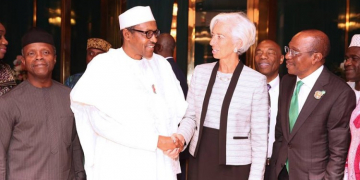










Managing Director of the International Monetary Fund (IMF), Christine Lagarde, after her closed door meeting with President Muhammadu Buhari today,聽addressed a press conference.
聽highlights the major issues she discussed with the president
IMF TO AUDIT NIGERIA鈥橲 BUDGET
Lagarde revealed that the IMF team of economist would be in Nigeria next week to audit Nigeria鈥檚 budget.
鈥淚t is not for me here and now to actually approve or comment on the budget, because we have procedures at the IMF under which a team of economists is going to come next week actually, to do what we call the article four, which is a review, audit and a discussion between countries; the IMF on the one hand, the country authorities on the other.鈥�
IMF SUPPORTS BUHARI鈥橲 ANTI-GRAFT WAR
IMF said the president鈥檚 decision to tackle corruption is very important to the agenda and reforms of the IMF.
鈥淲hat I mentioned to Mr President this morning was that his determination to fight corruption and his determination to bring about transparency and accountability at all levels of the economy were very important agenda item.
鈥淗e himself is definitely committed too it, as he indicated this morning, and as he inspires among his team members.鈥�
IMF SUPPORT FOR SUBSIDY REMOVAL
Consistent with its previous recommendations to the Nigerian government, the IMF says it supports reforms in the country, which include subsidy removal.
鈥淎 vibrant economy still has to deal with a lot of poor people with a lot of inequality and those two components should always be the driver of reforms, whether it is looking at subsidies and how they are structured and how they can be phased out,鈥� Lagarde said. 鈥淲hether it is monetary policy and where flexibility is needed, all of those are ambitions that we quickly recognise and support.
鈥淔or those of you who wonder why the IMF managing director is visiting Nigeria, well it is to have a good discussion about these new objectives, these reforms, Agenda, that have been identified and supported by the president and also to appreciate the impact that it would have on neighbouring countries.
NOT ANOTHER 鈥淪AP鈥� OR CONDITIONAL LOAN
One major reason why Nigerians are sceptical about the IMF is the Structural Adjustment Programme (SAP) in the Ibrahim Babangida years, which many believe was the start of Nigeria鈥檚 economic woes. However, Lagarde any possible tension about a recurrence, saying she was not in the country for another programme or loan facility negotiation.
鈥淚 am not here nor is my team here to negotiate a loan with conditionalities. We are not into programme negotiation and frankly, at this point in time, given the determination and resilience displayed by the president and his team, I don鈥檛 see why an IMF programme would be needed.
鈥淒iscipline is going to be needed, of course implementation is going to be needed, of course implementation is going to be key, but the objectives and ambition would serve the country well, in order to be actually sustainable.
FLEXIBILITY WITH NAIRA DEVALUATION
Speaking on Nigeria鈥檚 current account (foreign reserves), Lagarde said the country needs to shift grounds on its currency monetary policy, hinting naira devaluation.
鈥淭he current account, we believe that with very clear primary ambition to support the poorer people of Nigeria, there could be added flexibility in the monetary policy, particularly if as we think, the price of oil is likely to be low for longer.
鈥淭he occurrences should not deplete the reserves of the country, simply because of being seemingly rigid. I鈥檓 not suggesting that rigidity be totally removed, but some form of flexibility would help.鈥�
Lagarde will also be meeting with senate president Bukola Saraki, Yakubu Dogara of the house of representatives and select legislators, before heading to Cameroon.