






Akinwande Soji-Ojo
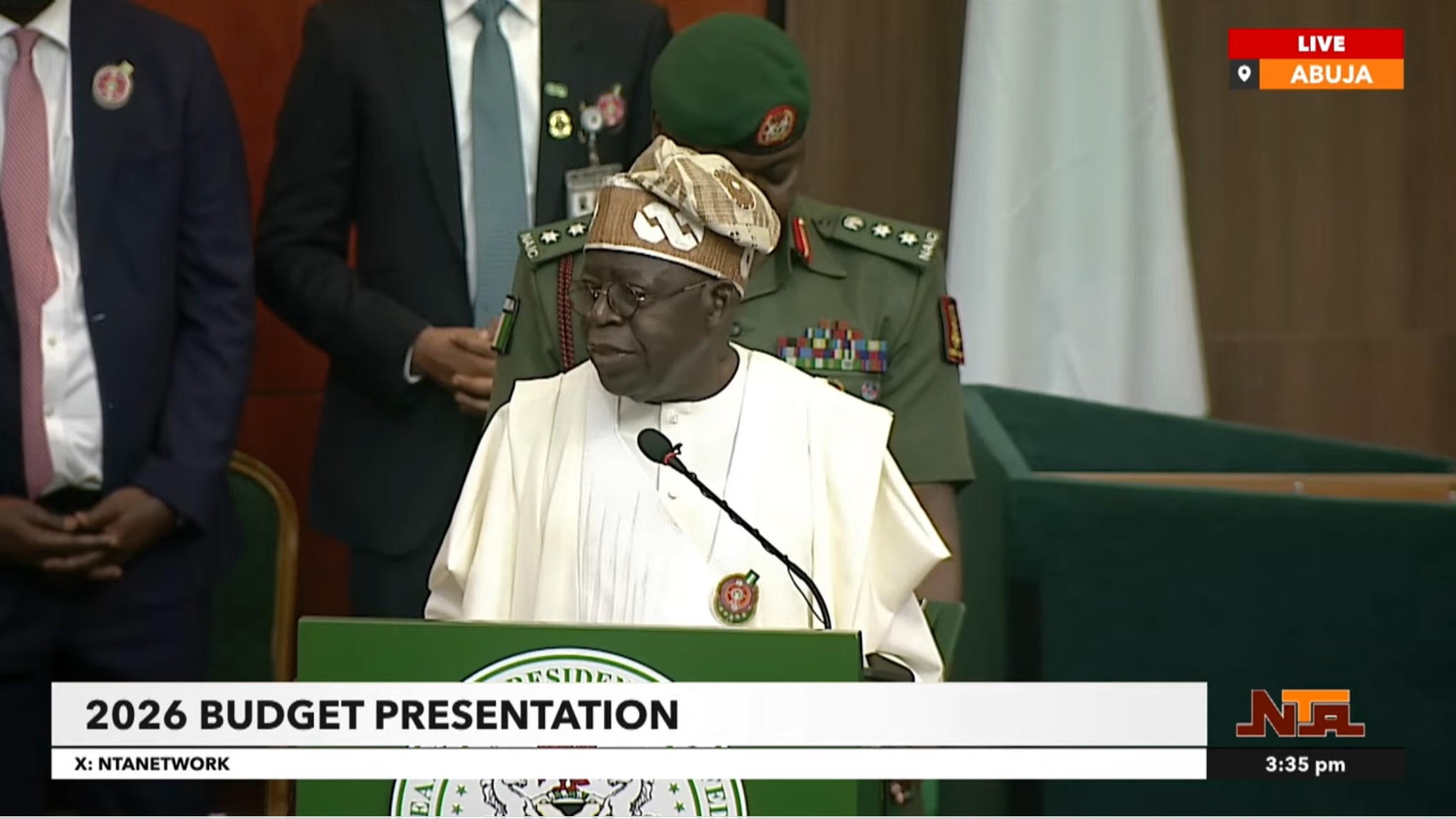
President Bola Tinubu on Friday presented a ₦58.18 trillion 2026 Appropriation Bill to a joint session of the National Assembly, with defence and security receiving the highest allocation of ₦5.41 trillion.
The president, who described the proposal as a critical step in Nigeria’s reform journey, said the 2026 budget was aimed at consolidating economic gains, strengthening national resilience and translating recovery into improved living standards for Nigerians.
“This is a defining moment in our national journey of reform and transformation. Today, we come with a Budget that consolidates our gains, strengthens our resilience, and turns recovery into improved living standards for every Nigerian household,� he said.
The budget, themed “Budget of Consolidation, Renewed Resilience and Shared Prosperity,� represents an increase of about six per cent over the 2025 estimate. Tinubu said it was designed to lock in macroeconomic stability, deepen competitiveness and ensure that growth leads to jobs, rising incomes and better quality of life.
According to the president, the proposed ₦58.47 trillion spending plan is anchored on expected revenues of ₦34.33 trillion and total expenditure of ₦58.18 trillion, including ₦15.52 trillion earmarked for debt servicing. Capital expenditure is projected at ₦26.08 trillion, while the budget deficit of ₦23.85 trillion represents 4.28 per cent of GDP.
Beyond security, major sectoral allocations include ₦3.56 trillion for infrastructure, ₦3.52 trillion for education, and ₦2.48 trillion for health and social services.
Tinubu said the emphasis on security was deliberate, noting that peace and stability remain the foundation for development and investment.
“Without security, investment will not thrive. Without educated and healthy citizens, productivity will not rise. Without infrastructure, jobs and enterprise will not scale,� the president said.
He explained that the security vote would support the modernisation of the armed forces, intelligence-driven policing, border security and community-based peacebuilding, adding that spending in the sector would be tied to clear outcomes.
Tinubu told lawmakers that recent reforms were already producing results, citing economic growth of 3.98 per cent in the third quarter of 2025, eight consecutive months of declining inflation, improved oil production and stronger non-oil revenue performance. He also said Nigeria’s external reserves had risen to a seven-year high of about $47 billion.
“These outcomes are not accidental. They reflect difficult but deliberate policy choices. “Our task now is to consolidate these gains, so that stability becomes prosperity, and prosperity becomes shared prosperity,� he added.
On human capital development, Tinubu said the budget strengthens investment in education and healthcare, noting that over 418,000 students have benefited from the Nigerian Education Loan Fund (NELFUND), while healthcare spending accounts for about six per cent of the total budget, net of liabilities.
He also outlined plans to boost infrastructure, agriculture and productivity, stressing that food security remains a national priority.
Assuring the National Assembly of improved implementation, the president said 2026 would be marked by stricter discipline in budget execution and stronger accountability across government agencies.
“We will spend with purpose, manage debt with discipline, and pursue growth that is broad-based and sustainable.� Tinubu said,
Tinubu also announced measures to end the practice of overlapping budgets, stressing that the government is determined to operate a single, clearly defined fiscal framework.
“We are terminating the habit of running three budgets in one inflow. By March 31, 2026, all capital liabilities from previous years will be fully funded and closed. From April, Nigeria will operate on a single budget,� he said.
To ensure strict adherence to timelines and fiscal rules, the president directed the Minister of Finance and Coordinating Minister of the Economy, Minister of Budget and Economic Planning, as well as the Attorney-General of the Federation, to ensure that the 2026 budget is implemented strictly in line with approved timelines and provisions.