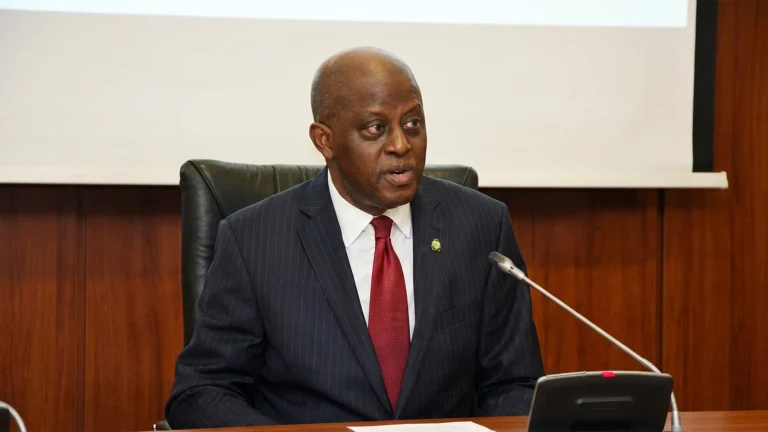
The Central Bank of Nigeria (CBN) on Tuesday directed banks in Lagos, Rivers, Kano, Ogun, Anambra, Abia and FCT to begin implementation of the new policy on cash-based transactions by imposing processing charges on deposits and withdrawals on amounts above N500,000 for individual and N3 million for corporate organisations, as from Wednesday, September 18, 2019.
It said the policy will apply nationwide as from March 2020.
According to the circular, the charges will attract three per cent processing fees for withdrawals and two per cent processing fees for lodgments of amounts above N500,000 for individual accounts.
For corporate accounts, the banks would charge five per cent processing fees for withdrawals and three processing fee for lodgments of amounts above N3,000,000.
The circular stated that imposition of charges on deposits聽was introduced in addition to already existing charges on withdrawals.
It generated confusion and various interpretations of the policy with many saying it applies to transactions irrespective of whether it is cash-based or online. There was also an argument on whether it was an already existing policy or a completely new one.
To help get clarity, 黑料不打烊online referred to earlier directives to the banks since the Tuesday circular actually referred to a previous circular, and pulled details from a fact-sheet titled, Cash-less Nigeria, published by the apex bank on its website:
The following were made clear from the search:
- The policy affects only cash transactions at ATMs, and over the counter cash withdrawals and deposits.
- The new policy aims at reducing the amount of physical cash (coins and notes) circulating in the economy
- The policy is not aimed at eliminating cash transactions. As a matter of fact, it aims to generate revenue from cash transactions.
- You can not be too smart. As an individual, you will still be charged 2% even if you walk into the bank and deposit N450,000, leave and then come back later to deposit N100,000. Why? The charges are cummulative on daily transactions. You can only escape it by depositing today and coming back the next day to do the rest.
- The new policy also aims to encourage more electronic-based transactions (payments for goods, services, transfers, etc.)
- Third party cheques above N150, 000 shall not be eligible for encashment over the counter. Value for such cheques shall be received through the clearing house.
It however emerged later that the apex grossly miscommunicated the policy as it made attempts on Thursday to make clarifications which many however suspect was just an afterthought.
Amid the massve outrage and condemnation that greeeted the directive, many had thought that when you deposit N500,000, the bank and the government takes N10,000 (2%) and when you decide to withdraw the N500,000 cash, the bank and the government takes N15,000 (3%), making a total of N25,000.
In a short release on Thursday, the CBN explained that the deposit and withdrawal charges apply only on the amount in excess of the limit.
On Friday, it wrote:
“The Cash-less Policy deposit/withdrawal charge is only on the amount in excess of the limit. For instance, if you deposit a cash of N501,000.00. N1,000.00 is in excess of the limit. The bank will charge you 2% of N1,000.00 which is N20.00.”
Which means that if you deposit N1million naira cash, you would be charged N10,000 which is 2% of N500,000 which is the excess.
The clarification has however not changed people’s view about the policy.
The introduction of charges on deposits is strongly being criticised and giving the new policy the label, “anti-people”. Many say it will discourage banking all together since the economy is still very mich cash dependent irrespective of how popular electronic banking has become.
It is also being viewed as an additional taxation and burden on people struggling to survive or run legitimate business (especially ones with huge turnover but marginal profits).
A popular careers and personal development coach, Dr Dipo Awojide, said on Twitter: “Why do I need to pay an extra 2% when I deposit over N500,000 or pay 3% when I withdraw same? After paying account maintenance charges monthly, ATM maintenance charge, stamp duty charges and transaction charges when I transfer to other banks? This cashless policy is confusing.
“Why is CBN squeezing citizens hard? Why not go about this cashless policy in ways that will not amount to paying extra charges on transactions?”
The CBN fact sheet on Cash-less Nigeria reads in full:
The Central Bank of Nigeria (CBN) has introduced a new policy on cash-based transactions which stipulates a 鈥渃ash handling charge鈥� on daily cash withdrawals that exceed N500,000 for Individuals and N3,000,000 for Corporate bodies. The new policy on cash-based transactions (withdrawals) in banks, aims at reducing (NOT ELIMINATING) the amount of physical cash (coins and notes) circulating in the economy, and encouraging more electronic-based transactions (payments for goods, services, transfers, etc.)
Why the Cash Policy?
The new cash policy was introduced for a number of key reasons, including:
1. To drive development and modernization of our payment system in line with Nigeria锟絪 vision 2020 goal of being amongst the top 20 economies by the year 2020. An efficient and modern payment system is positively correlated with economic development, and is a key enabler for economic growth.
2. To reduce the cost of banking services (including cost of credit) and drive financial inclusion by providing more efficient transaction options and greater reach.
3. To improve the effectiveness of monetary policy in managing inflation and driving economic growth.
In addition, the cash policy aims to curb some of the negative consequences associated with the high usage of physical cash in the economy, including:
鈥� High cost of cash: There is a high cost of cash along the value chain – from the CBN & the banks, to corporations and traders; everyone bears the high costs associated with volume cash handling.
鈥� High risk of using cash: Cash encourages robberies and other cash-related crimes. It also can lead to financial loss in the case of fire and flooding incidents.
鈥� High subsidy: CBN analysis showed that only 10percent of daily banking transactions are above 150k, but the 10percent account for majority of the high value transactions. This suggests that the entire banking population subsidizes the costs that the tiny minority 10percent incur in terms of high cash usage.
鈥� Informal Economy: High cash usage results in a lot of money outside the formal economy, thus limiting the effectiveness of monetary policy in managing inflation and encouraging economic growth.
鈥� Inefficiency & Corruption: High cash usage enables corruption, leakages and money laundering, amongst other cash-related fraudulent activities.
Content of the Cash policy
The following aspects of the policy was applied from January 1st 2012 in Lagos State (鈥渢agged Cash-less Lagos鈥�):
鈥� Only CIT licensed companies is allowed to provide cash pick-up services. Banks will cease cash in transit lodgment services rendered to merchant-customers in Lagos State from December 31st 2011. Any Bank that continues to offer cash in transit lodgment services to merchants shall be sanctioned.
鈥� 3rd party cheques above N150, 000 shall not be eligible for encashment over the counter. Value for such cheques shall be received through the clearing house.
The service charge took effect from March 30th, 2012, this gave people time to migrate to electronic channels and experience the infrastructure that has been put in place. Banks were to use this period as grace to encourage their customers to migrate to available electronic channels, and where possible, demonstrate the costs that will accrue to those that continue to transact high volumes of cash from March 30th, 2012 in Lagos State.
In addition, below are some detailed context and pertinent clarifications on the policy:
鈥� Location
o The pilot was run in Lagos State from January 2012 while the policy took effect in Rivers, Anambra, Abia, Kano, Ogun and the Federal Capital Territory (FCT) on the 1st July, 2013. The policy will be implemented nationwide on July 1st, 2014.
鈥� Account Application
o The cash-policy applies to all accounts with exception to Government revenue generation account, Primary Mortgage Institutions, Microfinance Banks and Embassies. Banks should therefore work with their corporate customers to arrange for suitable e-collection options.
鈥� Limits
o The limits are cumulative daily limits each for withdrawal(e.g. for Individuals, the daily free withdrawal limit is N500,000)
o The limits apply to the account so far as it involves cash, irrespective of channel (e.g. over the counter, ATM, 3rd party cheques encashed over the counter, etc) in which cash is withdrawn (e.g. if an individual withdraws N450,000 over the counter, and N150,000 from the ATM on the same day, the total amount withdrawn by the customer is N600,000, and the service charge will apply on N100,000 – the amount above the daily free limit). The limit also applies to cash brought through CIT companies, as the CIT company only serves as a means of transportation.
鈥� Charges
o The charges started to apply from March 30th 2012 in Lagos, October 1st 2013 in Rivers, Abia, Anambra, Ogun, Kano and the FCT.
o The service charge for daily withdrawals above the limit into an account shall be borne by the account holder.
o Please note that the policy does not prohibit withdrawals above the stipulated amounts, but that such transactions will be subject to cash handling charges.
Expected Benefits of the New Cash Policy
A variety of benefits are expected to be derived by various stakeholders from an increased utilization of e-payment systems. These include:
鈥� For Consumers: Increased convenience; more service options; reduced risk of cash-related crimes; cheaper access to (out-of-branch) banking services, access to credit and financial inclusion.
鈥� For Corporations: Faster access to capital; reduced revenue leakage; and reduced cash handling costs.
鈥� For Government:Increased tax collections; greater financial inclusion; increased economic development. Increased tax collections; greater financial inclusion; increased economic development.
Current Awareness/Engagement Status
The CBN has been running targeted stakeholder engagement sessions for key groups that will be most impacted by the cash policy as a first stage of its planned communication campaign, with the objective of creating awareness and providing an opportunity for stakeholders to raise issues and get on the spot clarifications. These stakeholders includes markets, associations, professional bodies, religious bodies etc. These stakeholder sessions have run nationwide while the media campaign will continue.
This report has been updated with the clarification made by the CBN that deposit/withdrawal charge applies only on the amount in excess of the limit. 聽