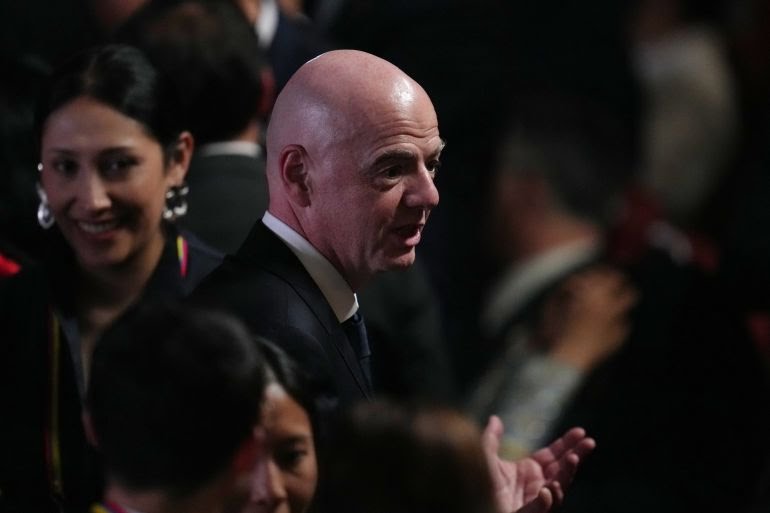






Three of world football’s most influential continental governing bodies鈥擴nion of European Football Associations (UEFA), the Asian Football Confederation (AFC) and Confederation of North, Central America and Caribbean Association Football (CONCACAF)鈥攈ave intensified pressure on FIFA president, Gianni Infantino, accusing him of undermining trust in the game’s governance over his failed plan to bring private investment into the FIFA World Cup and other major competitions.
In a joint open letter released on Monday, the confederations rejected FIFA’s explanation of the controversy as merely a communication failure, insisting instead that it represented a profound failure of judgement and governance.
They also demanded a fully independent investigation into the aborted Football Forward Enterprise (FFE) proposal, which sought to sell a stake in a company that would commercialise the rights to the World Cup and other FIFA tournaments.
The letter was jointly signed by UEFA president, Aleksander 膶eferin; AFC president, Sheikh Salman bin Ibrahim Al Khalifa; and Concacaf president Victor Montagliani, as well as the three confederations’ general secretaries鈥擳heodore Theodoridis (UEFA), Datuk Seri Windsor John (AFC) and Philippe Moggio (CONCACAF)鈥攈ighlighting a united front from both the political and administrative leadership of the three regional governing bodies.
The latest intervention marks a significant escalation in the crisis surrounding FIFA’s leadership, with UEFA, AFC and CONCACAF also discussing possible alternative competitions should relations with FIFA continue to deteriorate.
UEFA has repeatedly threatened to boycott FIFA competitions, raising uncertainty over participation in next month’s FIFA Under-20 Women’s World Cup.
In the letter, the confederations stressed that football’s leadership must be rooted in service rather than personal authority.
“Leadership in football is not a possession. It is not about holding or demanding power to be held. It is a duty of service to the football family that entrusts it. When trust is broken through deception, when an individual places himself above the collective that entrusted him with authority, that duty has been abandoned,” the statement said.
The confederations argued that FIFA had fundamentally misrepresented the controversy by portraying it as a communications problem.
“It treats this as a failure of communication, when what football witnessed was a failure of judgment. It did not acknowledge that the proposal itself was inherently wrong. There remains no recognition that attempting to sell an interest in the FIFA World Cup was a profound failure of judgment鈥攏ot just a procedural misstep, but a fundamental breach of trust with the very institutions FIFA exists to serve,” they said.
The letter also criticised FIFA’s emergency leadership meeting in Rabat, Morocco, noting that only one elected official attended while FIFA Council members and member associations were excluded.
“This recent meeting attended by only one elected football official and excluding both the FIFA Council and FIFA’s Member Associations, only reinforces these concerns and represents a continuation of the very pattern of conduct that brought us to this moment. It is not the conduct of a custodian of the game, but of one who believes the game is answerable to him,” they said.
Calling for accountability, the three bodies insisted that any review of the failed proposal must be conducted entirely outside FIFA.
They said FIFA’s administration “should play no role in conducting the review,” arguing that an investigation overseen by the organisation itself would undermine confidence in the outcome.
The confederations also sought to reassure member associations that their position was not aimed at reducing FIFA development funding or reversing jointly agreed reforms.
“This is not about money. The Confederations have already called for the responsible distribution of FIFA’s vast existing reserves to further strengthen investment in the development of Member Associations. Nor is it about any Member Association losing the support it has earned, despite the fearmongering directed at our membership to suggest otherwise. It is about protecting the integrity of football’s governance, restoring trust and ensuring that the game is led in the interests of all who serve it.
“There is silence where there should be accountability, distance where there should be openness. Football’s strength has always been its unity. We call for that unity to be honoured now, with leadership that serves football, not seeks to command it,” the statement added.
However, FIFA has rejected accusations against its leadership, saying there is “a concerted and ongoing effort” by some individuals to undermine both the governing body and Infantino.
It maintained that any challenge to the president’s leadership must be pursued through FIFA’s statutes and democratic processes.
The dispute has exposed deep divisions across global football.
While UEFA, AFC and CONCACAF have openly criticised FIFA’s handling of the affair, the Confederation of African Football (CAF) has reaffirmed the support of its 54 member associations for Infantino. South American governing body, CONMEBOL, has also backed him, alongside Argentina, Paraguay, Ecuador and Bolivia, while Mexico has declared its support despite being a CONCACAF member.
Pressure, however, continues to mount. Norwegian Football Federation president, Lise Klaveness, has publicly called on Infantino to resign immediately, while CONCACAF President, Victor Montagliani, is regarded as one of the leading potential candidates should the FIFA presidency become vacant. Candidates for the next FIFA presidential election must formally declare their bids by November 18.