Akinwande Soji-Ojo
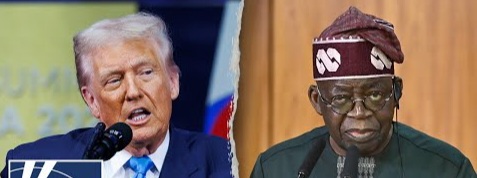
The recent threat by United States President, Donald Trump, to launch military operations in Nigeria has sparked widespread debate about national sovereignty, international law, and the limits of foreign intervention.
Trump had on Sunday said he was considering 鈥渁ir strikes and boots on the ground鈥� to 鈥渨ipe out Islamic terrorists killing Christians in Nigeria,鈥� a comment that has drawn global attention and stirred diplomatic unease.
Trump鈥檚 declaration, which many observers view as inflammatory, came on the heels of his claim that Nigeria has become 鈥渁 country of particular concern鈥� over what he called 鈥淐hristian genocide.鈥� The statement has ignited a storm of reactions, both within Nigeria and internationally, over the legality and implications of such a move.
However, Nigerian President, Bola Tinubu, has dismissed former Trump鈥檚 allegations of religious intolerance in the country.
In a statement, Tinubu insisted that Nigeria remains a democracy firmly anchored on constitutional guarantees of religious freedom.
He noted that since assuming office in 2023, his administration has maintained 鈥渙pen and active engagement with Christian and Muslim leaders alike鈥� while addressing security challenges affecting citizens across all faiths and regions.
鈥淭he characterisation of Nigeria as religiously intolerant does not reflect our national reality, nor does it take into consideration the consistent and sincere efforts of the government to safeguard freedom of religion and belief for all Nigerians,鈥� Tinubu said.
He reaffirmed that 鈥渞eligious freedom and tolerance have been a core tenet of our collective identity and shall always remain so,鈥� stressing that Nigeria 鈥渙pposes religious persecution and does not encourage it.鈥�
The president noted that the Nigerian Constitution guarantees the rights of citizens of all faiths and that his government remains committed to promoting interfaith harmony.
鈥淥ur administration is committed to working with the United States government and the international community to deepen understanding and cooperation on the protection of communities of all faiths,鈥� he said.
In its official response, the Nigerian government also dismissed the allegations and warned against any attempt to undermine its sovereignty.
Presidential aide, Daniel Bwala, said President Bola Tinubu, remains committed to protecting all Nigerians irrespective of faith or ethnicity, adding that the US has no moral or legal basis to threaten military action against a sovereign nation.
In a chat with BBC World Service, Bwala said: 鈥淣igeria remains a sovereign nation, and while collaboration with international partners in addressing insecurity is welcome, any form of intervention must respect our sovereignty. It would not be diplomatically appropriate for the United States to take unilateral action without engagement and consent from the Nigerian government.鈥�
The presidency also recalled that Nigeria has been at the forefront of the global fight against terrorism, often in cooperation with US intelligence and military assistance. It emphasised that while insecurity remains a concern, the situation does not justify unilateral military intervention by any foreign power.
Reactions among Nigerians have been sharply divided. Some citizens believe that US involvement could help eliminate extremist groups that have plagued parts of the country for over a decade. Others, however, view Trump鈥檚 statement as a direct affront to Nigeria鈥檚 independence and a potential violation of international law.
Civil society groups and security analysts have urged the Federal Government to adopt a firm diplomatic approach. Human rights lawyer, Femi Falana (SAN), said the Nigerian government must 鈥渄raw the line鈥� and remind Washington that 鈥渢he world no longer operates under colonial arrogance.鈥�
Under international law, particularly the United Nations Charter, Trump鈥檚 threat raises serious questions. Article 2(4) of the Charter “prohibits member states from using force against the territorial integrity or political independence of another state.” The only exceptions are actions authorised by the UN Security Council or acts of self-defence.
The Charter also empowers the UN Security Council to determine “whether a threat to peace exists and to authorise collective action where necessary.” In this case, no such authorisation has been sought or granted, making any unilateral US strike on Nigeria a violation of international law.
UN officials have yet to issue a formal statement on Trump鈥檚 remarks, but it was learnt that the organisation have indicated that such rhetoric undermines global stability. A senior UN diplomat, speaking anonymously, told BBC that: 鈥淭he United Nations discourages unilateral use of force. Any operation must follow due process under the Charter.鈥�
At the continental level, the African Union (AU) Charter is equally clear. Article 4(f) of the Constitutive Act of the African Union affirms 鈥渢he right of member states to live in peace and security and to have their sovereignty and territorial integrity respected.鈥� It also states that 鈥渘o Member State shall interfere in the internal affairs of another.鈥�
The AU Peace and Security Council is mandated to respond to any external aggression against a member state. Diplomatic observers expect the AU to convene discussions if Trump鈥檚 threat escalates, reaffirming Africa鈥檚 collective opposition to foreign military interference.
Regional blocs such as the Economic Community of West African States (ECOWAS) are also watching closely. Analysts say ECOWAS, which has championed constitutional order in the region, would likely oppose any foreign invasion of Nigeria, seeing it as a dangerous precedent for Africa鈥檚 stability.
Some commentators believe Trump鈥檚 rhetoric is more political than practical, aimed at energising his support base in the US ahead of elections. Still, Nigeria鈥檚 Foreign Ministry has been advised to treat the threat seriously and to engage Washington diplomatically to prevent escalation.
For now, both local and international stakeholders are waiting to see whether Trump will make good on his threat or step back under global pressure. As tensions rise, all eyes remain on the United States and Nigeria 鈥� fingers crossed on whether Trump will indeed carry out his threat.