





Akinwande Soji-Ojo
President Bola Tinubu on Thursday said his administration refused to negotiate with or pay ransom to the abductors of schoolchildren and teachers kidnapped in Oriire Local Government Area of Oyo State because security agencies understood the terrain where the victims were held.
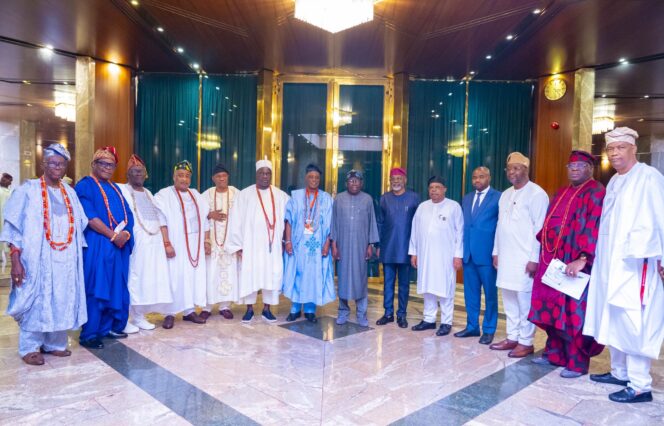
The President spoke at the Presidential Villa, Abuja, while receiving a delegation of traditional rulers from Oyo State led by the Olubadan of Ibadanland, Oba Rashidi Adewolu Ladoja.
Tinubu said the successful rescue operation underscored the need for a stronger security architecture, including the expansion of military formations, the establishment of state police and enhanced operations by forest guards.
He also commended the armed forces for securing the release of the victims and thanked the traditional rulers for their support and prayers.
“Congratulations on the successful rescue of the Oriire, Oyo State, abductees. I think we succeeded with your support and prayers. I agree with you that we should commend the men and women of the Armed Forces for their excellent performance.
“On their behalf, I accept your message and will convey it to them.
“I should emphasise the issue of security. Every incident teaches us a new lesson. It opens our eyes, challenges us to examine and re-examine our security architecture, our strategies, our plans and our operations.
“We refused to pay ransom because we understand the geography of the forest. We know the terrain and, in response, we are expanding the Nigerian Army from eight divisions to 12 divisions to shorten response time and give our security forces the capacity needed to defeat terrorism and banditry. It is very necessary, and we are doing so,” he said.
Tinubu reiterated his administration’s commitment to establishing state police, saying the initiative would strengthen security at the grassroots while incorporating safeguards against abuse.
“We have equally embarked on what has been missing for several decades. The fears and uncertainty about security at the local level will be corrected.
“There will be state police, and there will be guardrails to prevent abuses. We will protect the system from abuse,” he said.
The president. also said the Federal Government was strengthening the capacity of forest guards to tackle criminal activities in forests across the country.
“They are not just there to chase antelopes and animals. They will chase criminals and deal with them in the forests,” he added.
Earlier, the Olubadan commended Tinubu and the security agencies for rescuing the abducted pupils and teachers without paying ransom, describing the operation as a major breakthrough in the country’s fight against kidnapping.
“When we heard about the incident, we were apprehensive. But we have now found that, between you and your security personnel, whom I must thank through you, you have made a turning point in the fight against kidnapping in Nigeria.
“We cannot thank you enough for that feat. It was a big achievement because the people of Oyo State were asking, ‘Are we going to become another Chibok? Is this going to become a perennial issue?’
“The fact that you did not pay ransom and that you stood your ground shows that we now have a government that knows what it is doing.
“People now know that they have a President who will not negotiate with kidnappers from a position of weakness,” Olubadan said.
The monarch, however, urged the president to sustain the deployment of security personnel in the forest corridor spanning Oyo, Kwara and Niger States to prevent criminal groups from returning.
“You have been able to drive away the kidnappers, but please let us continue to have the presence of security agencies there so that they do not regroup,” he said.
Oba Ladoja explained that the forest stretches from Iseyin through Igboho and Kishi into parts of Kwara and Niger states, noting that securing the area would significantly improve safety in Oyo State.
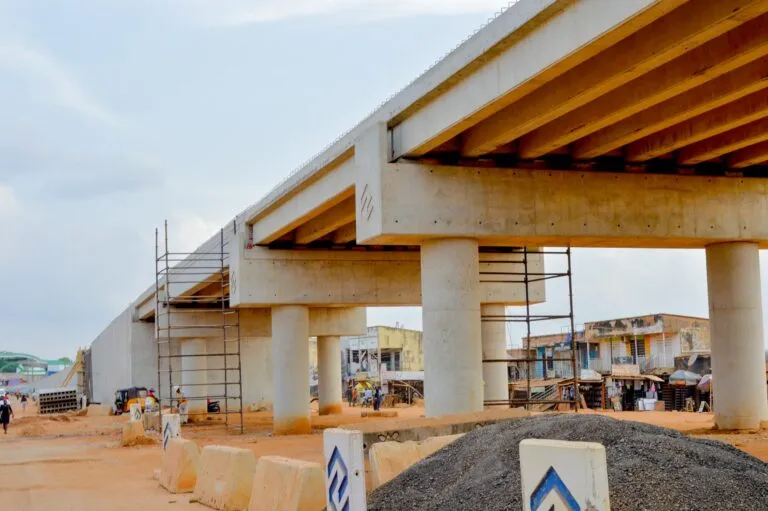
The former Oyo State governor also praised the Tinubu administration’s infrastructure projects in the state, saying ongoing federal road projects had renewed hope among residents.
“I don’t think we have ever had it this good before. The decay in our road network is gradually becoming a thing of the past, and we are hopeful that by the end of your second term, it will have been completely addressed,” he said.