






By Efa Sunday
President Bola Tinubu鈥檚 Democracy Day broadcast of 12 June did Ibadan incalculable dishonour. The speech celebrated heroes of Nigeria鈥檚 25 years of civil rule with very scant mention of Ibadan鈥檚 fight against the tyranny of military rule. Was it an institutional slight of the city of Ogunmola, the great warrior? The angry spirits of Ibadan dead must be seeking vengeance. Why does Aso Rock suffer an austerity of official remembrancers?
Nelson Rolihlahla Mandela did not allow the comforting breeze of freedom to numb his sense of remembrance. Walking out of the Victor Verster Prison after 27 years in jail, his first post-prison address at the Cape Town City Hall on 11 February, 1990 showed that Mandela never forgot Cape Town, the city where the battle against the tyranny of Apartheid was fought and won. 鈥淚 send special greetings to the people of Cape Town, this city which has been my home for three decades. Your mass marches and other forms of struggle have served as a constant source of strength to all political prisoners,鈥� he said.
In that speech, Mandela recognised the contours of personal and city/town heroism. To him, when you add these to the pathos of elite heroism, it forms an ensemble of struggles of men and women who constitute the corpus of the unforgettable people of yesterday. In recognising that an average person possesses the innate power to act heroically, Mandela raised his hand up in a symbolism of the anti-Apartheid struggle, and shouted 鈥淎mandla! Amandla! I-Africa Mayibuye!鈥� translated to mean, 鈥淧ower! Power! Africa, it is ours!鈥� He then began an acknowledgment of 鈥淔riends, Comrades and fellow South Africans鈥� who 鈥淚 stand before鈥� not as a prophet, but a humble servant of you, the people.鈥� He then reeled out the names of 鈥渕illions of my compatriots and those in every corner of the globe who campaigned tirelessly for my release.鈥� While acknowledging the big fishes of the liberation struggle, Mandela remembered Joe Slovo, a South African Marxist-Leninist Lithuanian emigre who died of cancer in 1995. Slovo passed on a few months after the expiration of the white rule he spent a significant portion of his adult life fighting. Mandela also memorialised ordinary men, 鈥済reat communists like Moses Kotane, Yusuf Dadoo, Bram Fischer and Moses Mabhida,鈥� who he said 鈥渨ill be cherished for generations to come.鈥�
Were the inputs of remembrancers sought and brought into the drafting of that Tinubu鈥檚 25th Democracy Celebration speech, the submission of two American social psychologists, Zeno Franco and Philip Zimbardo, could have struck the drafters. In their The Banality of Heroism, these two authors concluded that heroism isn鈥檛 strictly the preserve of the elite who perform extraordinary actions. They said that heroism can be found in the everyday actions of ordinary individuals faced with challenging situations or moral dilemmas. So, when Tinubu reeled out the extraordinary actions of his elite colleagues in the trenches who fought military rule, he forgot a long list of towns and ordinary Nigerians who suffered and died so that he could be in Aso Rock.
Though Abacha was part of Ibadan city, having been GOC of the Second Mechanised Division, Ibadan rose against him. In his infernal autocratic anger, he responded by mowing down Ibadan, leaving weeping, wailing and the gnashing of teeth in its trails.
The eyes of the world had riveted towards Ibadan immediately Abacha began to design subterranean plots to transmute into a civilian dictator. To underscore his anger at Ibadan turning itself into the political capital of dissent against the military, Abacha reportedly got his goons to kill Ibadan sons and daughters who were against him. One of them was a retired nurse, Alhaja Suliat Adedeji. The cruel and inhuman mode of assassination of Adedeji reflected the anger of the mastermind of her killing. He established five political parties, superintended over by his lackeys, as springboard to achieving the aim of becoming a civilian autocrat, and then attempted to get them all to adopt him as their consensus presidential candidate. The five parties received the flagellating tongue of Bola Ige, right from his Ibadan home, where he penned his Uncle Bola鈥檚 Column in the Sunday Tribune. In a cryptic analogy, Ige likened Abacha鈥檚 five political parties to the five fingers of a leprous hand; a description that riled the dictator.
Being the traditional capital of the old Western Region, it was obvious that any resistance elegy chanted in Ibadan approximated a dirge from the Yoruba people. While Lagos was a mirror of inchoate voices, resistance in Ibadan, where Obafemi Awolowo incubated developmental projects, was a signifier of the dissent of the sons and daughters of Oduduwa. With resistance to military rule effectively curtailed in Lagos, Abacha looked towards Oluyole. He then planned a Two Million Man Rally slated for a sprawling 130,000 square kilometre multipurpose centre, hitherto named Race Course, now the Lekan Salami Stadium, Adamasingba. On that day, I saw a young man lying in the pool of his blood. He was dead to all the cares of this world. Blood oozed out of him like a broken cistern. Nobody knew his identity. He was one of the about three persons who were martyred for the rebirth of democracy in Nigeria. They were felled by the irreverent rifles of Abacha鈥檚 death squad of policemen and soldiers. The rally was one of those scheduled to etch Abacha鈥檚 name in the pantheon of life rulers in the hue of Hastings Kamuzu Banda. A success of the rally would have spelt the Yoruba鈥檚 approval stamp on Abacha鈥檚 transmutation bid.
It must however be known that as resilient and valiant as Ibadan was, it had its own stones (k脿nda) in the rice in Lamidi Adedibu and Alhaji AbdulAzeez Arisekola-Alao. While the latter was a major contractor to the military, the latter was the anvil, his Man Friday. As such, Abacha got the above leading sons of Ibadanland, renowned for being his lickspittles, to handle the rally. They then got an Islamic musical group called Alasalatu to sing to pep up the event. Renowned Ibadan masquerade, Jalaruru was also recruited for a traditional icing on the cake of the infamy.
The Lekan Salami Stadium quaked on Tuesday 14 April, 1998. The pro-democracy movement, coordinated by Comrade Ola Oni, elder brother of another military apologist, Niyi Oniororo, firmed out plans to scuttle Arisekola-Alao and Adedibu鈥檚 Abacha rally. A coalition of groups arrived at strategies to ward off an impending sacrilege of planting autocracy on Ibadan soil.
On D-Day, I was there to report for my medium, Omega Weekly. I had, a few months earlier, resigned from the Tribune to join forces with Segun Olatunji, Wale Adebanwi, Adeolu Akande and Bode Opeseitan, who had also left the Tribune. Journalists like Dapo Ogunwusi, Tinu Ayanniyi, and Lasisi Olagunju of the Tribune were also there. It was a day of war. We could not enter the stadium as it was filled to the brim. The group of pro-democracy protesters soon took over the environs of the stadium. They were estimated to be above 5,000 people and were singing caustic songs which demanded that Abacha should relinquish power. They also sang demanding that Generals Oladipo Diya, Olanrewaju, Abdulkareem Adisa and three other South-Western region soldiers who had been sentenced to death a month earlier for plotting a coup called phantom, should have their sentences commuted. What still astounds me is that, immediately after his release from prison upon Abacha鈥檚 death, and when current editor of the Tribune, Debo Abdulai and I interviewed him in his Oja-Iya Road office in Ilorin, Adisa told us, 鈥淚 don鈥檛 know what Boda Diya was saying o. We planned coup o. May the spirit of Gen Abasa (sic) forgive me.鈥�
On the rostrum, Arisekola-Alao and Adedibu were elated that Abacha must be popping champagne on the impending success of their Satanic endeavour. However, outside the stadium, expletives were being shelled on the maximum ruler. People trekked from all the four corners of the metropolis to identify with Ibadan鈥檚 anger against Abacha. Abacha鈥檚 Military Administrator, the very loquacious Colonel Ahmed Usman, was also in high spirit, literal or metaphoric. As he addressed the rally, sure his cringing voice would be amplified to Aso Rock, Usman decked his principal in superlatives. All of a sudden, stones and other dangerous objects began to fly into the stadium. This got the people within scampering in a death race out of the stadium. Then, the huge crowd stormed the mainbowl of the stadium in maximum anger. A stampede ensued. Jalaruru the masquerade, the Alasalatu crew and other hired crew fled. They all abandoned the instruments of their panegyric craft. Members of the Alasalatu group were so thoroughly beaten by the pro-democracy group militants that their songs changed immediately to that of ululation. They sang: 鈥淪猫b鈥櫭乴谩s脿l谩t霉 la b谩 d茅 b铆, a d鈥櫭硆铆i f铆矛d矛 l贸 b谩 d鈥櫭�b谩ch脿, s猫b鈥櫭乴谩s脿l谩t霉 la b谩 d茅 b铆 鈥� We came here as prayer group, only to become hirelings of Abacha.
As Adedibu fled out of the stadium, he ran into the furious anti-Abacha campaigners and was reportedly hidden inside the OB Van of a private television station at the event. The van got damaged in the process of saving Adedibu from being killed. The victory of the anti-Abacha elements was short-lived as 82 Div sent a detachment to the stadium. Thugs were also unleashed on the activists with soldiers firing into the crowd. Many died and some sustained injuries.
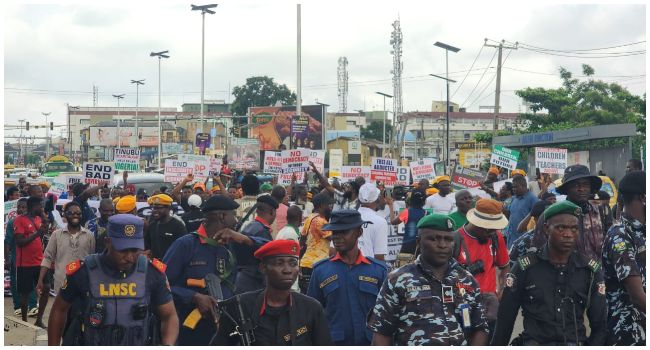
On May I, 1998, mayhem was again unleashed on Ibadan. Military and police killed protesters at random. The protesters had pounced on the property of Arisekola-Alao and set them alight. The Monitor Newspapers, which had Arisekola-Alao as publisher, was set on fire. Eleven exotic cars were burnt in the process, as well as premises of his newspaper. Adedibu鈥檚 three houses were also incinerated in the process. Arisekola鈥檚 multi-million flour mill however escaped being razed. The Abacha forces, in riposte, shelled the protesters with live bullets, leading to the death of at least ten protesters, with many others suffering varying degrees of injuries.
Words soon got to Arisekola-Alao that some of those who escaped from the burning of Monitor ran into the opposite building which housed a hospital called Lifecare. It was owned by then South-Africa-based elder brother of one of the pro-democracy activists, Niyi Owolade. Gunmen were immediately ordered to storm the hospital. They ransacked the hospital, shooting sporadically at the infirm who were killed in cold blood in their scores. In other areas in Ibadan, some journalists got shot. Current News Editor of the Tribune, Akin Durodola, escaped death by the whiskers on his way to the office. A gunshot grazed his skin and missed his spine by a hair鈥檚 breadth.
Three days after, masterminds of the pro-democracy activism were rounded up. Forty people, which include leaders of the group like Dr. Ola Oni, Bola Ige, Comrade Moshood Erubami, Niyi Owolade, Lam Adesina, and others, were slammed into Agodi Prison. The list also included Femi Adeoti, Editor of the Sunday Tribune, who had to carry the can for Paul Ogundipe whose story on the riot irked Abacha. Ogundipe never recovered. He died a few years after. They were subsequently charged to court. Flippant Usman, who himself was a marked man by the Abacha regime, having been a prot茅g茅 of General Olanrewaju, one of the arrested officers of the Abacha phantom coup, seeking to cry more than the bereaved, immediately sprung into action and declared the activists 鈥淧risoners of War鈥� who could be summarily tried and imprisoned. The trial of the POW however could not hold as Abacha died on June 8, 1998 and the country breathed an air of freedom.
On November 17, 1998, while anger against his role in the Abacha debacle still subsisted, Arisekola-Alao was spotted coming into the University of Ibadan gate by irate students. It was the university鈥檚 convocation. Nobody claimed responsibility for inviting him to the occasion. He was thoroughly man-handled, leaving him visibly shaken. He had attended the ceremony in a convoy of cars. Six of the cars in his entourage, including a Limousine, were burnt by the irate mob. He was spirited away by security operatives.
While Tinubu did well in generically affixing heroism on the press, he did incalculable damage to the memories of the dead in the media by not singling them out for mention. He did Ibadan worse injustice. Those media heroes were the ordinary individuals in everyday situations who Franco and Zimbardo spoke glowingly of in their The Banality of Heroism. The Nigerian media paid dearly for being in bed with civil society activists. Men of Tell, The News and Tempo deserve to have their names carved out in the pantheon of unsung heroes. Till date, the body of The News鈥� Bagauda Kaltho is yet to be found. Journalists lost their means of livelihood as The Guardian, Punch and others were shut down peremptorily by the duo of Generals Ibrahim Babangida and Abacha. Alex Ibru, owner and publisher of The Guardian escaped assassination attempt perpetrated by the regime of Abacha on 2 February, 1996. State assassins fired at his car, hitting Ibru in the eye, with one of his eyes dangling from its socket. He was partially blind by the time he transited. Former editor of ThisDay, Yusuph Olaniyonu, once told me that a week after his wedding, he encountered Abacha鈥檚 executioner-in-chief, Colonel Frank Omenka at his Apapa office which traumatized him for years.
Ibadan, a formidable axis of the much-talked about Lagos-Ibadan press, received chunks of the military and Abacha鈥檚 scalding anger. As said earlier, Omega became Ibadan鈥檚 avenue to express unbridled anger against military autocracy. We were young men with luxuriating idealism. Funded by pro-democracy activists, in Abacha鈥檚 dying years, Omega shelled his government. From the first print to the last, Omega concentrated on deconstructing the Abacha regime. Indeed, the last cover of the newspaper had the banner headline 鈥淎nti-Abacha forces emerge in Aso Rock.鈥� About two weeks later, Diya and others were rounded up in alleged military coup. None of us returned to our Olusanya, Ring Road office after that edition. We moved our computer equipment from one point to the other. One day, we moved them to the inner room of a cloth seller鈥檚 shop in Ibadan鈥檚 Gbagi market to produce the paper鈥檚 edition. At a point, the computers were moved at night to my house in Oke-Ayo area of Odo Ona, Ibadan. There, two great heroes of this press struggle against military autocracy 鈥� Mr. Ayo Isikaye and Mr. Tunde Solomon Adesina, (Adshine) our computer operators, unsung heroes 鈥� demonstrated their love for fatherland. Whenever I saw my Iwo, Osun state-born landlady, now late, Madam Folashade Ashake, I used to pity her. If only she knew that by harbouring journalist-dissidents in her house, among whom I was one, she was whiskers away from being whisked away as accessory to anti-government publication!
So you can imagine how anyone who went through that Abacha experience would feel at being under any other government that figuratively brings back Abacha鈥檚 memories. It will amount to figuratively running from sickness, only to encounter death. It will then mean that, in the bid to escape death, we ran to Okuku, only to be told, upon getting to Okuku, that the king of Okuku had just died; what Yoruba express as, 鈥� a t鈥檕r铆i k谩 m谩 ba脿 k煤 a s谩 lo s鈥櫭搆uk霉, a d鈥櫭搆uk霉, w贸n l鈥櫭搇贸kuk霉 s猫s猫 k煤.鈥�
Great that the Tinubus did the struggle a lot of good by counterpoising the struggle in exile, if we had all run away like them, Abacha would likely still be in the saddle today. Similarly, if the struggle were strictly a Lagos battle as Tinubu seemed to have approximated it in his Democracy Day speech, the war would have been lost and the military would still be here today. It was the moment Ibadan joined the struggle, as it did in 1840, that the war against military rule became won.
Tell the above epistle to those children of perdition who ignorantly accuse the Tribune and Ibadan axis of the Nigerian press of misguided antagonism against today鈥檚 presidency. We risked our all to give them what they proudly call their 鈥渂ragging day鈥� of today. For us, as Thomas Jefferson once said, eternal vigilance remains the price of freedom. We will not relent in fighting autocracy shawled in the cloak of democracy. Let them know that no one can remove the resilience, glory and liberation fervor of Ibadan. I leave them with this evergreen aphorism of musician Ayinla Omowura. He sang that, though strikes of thunder and lightning assail trees in the forest, they only strengthen the Baobab tree, called Igi Os猫 by the Yoruba. This unique tree does not suffer what ordinary trees suffer. When its bark is even peeled, it does not wither. Ose shocks and shames its attackers by blossoming into awesomeness. Adversity gives it greater energy to live for a thousand years. Singing in Yoruba, Omowura said, 鈥淢茅l貌 m茅l貌 l鈥櫭爎谩 t贸 ti s谩n lo鈥� 矛pa t铆 w贸n 艅p鈥橭s猫 l鈥櫭砶o, 艅se l鈥櫭� fi 艅sanra鈥︹��
Are they listening?