









By Efa Sunday
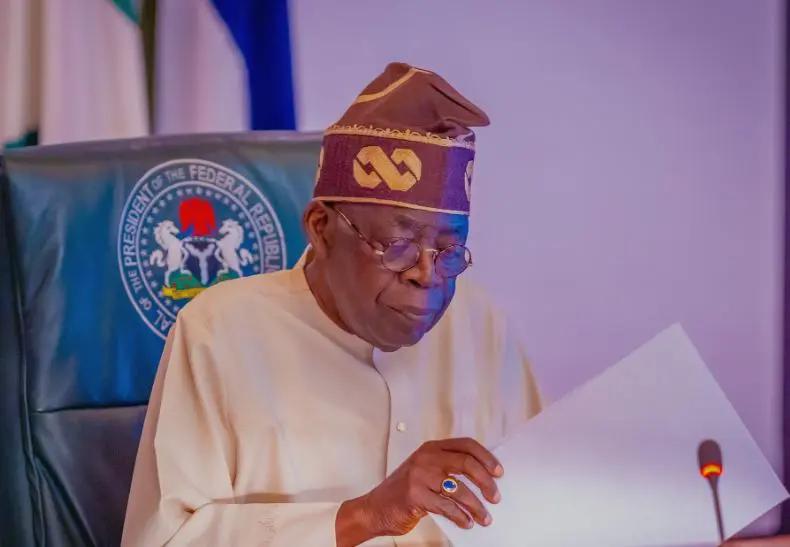
President Bola Tinubu has commended corporate Nigeria, investors, and capital market stakeholders following the Nigerian Exchange (NGX) reaching an unprecedented N100 trillion market capitalisation, describing the feat as a strong indication of economic renewal and resilience.
In a statement shared on his official X account and issued by his Special Adviser on Information and Strategy, Bayo Onanuga, on Thursday, the president said the milestone marked a turning point for the Nigerian economy and urged citizens to expand their investments within the country.
鈥淲ith the Nigerian Exchange crossing the historic N100 trillion market capitalisation mark, the country is witnessing the birth of a new economic reality and rejuvenation,鈥� Tinubu said.
The president noted that Nigeria鈥檚 capital market performance stood out globally at a time when several economies were grappling with weak recovery.
鈥淚n 2025, while many of the world鈥檚 markets struggled with stagnation or tepid recovery, the NGX All-Share Index was on the ascent. It closed 2025 with a 51.19 per cent return, higher than the 37.65 per cent recorded in 2024. This performance ranks among the highest in the world. Year-to-date returns have significantly outpaced the S&P 500, the FTSE 100, and even many emerging market peers in the BRICS-plus group,鈥� he said.
According to Tinubu, the stock market surge reflects renewed investor confidence in the Nigerian economy.
鈥淣igeria is no longer a frontier market to be ignored. It is now a compelling destination where value is being discovered. As the stock market mirrors the broader economy, its stellar performance is a significant indicator of the country鈥檚 economic health and investor confidence,鈥� he stated.
He attributed the growth to strong performances by listed companies across multiple sectors, particularly industrial firms and the banking industry.
鈥淥n the NGX, we have witnessed remarkable performances from listed companies across all sectors 鈥� from blue-chip industrial giants that have localised their supply chains to a banking sector that has demonstrated resilience and technological innovation. Nigerian companies are proving that the country can deliver strong returns on investment,鈥� Tinubu said.
The president added that more companies were preparing to list on the exchange, a development he said would further expand economic participation.
鈥淎nd we are just getting started. The pipeline for new listings is robust. More indigenous energy firms, tech unicorns, telecoms, and infrastructure-heavy entities are seeking access to the public market to fund their expansion. Their listing will boost market capitalisation and deepen democratic ownership of the Nigerian economy,鈥� he said.
Tinubu also linked the stock market gains to broader economic reforms, citing improvements in inflation trends and currency stability.
鈥淲e are not celebrating stock market performance in isolation. We are also celebrating the macroeconomic effects of our reforms. After the initial headwinds, we are finally seeing a bend in the inflation curve,鈥� he said.
He explained that fiscal and monetary discipline had contributed to the progress.
鈥淐rucial monetary tightening and the removal of distortionary 鈥榃ays and Means鈥� financing have restored stability to the naira. Investments in agriculture have also contributed to a consistent decline in inflation over the past eight months,鈥� he added.
Providing figures, the president said inflation had dropped significantly.
鈥淔rom a 24-month high of 34.8 per cent in December 2024, inflation decelerated to 14.45 per cent as of November 2025, with projections indicating it will reach 12 per cent in 2026. Indeed, inflation is likely to fall below 10 per cent before the end of the year, leading to improved living standards and accelerated GDP growth. The year 2026 promises to be epochal for delivering prosperity to all Nigerians,鈥� he said.
Tinubu also highlighted improvements in Nigeria鈥檚 external accounts.
鈥淚n 2024, Nigeria recorded a current account surplus of $16 billion. According to the Central Bank of Nigeria (CBN), this is projected to rise to $18.81 billion in 2026, up from $16.94 billion in 2025,鈥� he said.
On trade, the President said Nigeria was recording increased exports while reducing imports of goods that could be produced locally.
鈥淣on-oil exports surged by 48 per cent by the third quarter of 2025 to 鈧�9.2 trillion. Exports to Africa rose by 97 per cent to 鈧�4.9 trillion, while manufacturing exports increased by 67 per cent year-on-year in the second quarter of 2025,鈥� he said.
He further cited improvements in external reserves and currency stability.
鈥淣igeria鈥檚 foreign reserves have crossed the $45 billion mark, giving the Central Bank the capacity to maintain stability. The naira has stabilised, moving away from the volatility that once fuelled speculation. According to the CBN鈥檚 latest outlook, foreign reserves are expected to exceed $50 billion in the first quarter of 2026,鈥� Tinubu said.
The president also pointed to progress in infrastructure, healthcare, and education.
鈥淲e are expanding rail networks, completing major arterial roads, and revitalising our ports. Transformative projects such as the Lagos鈥揅alabar and Sokoto鈥揃adagry superhighways are reshaping national infrastructure.
鈥淥ur healthcare facilities are improving, medical tourism costs are declining, students are benefiting from the Nigeria Education Loan Fund (NELFUND), and universities are receiving increased research grants,鈥� he added.
Describing the 鈧�100 trillion market capitalisation as a strong signal to the international community, Tinubu said it reflected the strength of Nigeria鈥檚 economy.
鈥淣ation-building is a process, not a destination. Hard work, sacrifice, and collective focus build a nation. The 鈧�100 trillion market capitalisation signals to the world that Nigeria鈥檚 economy is robust and productive,鈥� he said.
The president concluded by reaffirming his commitment to sustained reforms and inclusive economic growth.
鈥淎s your leader, I remain committed to building an egalitarian, transparent, and high-growth economy, further catalysed by historic tax and fiscal reforms that came into full implementation on January 1,鈥� Tinubu said.






