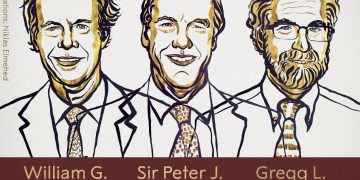






Three scientists have jointly won the 2019 Nobel prize for physiology or medicine for their work on how cells sense and respond to oxygen.
The scientistss, Gregg Semenza of Johns Hopkins University School of Medicine, William Kaelin of Dana Farber Cancer Institute in Boston and Peter Ratcliffe of the Francis Crick Institute in London made discoveries relating to the HIF system, proteins that fine tune cells鈥� response to oxygen.
They will split the prize of 9 million Swedish krona, or more than $900,000.
If oxygen isn鈥檛 regulated properly, cells could die, Nobel committee member Randall Johnson, said during the announcement of the prize by the Nobel Assembly of the Karolinska Institute in Stockholm on October 7. The work has implications for nearly every aspect of physiology from metabolism to exercise, immunity, embryo development and the response to lack of oxygen at high altitudes. The HIF system plays a role in anemia, cancer, heart attack, stroke and other disorders.
The discoveries were made in the 1990s, but as the late Ralf Pettersson, a former chairman of the Nobel selection committee at the Karolinska Institute, once explained, 聽it often takes decades before the Nobel Assembly awards the prize as it waits for 鈥渢he year when the full impact of the discovery has become evident.”
鈥淚t鈥檚 very clear that we now understand this fundamental biological switch,鈥� said Johnson. 鈥淚t seems like a complete and clear story.鈥�