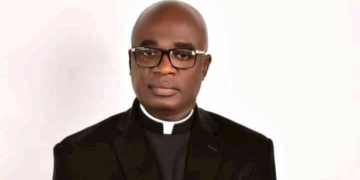










By Akinwande Soji-Ojo
The suspended priest in the Catholic Diocese of聽Gboko, Benue State, Rev. Fr. Hyacinth Alia, has said he joined the state鈥檚 governorship race to effect a change.
Alia, a governorship aspirant on the platform of the All Progressives Congress (APC), was聽suspended聽by the church last Friday.
Reacting to the development via a post on his page, the priest said he was fully aware of the sacrifice he was going to make.
He wrote: 鈥淔rom the day I took the decision to answer the overwhelming calls of my people to contest the governorship of Benue with the aim to rescue our people from the shackles of maladministration, I was fully aware of the sacrifice I was going to make.
鈥淎nd I am convinced that it is worth the cause I am fighting to serve the souls of Benue people and the state. I remain resolute and please don鈥檛 be anxious either because I am well prepared and focused.
鈥淢ore importantly, I am more charged because I have seen the genuineness in the agitations for me to step in and help salvage the already sorry situation the state has found itself for some time.
鈥淎s stated in the last paragraph of the suspension letter, I shall return to the public pulpit after I must have served out my mandate as the Governor of Benue State.鈥�
The priest also spoke on the position of the Bishop of the Catholic Diocese of Gboko, William Avenya, who said the canon law of the Catholic church forbids clerics from being involved in partisan politics.
Speaking through Donald Kumun, his media aide, Alia said the canon law did not imagine salaries and gratuity of citizens would not be paid.
鈥淭hey never imagined that there would be a governor who would refuse to listen to a Catholic bishop begging for the payment of workers鈥� salaries in the way and manner that Bishop Avenya (Catholic Bishop of Gboko) has done in Benue State.
鈥淭hey never knew it would be possible for a governor to stay in power for almost eight years with literally nothing to show for it by way of infrastructural development.
鈥淭hey never thought of a situation where a state would produce numerous raw materials with practically no industry to process them; while the government plans to sell the existing state-owned industries.
鈥淭hey never imagined that poor farmers, who are not benefiting anything from the government, would be made to pay cut-throat taxes on their farm produce.
鈥淣one of the drafters of the code of canon law imagined that a state will deliberately increase school fees in government-owned tertiary institutions in a way that makes it impossible for the children of the poor to go to school.
鈥淐ertainly, they never knew there would be a state in Nigeria where a government would deliberately and consciously impoverish its citizens just to make them politically pliable.
“The canon law never envisaged a state that would turn her highly intelligent youths into political thugs instead of engaging them productively just to mention but a few,” he said.