






Akinwande Soji-Ojo
The Supreme Court has explained that it restored the Martins Amaewhule-led Rivers State House of Assembly because a House of Assembly must be formed as stated in the 1999 Constitution.
In the 62-page Certified True Copy of the judgement, the apex court ruled that there was 鈥渘o iota or shred of evidence to prove that the 27 lawmakers defected from the Peoples Democratic Party to the All Progressives Congress.”
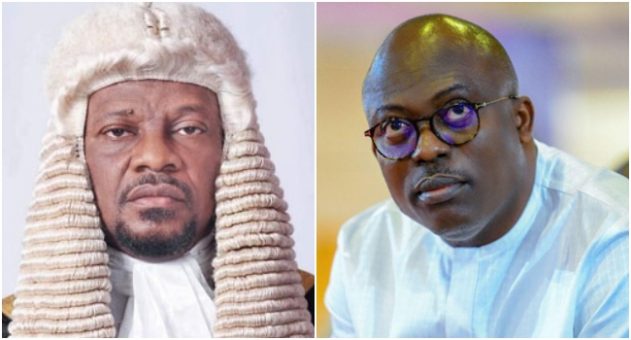
Justice Emmanuel Agim, who signed the judgement, stated that the Constitution does not support Governor Siminalayi Fubara鈥檚 decision to recognise only four members as the authentic House of Assembly.
It explained that Fubara initially accused the 27 lawmakers of defecting, but later 鈥渧oluntarily withdrew the allegations鈥� at the Federal High Court in Abuja.
According to the apex court, since the allegation was withdrawn, 鈥渘o defection had taken place, and the assembly must continue as it was.”
The judgement stated that it would be 鈥渦nlawful鈥� for Fubara to engage with any assembly other than the one led by Martins Amaewhule.
“What is clear from the above concurrent findings is that the eighth respondent (Fubara) started the prevention of the sittings of the Rivers State House of Assembly constituted by the number of members as prescribed by Section 96 of the 1999 Constitution long before the issue of the remaining 27 members defecting to another political party arose,” the judgement said.
It further ruled that Fubara鈥檚 claim of defection was a cover-up to justify his illegal actions, describing his reliance on the doctrine of necessity as a 鈥渞ed herring aimed at destroying the Assembly and the rule of law.”
鈥淭he doctrine of necessity cannot be invoked to justify the continued existence of a deliberately contrived illegal or unconstitutional status quo鈥� It applies to genuine situations that were not contemplated in the provisions of the Constitution or any law, which situations require the taking of some legitimate extra-constitutional or extra-legal actions to protect the public interest,鈥� the court said.
Supreme Court criticised Fubara鈥檚 actions, saying: 鈥淎 government cannot be said to exist without one of the three arms that make up the Government of a State under the 1999 Constitution鈥� In this case, the Executive arm of the Government has chosen to collapse the Legislature to enable him to govern without the Legislature as a despot. As it is, there is no government in Rivers State.鈥�
It also ruled that political disagreements cannot justify attacks on the rule of law, stating: 鈥淲hat the eighth respondent has done is to destroy the government because of his fear of being impeached.鈥�
The apex court dismissed Fubara鈥檚 cross-appeal, affirming the decision of the Federal High Court in suit No. FHC/ABJ/CS/984/2024.
It ordered that the Central Bank of Nigeria and Accountant-General of the Federation should 鈥渇orthwith stop releasing and paying to the Government of Rivers State, its organs, departments, and officials any money belonging to Rivers State until an Appropriation Law is made by Rivers State House of Assembly constituted as prescribed by the 1999 Constitution.鈥�
The court directed that Martins Amaewhule and the 26 lawmakers should 鈥渇orthwith resume unhindered sitting as Speaker and members of the Rivers State House of Assembly.”
鈥淭he Rivers State House of Assembly should resume sitting with all elected members forthwith,” it stated.