









By Emmanuel Adeleke
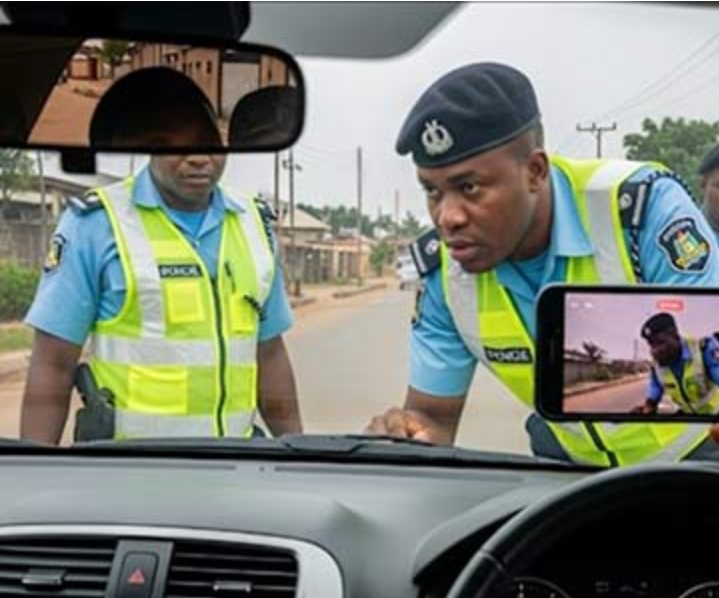
A Federal High Court in Delta State has ruled that Nigerians have the constitutional right to record police officers conducting stop-and-search operations in public spaces.
Justice Hyeladzira Nganjiwa gave the judgement while ruling on an enforcement of a fundamental rights suit filed by a lawyer, Maxwell Nosakhare Uwaifo.
Uwaifo filed the suit following an encounter with police officers along the Sapele Roundabout while travelling from Benin to Warri on May 10, 2025.
The defendants in the suit were the Inspector-General of Police, Nigeria Police Force (NPF), Police Service Commission (PSC), and Attorney-General of the Federation (AGF).
The lawyer sought a judicial pronouncement on the constitutionality of police officers conducting stop-and-search operations without visible name tags and force numbers, as well as the right of citizens to record such officers.
In the suit, Uwaifo asked the court to declare that Nigerians are entitled, under Section 39 of the 1999 Constitution, to freely express themselves, including recording the conduct of law enforcement agents performing public duties. He also sought a declaration that it is unlawful for police officers to seize devices, arrest, or threaten citizens recording their activities.
Among the reliefs sought were: “A declaration that the acts of police officers engaging in patrols, stop-and-search operations, and other public interactions without wearing uniforms that visibly display their names and force numbers is unconstitutional, illegal, and a breach of Sections 34, 35, and 36 of the Constitution and the Police Act.
“An order of perpetual injunction restraining the respondents, their agents, officers, or privies from further engaging in stop-and-search or checkpoint operations without ensuring all operatives wear uniforms bearing their full names and force numbers.
“An order directing the 1st to 3rd respondents to issue clear directives and training guidelines to all officers of the Nigeria Police Force affirming the public’s right to record and report police activities conducted in public spaces, including at checkpoints and during stop-and-search.
“An order mandating the 2nd and 3rd respondents to discipline any officer found to have acted in breach of this right.
“An order mandating the 3rd respondent (Police Service Commission) to issue a circular requiring all officers on public engagement duties to wear full uniforms with identification, and to initiate disciplinary action against any defaulters.
“The sum of N80,000,000 as general and exemplary damages against the respondents for repeated infringements of the rights of the applicant and members of the public.”
The police were not represented in court, but the AGF was represented by Babatunde Ajajogun and D.O. Tarfa.
Nganjiwa held that Nigerians have the constitutional right to record police officers performing their duties in public.
He ruled that officers must wear visible name tags and display force numbers or proper identification during public operations.
The judge also held that it is unlawful for police to harass, intimidate, arrest, or seize devices from citizens recording them and awarded N5,000,000 in damages for violation of fundamental rights as well as N2,000,000 for the cost of litigation.
Speaking after the judgement, Uwaifo recounted his ordeal.
“The operatives flagged me down and began to question me in an aggressive manner. When I noticed their behavior, which suggested extortion or harassment, I brought out my phone to record. Immediately I did, one of the men, dressed in black and appearing to be a police officer, threatened to arrest me and demanded that I put my phone away.
“The officers did not wear any name tags, nor did they introduce themselves. They also made no effort to disclose their identity or provide a reason for their conduct. The vehicle they used was a Toyota Sienna, painted black, with no police inscription, no plate number, and no markings whatsoever to identify it as a police vehicle. The entire interaction was intimidating, and the men created a hostile atmosphere. I could not confidently ask questions or continue recording for fear of being manhandled or unlawfully detained.
“Due to this fear and their threatening demeanor, I could not gather any concrete evidence, and I also could not record the video or identify them clearly due to the absence of name tags and their use of an unmarked vehicle. I have heard and seen many similar instances where police officers intimidate, harass, and even assault Nigerians simply for recording them or questioning their unlawful acts at checkpoints,” the lawyer stated.