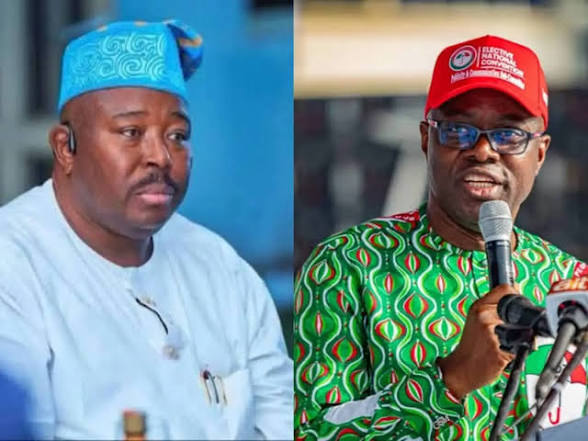
Former Governor of Central Bank of Nigeria (CBN), Prof. Charles Soludo, has written a mini-blueprint to assist President Muhammadu Buhari and the All Progressives Congress (APC) as they battle to revive聽the economy.
In the document, Soludo threw his weight behind Buhari’s emergency powers bill and advised the APC to set up a policy war room.
He said the document聽is not a 鈥渂lueprint鈥� in itself but 鈥渙nly broad pillars鈥�, which could be worked upon by a dedicated team to save the economy.
Below are聽highlights of the document as published by :
NIGERIA ALMOST A FAILED STATE
Highlighting the challenges face by the country, Soludo said Nigeria is ranked number 13 in the failed/fragile state index, behind Somalia, South Sudan, Central African Republic, Sudan, Yemen, Syria, Chad, Congo D.R., Afghanistan, Haiti, Iraq, and Guinea.
The professor of economics said this is聽due to uneven economic development, poverty and economic decline, demographic pressure, group grievance, refugees and IDPs, human flight and brain drain, state legitimacy, human rights issues and rule of law, poor security apparatus, factionalised elite and external intervention.
NIGERIA 鈥斅燗FRICA鈥橲 2ND LARGEST ECONOMY 鈥斅燙OULD AVOID RECESSION
Soludo stated that Nigeria鈥檚 GDP compression from about $575 billion to about $296 billion (almost 50%) back to 2nd position in Africa after South Africa could have been avoided.
鈥淓xchange rate and crude capital controls: confusing trial-and-error of tried and failed neo-socialist command and control policy regime of 1960s- mid 1980s.
鈥淎s predicted, quantities (employment and output collapse)! Capital market comatose; capital flight with vengeance, private investment pulse, inflation soars, and twin deficits exacerbate. Economy in Recession compared to APC 10% Growth; 3 million jobs p.a.鈥�
He said the recession was caused by 鈥渄elayed, incoherent (dysfunctional) and incomplete adjustment exerting great toll on the economy鈥�.
鈥淥utcomes so far (especially in 2016) self-inflicted by acts of omission and commission. Nigeria would have avoided a recession: One year enough for blaming fall in oil prices; after that blame our failures.鈥�
BUHARI鈥橲 BUDGET THE SMALLEST IN RECENT YEARS
At N6.06 trillion, Buhari鈥檚 budget of change was seen as the biggest budget in Nigeria鈥檚 history. But Soludo says the budget, in dollar terms, is the smallest in recent years.
鈥淔GN budget in US$ is smallest in recent years $15- 19bn depending on exchange rate and about 5% of GDP鈥� or approx. $80 per capita,鈥� he said.
In context, Goodluck Jonathan鈥檚 last budget, the 2015 budget, was $26.4 billion in dollar terms, while Buhari鈥檚 2016 budget is only $19.9 billion in dollar terms.
鈥�2016 FGN Budget signals more of the same, with tinkering at the margins; bail-outs, borrowing,鈥� Soludo added.
SOLUDO鈥橲 SOLUTION
In proffering solutions for the APC-led government, Soludo said the emergency economic bill is 鈥渁 positive step forward: Akin to Shagari鈥檚 鈥楨conomic Stabilization (Austerity measures) Act 1982鈥欌��
He warned that it 鈥渕ust be seen as only 鈥榝irst step鈥欌��, adding that the problems are 鈥渂eyond short-term demand management鈥�.
He said the focus so far has been stabilization plus reflation (basic pump-priming), which he called 鈥渇aulty, and could become race to the bottom鈥�.
He said the聽transition to an oil-independent聽economy is not聽sustainable by merely pumping money into the system 鈥� clapping with one hand 鈥� but must include an agenda for supply-side/structural transformation.
He said the APC has 607 working days to make an impression on Nigerians.
鈥淏ig ideas to steer the economy to the next level need aggregate public sector spending of 15-20% of GDP; unconventional monetary-fiscal-exchange rate-financial regime; structural and institutional changes; infrastructure boom; unleashing the States.鈥�
APC POLICY WAR ROOM
He said the APC needs a policy war room, which would drive political transformation and distinguish APC states.
鈥淧olitics always trumps economics, although sound economics is excellent politics: Sustainable change is impossible without political transformation of Nigeria!鈥�
鈥淣o successful transformation to a 鈥榩roductive and competitive economy鈥� with META-level institutions designed for 鈥榙istribution and consumption鈥欌��
He asked the APC to put up an agenda for 鈥渃ompetitive federalism via fundamental constitutional change, including fiscal federalism鈥攖axation powers, rights over natural resources, wage setting, fiscal responsibility, etc 鈥� breaking from unitary-federalism of uniform standards to multi-speed federalism with only minimum standards鈥�.
鈥淭oo many of existing laws are inconsistent with a regime for competitive production; new ones needed.鈥�
He proposed, among other things, that the policy war room should be fully funded to drive an industrialisation plan.
鈥淢erely getting infrastructure and prices right won鈥檛 automatically ignite industrialization: It requires intensive case study approaches 鈥� Dangote or our big banks did not just happen: deliberate efforts were set to 鈥榗reate them.鈥欌��