






Rauf Aregbesola Discourse: From Governance
to Big Development
by
by
Prof. Tunji Olaopa
Retired Federal Permanent Secretary
& Directing Staff, National Institute
For Policy and Strategic Studies
(NIPSS), Kuru, Jos
[email protected]
(Paper Presented at the Ogbeni Rauf Aregbesola鈥檚 Annual Colloquium and Webinar on the theme 鈥楪overnment and Big Development鈥� held on the 29th of May, 2021)
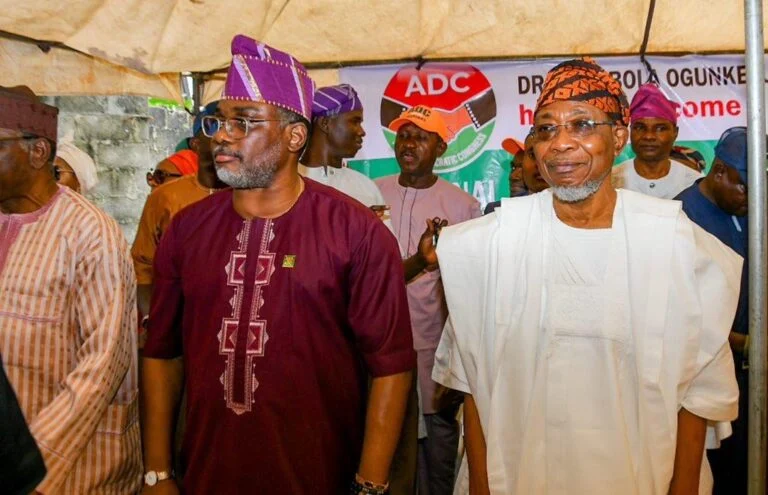
Just barely two weeks ago, Ogbeni Rauf Adesoji Aregbesola, former governor of Osun State and the current Minister of the Interior of the Federal Republic of Nigeria, celebrated his 64th birthday. Not one given to frivolities, he organized an online colloquium to mark the day. It was themed 鈥淕overnment and Big Development.鈥� And I had the honor to have been invited to speak at the resoundingly successful seminal event. William Barclay the Scottish theologian and author said clearly that 鈥淭here are two great days in a person’s life – the day we are born and the day we discover why.鈥� There is no doubt that Ogbeni Aregbesola has discovered his own why. And that has been demonstrated by his knowledge-propelled governance credentials in all his years in public office, and especially from Lagos state to the state of Osun. Both in character and achievements, Aregbesola has remained, in his own unique way, mercurial and sterling. His Marxist principles keeps him firmly entrenched in a populist ideology that keeps the people at the center of his governance model. And the annual colloquium signals his willingness to institute a continuing conversation that keeps reshaping the template of good governance on behalf of Nigerians.
At this year鈥檚 colloquium, the Vice President of Nigeria, Prof. Yemi Osinbajo, made two crucial points that will serve as the premise for my intervention. The Vice President鈥檚 concerns relate to two correlated issues of the burdensome cost of governance that keeps draining Nigeria鈥檚 depleting resources, and Nigeria鈥檚 low productivity profile which deeply constrained a return on government investments. These two issues speak in serious terms to the development predicament of the Nigerian state. And it means a lot that the Vice President was able to hit the nail on the head. The bloated nature of the workforce of the public service, however, must be seen in terms of the near absence of the right competency mix, skills composition and organizational IQ, rather than of the number of workers, most of whom do little or nothing but with a very few doing too much. This implies that while creative rightsizing and institutional restructuring are imperative as the change management options, government will not win except it comes to the change dynamics with equity. And this demands that a focus on payroll as a target for efficiency-savings, must also be complemented by the urgency of unbundling the entire expenditure structure of government through rigorous productivity audit.
Unfortunately, the demand for big development that attends sufficiently to the well-being of Nigerians must be a holistic and comprehensive reform. This is essentially what the 鈥渂igness鈥� of big development actually suggests. It speaks to a state-induced massive development leap. Such a leap creates the required momentum that is capable of creating desirable multiplier effects that deliver sustainable national transformation. Big development conceptually connotes an optimistic development scenario of macroeconomic possibilities that, for instance, produces a double-digit economic growth through the game-changing sustainable contributions of value-adding and critical growth-propelling sectors and drivers. In the social science literature, big development is often taken to be the task of a capable developmental state. Such a state is developmental to the extent that it is able to deploy the capability readiness of an efficient and flexible public service institutional architecture. Singapore, Japan and the Asian Tigers provides a ready example of states whose development trajectory has been qualitatively transformed as a result of dogged structural, institutional and leadership dynamics.
Since independence, and despite its best efforts, Nigeria has displayed an almost pathological incapacity of moving from governance vision and policies to performance outcomes in terms of development that activates its institutional frameworks to deliver infrastructural development to Nigerians. In summary, Nigeria lacks the capacity to get things done. In institutional reform terms, this is another way of saying that the devil in Nigeria鈥檚 non-transforming development initiatives and change management lies in the mix of a number of complex and correlated issues: i) the politics that Nigeria鈥檚 political class plays; ii) leadership IQ, sophistication and sincerity; iii) human resource capacity deficits, especially in the dynamics of policy implementation; iv) unstable macro-economic climate; v) policy, programme and project discontinuity, poor programme design, poor resource allocation; vi) lack of disciplined execution; and vii) corruption and the rentier culture. Overall, Nigeria is held in the unfortunate grip of the ever confounding and almighty Nigeria Factor which incapacitates every functional idea, model or paradigms that had worked elsewhere.
The optimistic news however is that transforming the Nigerian state into a democratic developmental one is not an impossibility. While appreciating the fact that Nigeria has not lacked in significant visions and development planning since independence, we need to note that visions and plans constitute only 15% of the development challenge. On the other hand, 85% is about the political will to push the implementation of development and policy execution through the complex and messy implementation trajectory. In deploying the required political will to jumpstart the change Nigeria needs to get things done, the entire leadership class in Nigeria鈥攆rom the president to the governors (together with their ministers and commissioners)鈥攊s faced with a critical question: What type of changes can be realistically achieved in 4 years that will bring government promise to the point of efficient services delivered effectively to Nigerians? This question speaks to the crucial short time and limited resources any sitting president and governor has to achieve a qualitative move from governance promise to tangible development outcomes.
The starting point of the whole structural and institutional transformation of the state into a developmental one commences with a deep-seated transformation of the state itself, especially in relation to the market and its dynamics for how government does its business. First, Nigeria needs to craft a formidable and viable national development agenda or plan. And at the heart of such a development plan is the priority given to the need for a national productivity paradigm shift in the national economy that is matched with smart implementable strategies, and the capacity to mobilize all sectors of society to implement it. The deployment of strategies will be fundamental at two levels. The first level requires urgently attending to the cost of governance burden through a national waste reduction strategy that will not only deal with institutional redundancy, but also get all critical sectors of the economy to articulate their productivity plans based on agreed national benchmark. This will also include productivity tools and metrics that will enable labour and management to both sign up for a revised collective bargaining framework that will facilitate the implementation of a new benchmarked ratio of capital-overhead-personnel budget backstopped by a new compensation system.
The second level of institutional strategies demands attending to the operational and performance dynamics of the MDAs. This is where it becomes imperative for the state to redefine its role and that of the MDAs vis-脿-vis the market and the private sector as a formidable engine that can calibrate the growth of the national economy. Once the role of the private sector is determined, then the strategic recalibration demands an alternative service delivery model that enables the MDAs to focus on their core functions while outsourcing their non-core functions to the private sector. This makes the public-private partnership model a significant model of doing business for government. Once this is taken for granted, it now remains for the MDAs to be taken through rigorous change management procedures that will make them capacity ready to deliver on their core functions of supporting policy making with strategic intelligence, mobilizing required resources to execute, regulate, etc. This is where the execution problematic becomes a critical risk factor in the need to achieve big development. It is in the implementation of the reform of the performance and productivity metrics of the MDAs that the devil really resides in the details.
Thus, apart from streamlining the MDAs鈥� productivity targets into the national development plan, there is the specific need to lay the structural foundation that will shift them from policy designs to policy intelligence and creative implementation capacity. One important step will be to outline critical bureau-pathological issues, like a bloated workforce and declining professional ethics for immediate attention. This also demands that critical gaps鈥攃apacity, policy, process, resource and performance鈥攂e dealt with. Another important step is to categorize the MDAs for a selective reform capacitation exercise on the strength of their significance. The public institutions to be targeted for capacitation fall into three categories: (a) MDAs that implement national priority programmes, (b) public institutions that regulate rules-based market players, investments points of opportunity, SMEs and the rule of law, and (c) institutions that facilitate welfare-oriented social impact, services and human capital development. And the key is to reengineer the MDAs鈥� management systems in ways that targets their operational and processual frameworks in ways that enable them to embrace project management culture, particularly ones that leverage strategic PPP modality. This also include putting in place strategic performance metric: job evaluation, skills re-composition, regrading, new pay structure and the rethinking of the intellectual contents of skills for running the business of government.
The desire for big development, in the final analysis, speaks to the emergence of a critical mass of political and bureaucratic leadership, that will be willing to go the whole hog with rethinking and rejuvenating Nigeria鈥檚 governance and development dynamics, with the agenda of making real the goal to build a democratic and developmental state. That, for me, is Nigeria鈥檚 future; a date she is meant to keep with her citizens who ought to benefit from the social contract with a great state.
Prof. Tunji Olaopa
Retired Federal Permanent Secretary
& Directing Staff, National Institute
For Policy and Strategic Studies
(NIPSS), Kuru, Jos
[email protected]
(Paper Presented at the Ogbeni Rauf Aregbesola鈥檚 Annual Colloquium and Webinar on the theme 鈥楪overnment and Big Development鈥� held on the 29th of May, 2021)