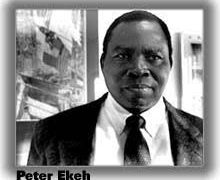










Just some few weeks ago, the global community of Africanists and African scholars woke to the very sad news of the demise of world-renowned scholar, Peter Ekeh. There is no serious scholar of African studies, or even African-American Studies who has not heard of Ekeh; or even more, who has not read some of Ekeh鈥檚 defining intellectual contributions to the understanding of postcolonial Africa. When in 1975, Peter Ekeh wrote and published 鈥淐olonialism and the Two Publics in Africa,鈥� he would be coherently and systematically dismantling many years of political theorizing about Africa and her social dynamics. With the idea of the 鈥渢wo publics,鈥� we came to a deeply fundamental understanding of how African polities and postcolonies function.
In the radical and most tempestuous company of others, like Claude Ake, Richard Joseph, Billy Dudley, and many others, African studies, and especially the discipline of Political Science, became disconnected from Western political pontifications. Between them, we can say that these scholars initiated what we can call a Machiavellian moment with the discipline of political science. Niccol貌 Machiavelli鈥檚 The Prince became notorious not only for the discourse on power and governance that it generated, which stands against the political morality instituted by Aristotle, but also his perception about political theorizing ought to be done. While Aristotle and Aristotelians conceive of politics as being moderated by morality鈥攕ince, for them, the end of all politics is the ability to live the good life鈥擬achiavelli insisted that politics must be outlined within a realist frame that present it as it is, rather than as it ought to be. And this is why The Prince presented a stark analysis of power and power relations between the prince and its subjects. For Machiavelli, the first condition for any successful rule is for the prince to learn how not to be good!
Ekeh and his intellectual contemporaries also immediately saw the danger in theorizing African political realities from a western political prism and perspectives. In Social Science as Imperialism, Claude Ake made the broad but radical claim that western social science writings and theorizing on third world realities constitutes an imperialism. Ake makes three correlated claims: (a) western social science imposes capitalist values and development on the third world; (b) social science analysis was bent towards making the third world more like the west; and (c) it initiated a mode of analysis that is hierarchical in the understanding of human development. In furthering this analysis, Ekeh brought an even more imposing intellectual stature. With initial undergraduate and graduate studies in sociology, Ekeh brought the full weight of sociological theory to bear on the analysis of political realities and dynamics in Africa. In 鈥淐olonialism and Social Structure,鈥� his inaugural lecture delivered in 1980 at the University of Ibadan, Peter Ekeh attempted to 鈥渦pdate our sociological conceptualization of colonialism over and above the colonial situation.鈥�
While Georges Balandier鈥檚 concept of the 鈥渃olonial situation鈥� was sufficiently revolutionary in bringing together the often-separated understanding of colonization and the various reactions and responses to it, Ekeh argues that the full implication of the 鈥渃olonial situation鈥� fails to take note of the epochal significance of colonialism beyond the colonial situation to the postcolonial and the supra-individual implications it has on the postcolonies. In other words, colonialism becomes sociologically and politically more interesting in its generation of 鈥渟ocial formations of supra-individual entities and constructs.鈥� And these social formations were motivated by the 鈥渃onfrontations, contradictions, and incompatibilities of the colonial situation鈥� to cast a long shadow on postcolonial realities and the significance of social structures in Africa. This analysis, for instance, according to Ekeh, cast serious intellectual doubt on the capability of concepts like decolonization, independence, or even neo-colonialism to enable a proper understanding of the postcolonial situation in Africa.
Peter Ekeh鈥檚 understanding of the epochal nature of colonialism in its establishment of social formations that poison postcolonial social structures undermined the postcolonial intellectual assumption that gave the Ibadan School of History its imposing stature. Given the conviction of the advocates of the Ibadan School of History that African history goes deeper than the instrumental readings provided by the colonial historians and anthropologist, they reached the conclusion that colonialism was an episodic incidence from which the continent will eventually pick up the pieces. Unfortunately, Peter Ekeh鈥檚 epochal analysis has been borne out by historical realities after the official termination of colonialism. Thus, between the transformed, migrated and emergent social structures, the postcolonial predicament and agonies of African postcolonies were almost determined.
With this fine-tuned and sophisticated analysis about the supra-individual social formations and entities that have come to determine sociopolitical relations and realities, Peter Ekeh therefore leaves for indigenous political scientists, and for African studies, a huge agenda for carrying forward the fundamental task of coming to terms with the conditions of the postcolonies. And this task for political science theorization is even more daunting from two perspectives. On the one hand, there is the need to square Ekeh鈥檚 Africa-centric agenda with the often-peculiar national outlook and dynamics operating within specific states. Nigeria constitutes a most outstanding instance in this regard. Each of Ekeh鈥檚 terms, concepts, arguments and discursive framework must be delicately unpacked in attempting to bring them to bear on understanding the Nigerian condition and predicament. And there cannot be any easy co-optation or deployment of Ekeh鈥檚 position to analyze Nigeria鈥檚 political situations and crises. What light does Ekeh鈥檚 analysis shed on Nigeria鈥檚 post-independence political realities? How does the relationship between the social structures鈥攊ndigenous, migrated and emergent鈥攅xplain Nigeria鈥檚 continuing insistence on operating a lopsided federal framework? How does that lopsided federalism eventuate in the civil war, and then the #EndSARS protests?
On the other hand, the urgency of the need to bring a sophisticated political analysis and theorization to bear on Nigeria鈥檚 predicament is further complicated by global developments. Since Peter Ekeh theorized the barest framework for political understanding and development of the African realities, the global socioeconomic and political realities have become even more complicated鈥攆rom liberal and neo-Marxian identity postulations to global injustice and inequalities to the rise of Trump and nationalism and populism, as well as the emergence of China as a global hegemonic force. The internet, media technologies and the social media have also become significant social forces enabling many decisive developments, from Tiananmen Square to Tahrir Square, and from Occupy Wall Street to Occupy Nigeria. and recently, the global ravage of the COVID-19 has further put in bold relief the political fissures and fragmentation of global inequalities and hegemonies.
The fundamental question is simple: how ought political science and political theorization in Nigeria to proceed in this dizzying world of complex political developments? And what lessons can we learn from Peter Ekeh鈥檚 intellectual admonitions and argumentations? The first lesson is straightforward. For Ekeh, disciplinary boundaries and framework are limiting for a deeper analysis and understanding of African and Nigerian postcolonial predicament. Ekeh himself deployed so many intellectual sensibilities and framework, from sociology to political science, and from African-American studies to history. This is only obvious: a complex postcolonial predicament cannot ever be amenable to single disciplinary observation and analysis. And yet unfortunately, most African and Nigerian political scientists are still bound by disciplinary isolation of political science from transdisciplinary necessities. The second issue is a corollary of the first. And this is that political theorization cannot be saddled with the search for easy answers to complex questions and issues. The academic reality in Nigeria is such that scholars generate academic papers to serve the urgency of promotion and career development. This therefore leads to spurious analysis that often fail to tease out deep-seated anomalies and even deeper (re)solutions.
The final lesson I want to draw is not new. It concerns the urgent need for an engaged political science theorization that is in tune with the demands of its contexts and the imperative of relevance. Political science is not just any ordinary discipline. There is a reason why Peter Ekeh made it his adopted discipline, and the theoretic base from which to launch his interdisciplinary analyses. Let us even be bold to say political science is the king of the social sciences. But it demands more than disciplinary pride and adulation; on the contrary, it places a huge onus on political scientists to prove its relevance to the task of bringing to light the terrible theoretic and practical elements of Nigeria鈥檚 predicament, underdevelopment, mal-governance, insecurity, corruption and unemployment in ways that will activate policy directions for politicians, development practitioners and public administrators. This brings us full cycle back to Niccol貌 Machiavelli, and the tradition of politically and nationally engaged political science theorizing. The Prince is meant as a manual for governance. Its purpose was to orient the governor of Florence on how that city-state could be made better in terms of its responsibilities to its subjects and to other city-states around. It is a manual meant to ensure that Florence continued to flourish.
Political science owes its context that responsibility of clarifying and deepening the socioeconomic and political understanding of the existence of the Nigerian state and its well-being vis-脿-vis her citizens. The Nigerian political science community owes a debt of honor to the Nigerian context to keep pushing forward the boundaries of democratic theories and experimentation in the direction of good governance. Thus, from pedagogical dynamics of the context of the political science curricula to the tradition of political science argumentations, Nigerian political scientists, the Nigerian Political Science Association (NPSA) and the political science community needs to craft an agenda informed by praxis鈥攖he critical combination of theory and practice that Nigeria urgently needs to make sense of its political development and its democratic responsibilities to her citizens鈥� well-being. That is what Peter Ekeh鈥檚 theorization intended for us to achieve.
Prof. Tunji Olaopa
Retired Federal Permanent Secretary
& Professor of Public Administration,
National Institute
For Policy and Strategic Studies
(NIPSS), Kuru, Jos
[email protected]
[email protected]