






By Efa Sunday
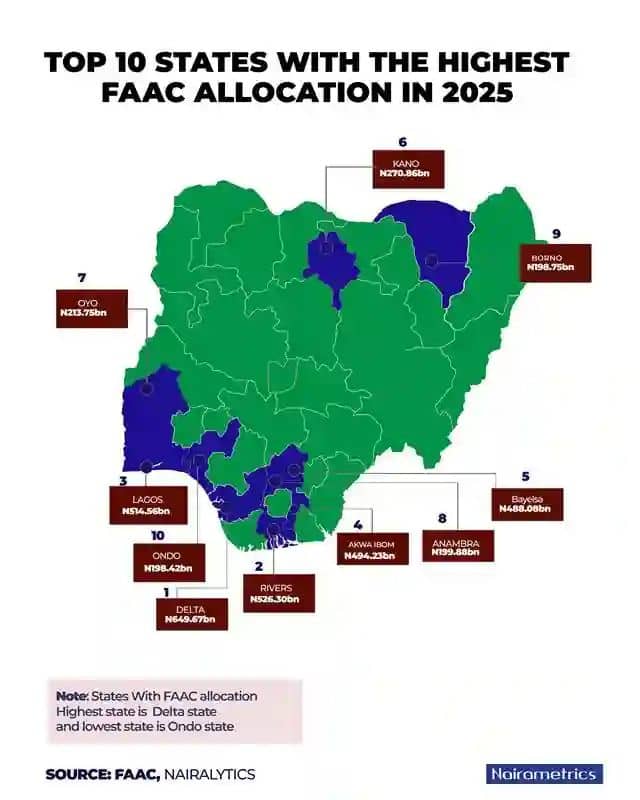
Oyo State has emerged as one of the top 10 beneficiaries of the 2025 Federation Account Allocation Committee (FAAC) allocations, ranking seventh nationwide with a total net inflow of N213.75 billion.
The figure translates to an average monthly allocation of about N17.8 billion, marking a sharp increase from the N5 billion to N7 billion monthly average the state received before 2023, when annual allocations hovered between N75 billion and N85 billion.
While oil-producing states dominated the top of the table, with Delta receiving N649.67 billion, Rivers N526.30 billion, Lagos N514.56 billion, Bayelsa N468.88 billion and Akwa Ibom N464.23 billion, Oyo stood out as the highest-ranked non-oil state in the South West outside Lagos. Kano followed with N270.86 billion.
The surge in allocation has significantly strengthened the state鈥檚 2025 budget of N678 billion, complementing steady growth in internally generated revenue, which rose to N65.28 billion in 2024 鈥� reflecting over 145 per cent growth since 2019.
Governor Seyi Makinde had, in July 2020, while signing the revised budget, declared his administration鈥檚 commitment to repositioning the state economically.
鈥淥yo State is viewed as a civil service state because we have not taken the needed action to boost the economy. I took an oath to lift Oyo State from poverty to prosperity, and I am determined to keep my word,鈥� he said.
Five years later, the increased FAAC inflow appears to have provided additional fiscal space for the government鈥檚 development agenda.
Agriculture, which contributes more than 40 per cent to the state鈥檚 gross domestic product, has received renewed attention. Through the Oyo State Agribusiness Development Agency, investments in irrigation, improved seedlings and agro-processing facilities have reportedly expanded. Officials say this has improved output in crops such as cassava, cocoa and yam, while creating employment opportunities for young people.
Infrastructure has also recorded visible activity. With over N152 billion allocated to works and transport in the 2025 budget, road construction and rehabilitation projects in Ibadan and other parts of the state have progressed. Improved road networks are expected to ease transportation for farmers and traders, as well as attract private investment.
In education, which accounts for about N145 billion of the budget, the state has expanded school renovations, recruited teachers and upgraded tertiary institutions. The government says the intervention is aimed at improving access and strengthening technical and vocational education for the growing youth population.
However, the windfall has not come without criticism. Opposition voices have questioned aspects of government spending, including allegations surrounding the use of funds for the state鈥檚 50th anniversary celebrations. Concerns have also been raised over rising debt levels. Budget reports show that the state borrowed N93.4 billion in the second quarter of 2025, while N18.6 billion was spent on debt servicing in the first half of the year.
Analysts say that although revenue has grown, prudent debt management and transparent project execution will be key to sustaining the gains. Some residents have also called for more equitable distribution of projects, especially in rural communities.
As Oyo State consolidates its position among the top FAAC recipients in 2025, stakeholders say the real test lies in translating increased allocations into measurable improvements in living standards, job creation and long-term economic stability.
As 2026 progresses, with the state receiving over N17.75 billion monthly, citizens鈥� attention remains on how effectively the government will convert federal inflows into lasting development for its people.