





By Oyeyinka Fabowale
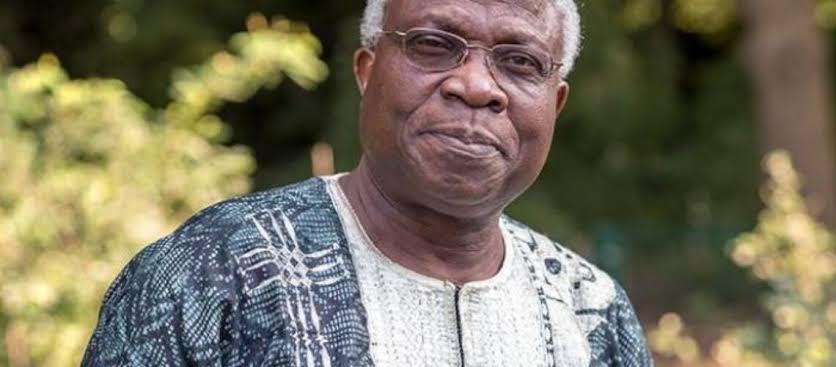
Multiple award-winning Nigerian poet and scholar, Professor Niyi Osundare, is expected in the country to give the keynote address at the 10th edition of the Lagos International Poetry Festival holding next week.
The poet laureate is also billed to receive the Lifetime Achievement Award at the event taking place between October 24 and 27 at Alliance Fran莽aise, The Mike Adenuga Center, Lagos.
The award, the high-point of the three-day programme, rounds off a three-country tour of Europe, America and Africa by the Poet Laureate to receive similar honours.
Osundare’s already feather-studded cap had added to it the 2024 Furious Flower Lifetime
Achievement Award and the 鈥淕olden Key of Smederevo鈥� at the World Conference on Black Poetry in the United States last month and the ongoing Smederevo City Festival in Serbia in Europe respectively.
For the recipient of Nigeria’s Order of National Merit whose first name, Niyi, means
“One deserving of honour,” the development is an ironic fulfilment of fate, having garnered so many recognitions in his career as a literary artist and intellectual.
TheDirector, Lagos International Poetry Festival, Efe Paul Azino, said the decennial honor, of which Prof Osundare is the first recipient, was to recognize individuals who have made exceptional contributions
to shaping and galvanizing poetry in Africa and across the world.
“Your profound impact,masterful craftsmanship, and unwavering commitment to using poetry as a vehicle for social
change leave an indelible mark on the African literary landscape. You have inspired generations of poets and redefined the possibilities of African poetry on the global stage. We remain indebted for your contributions,” he wrote in the letter inviting the poet laureate to the literary gathering running with the theme,”The
Science of Things.”
As the keynote speaker Osundare will set the note and tone of discourse for a panel to examine the topic: “Does Climate Science Need a New Language?” from his unique perspective as a poet who has long engaged with environmental themes.
Azino believed the renowned literary scholar’s experience would be “invaluable in exploring how poetry and other forms of creative expression can bridge the gap between scientific data and public understanding, potentially reshaping our approach to climate action.
Elaborating on the choice of the theme, Festival Director added: “As we travel deeper into uncertain territory with advances in Artificial Intelligence coinciding with fierce debates on everything, from
economic mobility to social identity and climate change, we must rely more dispassionately on the confluent forces of inquiry and imagination, language and experiment, poetry and science, to guide us into more sustainable ways of living, resisting along the way the forces that seek to
co-opt them as instruments for advancing political agendas and serving narrow economic interests.
Over four days of carefully curated panels, readings, performances, workshops, and
exhibitions, our lineup of poets, scientists, writers, educators, artists, and raconteurs will
embody our commitment to a world where poetry and science are reinvigorated to point us toward a future defined by our courage to explore, question, and understand.”
Prof Osundare will be returning to the country from Serbia where he is currently taking part in the Smerevo City Festival and will receive the “Golden Key of Smederevo鈥� awarded annually to a distinguished poet. The award’s paraphernalia includes a gilded replica of the city鈥檚 key, the publication of a bilingual poetry book (in the laureate鈥檚 language and Serbian), and a monetary prize of 鈧�1,000.
Miljan Guberini膰, the director of the festival, expressed delight at hosting Osundare and emphasized the festival鈥檚 deep commitment to celebrating poetry from diverse cultures.
The Awards Committee had praised Osundare as 鈥渙ne of the most prominent African poets, scholars, and intellectuals鈥� of our time. He has authored over twenty poetry collections, four plays, and numerous monographs and articles on literature, language, culture, and society. His works have been translated into multiple languages, and his educational background spans three continents, with degrees from the University of Ibadan, University of Leeds, and York University.
The panel noted Osundare鈥檚 deep connection to African culture and how he uses poetry as a tool to 鈥渂ridge the seas with verses,鈥� telling stories that resonate with people across the globe while keeping Africa at the center of his creative imagination.
It also lauded his critique of contemporary global movements, such as postmodernism and posthumanism, and his advocacy for a more human-centered world, as powerfully expressed in his poem 鈥淚 Sing of Change.鈥�
Last month, the Commonwealth Prize for Literature winner had also been honoured with a Lifetime Achievement Award at the Worlds of Black Poetry, held at James Madison University between September 18 and 21.
Lauren K. Alleyne, Executive Director, Furious Flower Poetry Center and Professor of English, James Madison University, said: “Osundare’s selection for the honour was both a ceremonial gesture and canonical activity.”
“We recognize your political courage in the face of tyranny, and your commitment to poetry as a vehicle for the voices of the people. We honor, too, your vision of poetry鈥攚hich you have sustained for decades鈥攁s a balm for our wounded ecology; your life鈥檚 work, epic in form, pastoral in texture, and planetary in scale, has been a tender love song to the earth,” the Director remarked in the letter of notification.
She added: “At Furious Flower, we consider Black poetry a movement grounded in culture,
history, community, archival resilience (we have one of the most significant archives of Black poetry), ancestral care, and
long memory.”
The festival, established in 1970 to preserve and promote poetry, has hosted over 2,000 poets from around the world and published more than 400 books.
The first Furious Flower Poetry Conference was dedicated to and headlined by Gwendolyn Brooks, the first Black woman to
win the Pulitzer Prize in poetry, in 1994. Since then, the Furious Flower Poetry Center, the first academic center in the United States dedicated to Black poetry, has been consistent in curating and nurturing this heritage.
The conference, held every ten
years, has honored Black poets and critics whose voices have, over the course of the previous decade, had the most
transformative impact on Black poetry.