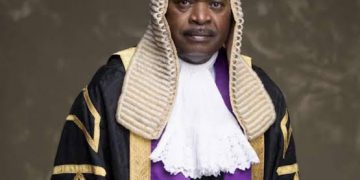







The Chief Judge of the Federal Capital Territory (FCT) High Court, Justice Ishaq Bello, was not elected as a judge at the International Criminal Court (ICC).
This was disclosed in the results of the election which was concluded on Thursday and made available on the ICC website.
President Muhammadu Buhari had nominated Bello as Nigeria鈥檚 candidate on June 20.
According to the results, Bello polled 12 votes鈥搕he second lowest鈥搊nly after Milandou Prosper, nominee from The Republic of Congo, out of 117 in the first round of the election.
In the second round, Bello garnered only 5 votes out of 110 votes.
Only Korner Joanna and Lordkipanidze Gocha, nominees of the United Kingdom and Georgia respectively, were elected judges out of the 18 candidates, according to The Cable.
Six judges were supposed to be elected to fill one-third of the court鈥檚 18 judicial seats.
Although the FCT Chief Judge has a master鈥檚 degree in International Criminal Law from Ahmadu Bello University, Zaria, the ICC said Bello lacked knowledge of the workings of the court.
The ICC advisory committee on the nomination of judges had earlier ranked Bello low in October, giving the indication that he may not be selected in the final election.
Also, a report by the International Justice Monitor, corroborated ICC鈥檚 verdict on Bello. The report claimed that despite Bello having considerable years of experience as a high court judge, he is a product of a flawed nomination process, has a poor record of upholding justice, and participated in a process that recommended unqualified lawyers for appointment as judges.
Before he was appointed a judge, he had worked as state counsel, magistrate, and deputy chief registrar of Nigeria鈥檚 highest court, the Supreme Court. He was appointed judge of the High Court of the Federal Capital Territory in 1997, and chief judge in 2015.
The report cited Ishaq Bello鈥檚 handling of the trial of policemen charged with extra judicial killings of six traders in Abuja in 2005 which left a dent in his career as a judge.
” The trial which lasted 12 years was a deliberate ploy to help one of the officers charged with the murder escape justice.
“Early this year, Ishaq Bello played a key role in recommending unqualified lawyers to be appointed as judges of courts where he presided as the chief judge.
“Also, in 2018, a senator (member of Nigeria鈥檚 upper legislative chamber- the Senate) led armed thugs to invade the chambers of the Senate, from where he stole the mace 鈥� the legislative symbol of authority. Following civil society pressure for the senator to be prosecuted, Bello, sitting as chief judge, issued an ex parte order barring police and other security agencies from arresting the senator for interrogation.
“That ruling is against long established precedent that courts have no power to stop law enforcement agencies from carrying out their constitutional duties,”the report said.
The report goes on to state that the process that led to Bello鈥檚 nomination was shrouded in secrecy.
” It smacked of cronyism, a trait that the administration of President Muhammadu Buhari has become notorious for. Applications were not invited from suitable candidates. Civil society organisations were shut out. No interview was conducted,” it added.