By Samuel Adegoke
Nigeria’s inflation rate cooled in February 2025, posting its second consecutive monthly decline to a still-high but gradually improving figure of 23.18 percent, from January’s 24.48 percent reading.
The latest data from the National Bureau of Statistics (NBS) showcased a shift in the country’s inflationary trend, with prices now easing off after reaching a three-decade peak of 35 percent in December 2024.
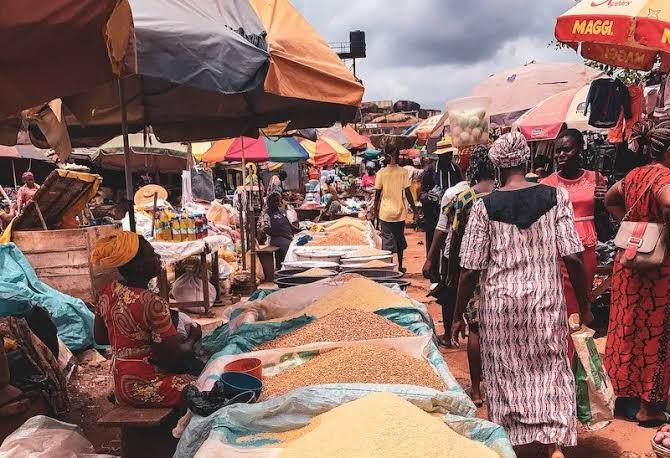
Even as Nigeria’s inflation rate declined, economists, analysts and citizens remain concerned about the persistently high prices of essential commodities across the country.
Despite the official statistics pointing to a downward trajectory of inflation, the lived experiences of Nigerians tell a different story of economic distress, where survival has become a daily battle amidst one of the most challenging economic periods in living memory.
According to economic reports, it is a no-brainer that Nigerians continue to struggle under the weight of elevated food prices, rising transportation costs, and the challenge of meeting basic living expenses.
With the surge of inflation pushing up the prices of goods and services to unprecedented levels, consumers now find themselves in a situation where higher prices have become the new norm, blunting their ability to discern any change or improvement in their daily expenses.
Adding to the mix of economic concerns, the United Nations Conference on Trade and Development (UNCTAD) recently projected that Nigeria’s total debt could surge past the N155 trillion mark in 2025, following the government’s proposal to borrow an additional N13 trillion to fund the budget deficit for the fiscal year.
President Tinubu’s administration’s reforms, intended to promote long-term economic stability, have since been implemented, resulting in harsh consequences for the average Nigerian. The sudden removal of fuel subsidies and exchange rate unification, while aimed at economic stability, has triggered a steep rise in living costs, plunging millions of Nigerians deeper into poverty and eroding their purchasing power.
According to reports, while the reforms were intended to restructure and fortify the Nigerian economy for long-term stability, the immediate effect on citizens has been a reduction in purchasing power and a sharp increase in poverty levels.
The reality of Nigerians was aptly described in a recent commentary titled 鈥淲HISPERS鈥� by economic think-tank Financial Derivatives Company Limited, stating: 鈥淚n February, inflation moderated for a second consecutive month to 23.2%, following a data overhaul in January that brought it down by almost 11% to 24.5%. Yet, the lived reality of most Nigerians tells a different story.
鈥淎necdotal evidence suggests that while inflation is slowing, the pace of moderation may not be as swift as official data implies. And let鈥檚 be clear: decelerating inflation does not mean prices are falling鈥攊t simply means they are rising at a slower rate. Purchasing power remains at rock bottom, and corporate sales have yet to stage a meaningful recovery.鈥�
Consumer price index performance in February 2025
Nigeria’s consumer inflation, measured by the Consumer Price Index (CPI), eased to 23.18 percent in February 2025, marking a 1.30 percent drop from January’s rate of 24.48 percent.
The NBS attributed the drop in the CPI index to a decrease in the average prices of certain items within the CPI basket of goods and services, across various divisions.
The sharpest declines in price levels were recorded in the Food and non-alcoholic Beverages division (9.28%), followed by Restaurants and Accommodation Services (2.99%), Transport (2.47%), Housing, Water, Electricity, Gas & other Fuel (1.95%), Education Services (1.44%), Health (1.40%), Clothing & Footwear (1.17%), and Information and Communications (-0.76%).
Price reductions were also observed in Personal Care, Social Protection, and Miscellaneous Goods and Services (0.76%), Furnishings & Household Equipment and Maintenance (0.69%), Insurance and Finance Services (0.11%), Alcoholic Beverages, Tobacco & Kola (0.09%), and Recreation, Sport & Culture (0.07%).
According to the CPI data, food inflation recorded a year-on-year decline of 14.41 percent, with the February 2025 rate of 23.51 percent representing a significant decrease from the 37.92 percent reported in February 2024.
Though the NBS acknowledged that the decline in food inflation could be partially attributed to the change in the base year, it also highlighted that on a month-on-month basis, food inflation rose by 1.67 percent in February 2025, reflecting an increase in food prices compared to the previous month.
Comparing the food sub-index data for February 2025 against the same period in the previous year, the NBS reported a 467 basis points increase in the average annual rate of food inflation, from 30.07 percent in February 2024 to 34.74 percent in February 2025.
In February 2025, the average prices of certain food items showed notable declines when compared with their January 2025 values. The specific food items identified by NBS included yam tubers, potatoes, soya beans, maize/cornmeal flour, cassava, and Bambara beans (dried).
The National Bureau of Statistics also reported the core inflation rate, which excludes volatile food and energy prices, to have declined to 23.01 percent in February 2025 on a year-on-year basis, representing a 2.12 percentage points decrease from the previous year’s rate of 25.13 percent.
Urban-rural inflation index
The NBS reported that in urban areas, inflation year-on-year rate increased to 25.15 percent in February 2025, although still lower than the previous year’s rate of 33.66 percent. Similarly, rural inflation rates rose from 29.99 percent in February 2024 to 19.89 percent in February 2025.
The average inflation rate of change over the last twelve months in urban areas stood at 32.22 percent in February 2025, a 428 basis points increase from the same month in the previous year. Likewise, rural areas recorded a 12-month inflation rate of change of 27.94 percent, an increase of 333 bps compared to the rate recorded in February 2024.
Adjusting to new realities as inflation slows
Amidst the harsh economic situation experienced by Nigerians, experts assert that the recent Consumer Price Index rebasing by the NBS may provide a silver lining, particularly for investors.
An assessment of the latest inflation report by analysts at Ascenix Consulting attributed the decline in inflation to the rebased Consumer Price Index figures from 2010 to 2024.
However, they asserted that Nigeria’s recovery trajectory is gaining strength, buoyed by the relative stability of the Naira against the U.S. dollar in the range of 1,500 NGN/USD between December 2024 and February 2025.
This stability, they argued, has boosted investor confidence in the Naira and offered promising short-term carry trade opportunities, potentially signalling a much-needed respite from the volatility and uncertainty that has long plagued the Nigerian economy.
Ascenix Consulting concluded that the Inflation for the next few months is expected to be below 24.0 percent.
The Centre for Promotion of Private Enterprise (CPPE) also weighed in on Nigeria’s inflationary status, stating that despite the 1.3 percent decrease in the headline inflation rate in February 2025, prices of essential goods remain elevated.
Muda Yusuf, director of CPPE, acknowledged that while the country’s inflation rate is decelerating, the persistent increases in the prices of goods and services are cause for concern and an indication that the federal government faces an uphill battle in controlling inflation.
鈥淭he inflation rate at 23.18 percent is still very high. This is because the (February inflation) rate indicates that there is still an increase in prices but at a slower rate. It also implies that there is still work to be done to ease the inflation pressure on the citizens,鈥� Yusuf said.
The CPPE director attributed the further deceleration in inflation rates in February to the CPI base effect and the stabilisation of the macroeconomic environment.
He stated further: 鈥淲hen we relate the 2025 figures to 2024, we expect to see a further narrowing of the gap in inflation rates because the inflation rate is essentially year-on-year and because prices in 2024 were generally highly elevated.
鈥淪o we are using that as a baseline. Typically, when we compare that to prices in 2025, we are likely to see a significant deceleration. This trend is likely to continue for the larger part of 2025.鈥�
According to the latest Inflation Expectations Survey Report published by the Central Bank of Nigeria (CBN), both businesses and households across the country are observing indications of a moderation in inflationary pressures, albeit with persistent concerns over key drivers such as energy prices, exchange rates, transportation costs, interest rates, and insecurity.
Notably, over 90 percent of businesses and more than 83 percent of households surveyed cited energy prices, exchange rates, and transportation costs as the top factors influencing inflation expectations.
The report also noted that household income distribution influenced respondents’ inflation perceptions. While households with monthly incomes exceeding N200,000 still largely considered inflation to be high, the proportion that believed inflation was moderating increased to 25.4 percent.
In contrast, low-income households with monthly incomes below N30,000 remained pessimistic, with 77.0 percent perceiving inflation as high, while only 6.7 percent believed inflation was moderating.
The survey also explored businesses’ and households’ expectations regarding inflationary trends over the next six months. While 40.3 percent of respondents anticipated that inflation would increase in the upcoming month, 47.1 percent believed inflation would remain steady, and 12.6 percent predicted a decrease in inflation over the same period.
鈥淏y the next three months, 44.0 per cent expect inflation to rise, but 21.4 percent anticipate a decline. Optimism grows further in six months, with 27.1 percent expecting inflation to decrease, compared to 28.6 percent who think it will remain unchanged.”