





Nigeria has recorded its first tele-robotic surgery after a surgeon in Ogun State remotely operated on a patient in Abuja to remove a kidney affected by a cancerous tumour.
The procedure was performed on Saturday, September 19, 2026, through a collaboration between Redeemer鈥檚 Health Village (RHV) in Ogun State, RoboMed Global and Nisa Premier Hospital in Abuja.
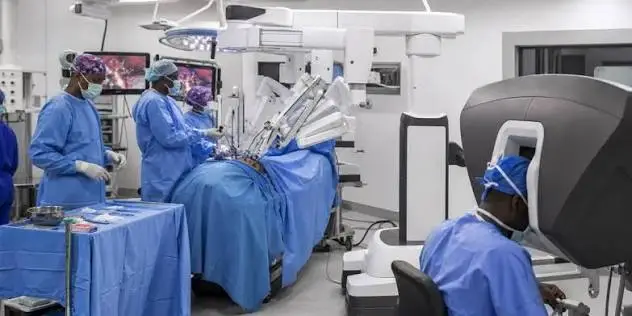
The patient remained at Nisa Premier Hospital, while Professor Obi Ekwenna-Davis, a professor of urology and transplantation and co-founder of RoboMed Global, performed the operation remotely from a Toumai robotic surgical console at RHV.
The procedure, known as a robot-assisted right radical nephrectomy, involved the removal of the affected kidney.
Unlike conventional surgery, where the surgeon operates beside the patient, Ekwenna-Davis controlled the robotic system remotely, with his movements transmitted in real time to the surgical robot in Abuja.
Tele-robotic surgery, also known as remote surgery, enables surgeons to perform procedures from another location through robotic equipment, telecommunications and real-time data transmission.
The operation lasted about three hours, with brief pauses to ensure the equipment and communication systems were functioning properly.
Ekwenna-Davis said the patient was in good condition after the operation and was expected to be discharged within 24 hours.
He stressed that the robot did not perform the operation independently, noting that the system remained under the control of the surgeon while medical teams were present at both locations.
鈥淒istance should never decide who receives safe surgery; this is what safe and trusted surgery looks like,鈥� the doctor said.
According to Ekwenna-Davis, the successful procedure demonstrated that telesurgery could be performed between different parts of Nigeria and potentially across international borders.
He said the technology could enable Nigerians to access highly specialised surgical expertise without travelling abroad, while also creating opportunities for Nigerian medical professionals in the diaspora to provide specialist care remotely.
Dr Adedamola Dada, Chief Executive Officer of Redeemer鈥檚 Health Village, described the procedure as the first telesurgery in West Africa.
Dada said the initiative was designed to demonstrate how modern healthcare technology could expand access to specialised treatment in Nigeria and help reduce medical tourism.
The procedure relied on Starlink connectivity, with MTN providing backup connectivity, according to reports. Reliable communication was critical because the surgeon鈥檚 commands had to reach the robotic system in Abuja in real time.
Dada, however, acknowledged that connectivity remained one of the challenges that would need to be addressed as telesurgery expands, noting that weather conditions, equipment quality and the availability of trained medical personnel could affect the technology鈥檚 reliability.
The achievement builds on RHV鈥檚 recent investment in robotic surgery.
Earlier in September, the hospital announced its first robotic-assisted prostate cancer surgery, with Ekwenna-Davis explaining that robotic systems allow surgeons to operate through smaller incisions while providing enhanced visualisation and precision.
The Federal Government had previously backed RHV鈥檚 robotic surgery programme, with the Minister of State for Health and Social Welfare, Dr Iziaq Adekunle Salako, describing the programme as a step towards improving advanced healthcare delivery and reducing medical tourism.
The ministry said the programme involved an investment of about $4 million and included training for Nigerian medical professionals.
Ekwenna-Davis also said a robotic academy would be established to train surgeons and other medical professionals, with a target of training at least 150 surgeons within two years.
Dr Ibrahim Wada, Chief Executive Officer and founder of Nisa Premier Hospital, said the Abuja facility had been a centre for robotic surgery in West Africa since November 2025.
He described the remote operation as an example of what could be achieved through collaboration among Nigerian medical institutions, noting that the patient received specialist surgical expertise without leaving Abuja.
The Chairman of RHV鈥檚 Board, Dr Kunle Onakoya, also stressed that robotic surgery does not mean robots independently perform operations.
He explained that the robot remains under the control of a human surgeon, with the technology magnifying the surgeon鈥檚 movements and providing greater precision.
Redeemer鈥檚 Health Village is a 300-bed multispecialty hospital established by the Redeemed Christian Church of God (RCCG).
The successful procedure marks a significant development in the use of remote surgical technology in Nigeria and demonstrates its potential to connect patients with specialised surgical expertise regardless of their location.