





By Efa Sunday
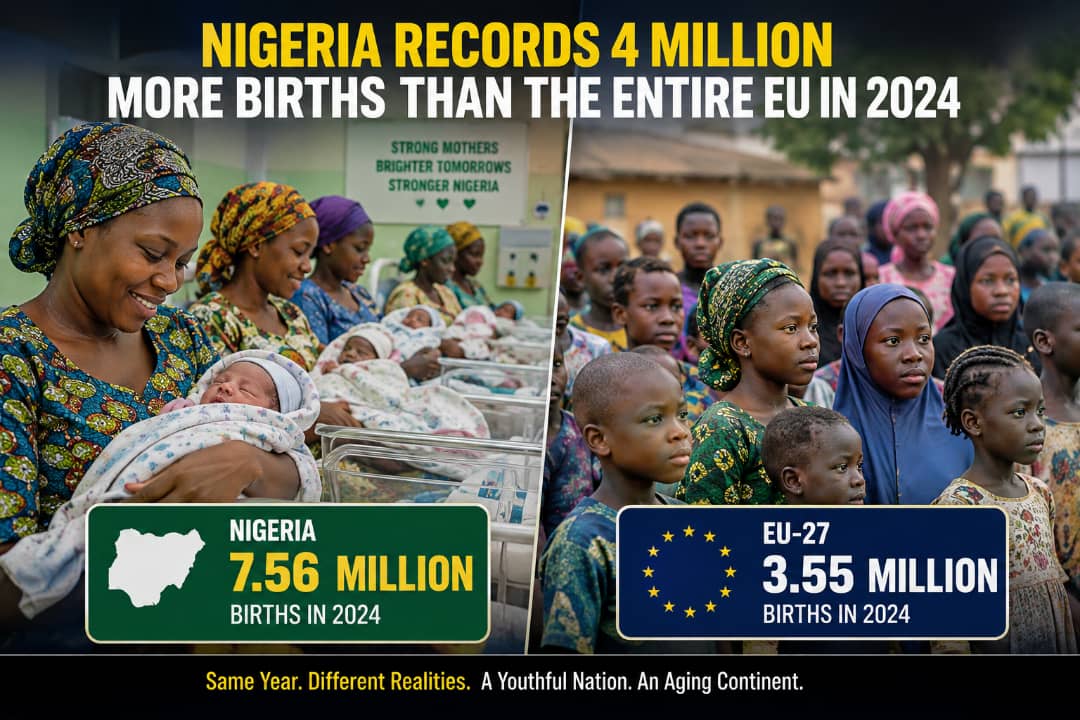
Nigeria recorded about four million more births than the entire European Union in 2024, according to demographic data from the United Nations (UN) and official statistics released by Eurostat, further highlighting the country’s status as one of the world’s fastest-growing populations.
The demographic comparison gained global attention after billionaire entrepreneur Elon Musk wrote on X that Nigeria alone recorded four million more births than the entire European Union in a single year. Musk cited an analysis generated by Grok, the artificial intelligence chatbot developed by xAI, which relied on official demographic data to support the claim.
According to Eurostat, the European Union’s official statistical agency, the 27-member bloc recorded approximately 3.55 million live births in 2024, representing a 3.3 per cent decline from the 3.67 million births recorded in 2023. The report also showed that the EU’s total fertility rate fell to a record low of 1.34 children per woman, remaining well below the replacement level of 2.1 needed to maintain a stable population without migration.
In contrast, the United Nations’ World Population Prospects 2024 estimates that Nigeria recorded approximately 7.56 million births during the same period. This means Nigeria had roughly four million more births than all 27 European Union member states combined.
Although the European Union’s population of more than 450 million is nearly twice Nigeria’s estimated population of about 230 million, demographic experts say the wide gap in annual births reflects fundamental differences in fertility patterns rather than population size alone.
Nigeria has one of the world’s youngest populations, with a median age of about 18 years and a large proportion of women of childbearing age. The country’s fertility rate, estimated by the United Nations at between 4.3 and 4.4 children per woman, remains among the highest globally.
By comparison, most European countries have experienced decades of declining fertility due to delayed marriage, rising living costs, increased female participation in education and the workforce, changing family preferences, and widespread access to family planning. Countries including Italy, Spain, Germany, Greece and Poland continue to record birth rates well below replacement level despite policies aimed at encouraging larger families.
The latest Eurostat figures show that births across the European Union have continued to decline, raising concerns about shrinking workforces, rising dependency ratios and growing pressure on pension and healthcare systems. As a result, many European governments increasingly rely on immigration to help offset the economic impact of ageing populations.
Although Nigeria’s civil registration system does not capture every birth, population experts regard the United Nations’ estimates as the global benchmark for demographic analysis. The UN Population Division compiles its World Population Prospects using national censuses, demographic and health surveys, household surveys, and available civil registration data to produce internationally recognised population estimates.
The figures also reflect broader global demographic trends. While Sub-Saharan Africa continues to account for the largest share of global population growth, much of Europe and East Asia are experiencing population stagnation or decline as fertility rates remain persistently low.
United Nations projections indicate that Nigeria is expected to become the world’s third most populous country before the end of the century, overtaking the United States, with its population projected to exceed 500 million by 2100 under the medium-variant scenario.
Demographers note that Musk’s comparison referred specifically to the European Union rather than the entire European continent. When non-EU countries such as the United Kingdom, Norway, Switzerland and Russia are included, Europe records an estimated 6.2 million to 6.3 million births annually, based on recent United Nations estimates. Even under that broader comparison, Nigeria still records between 1.2 million and 1.4 million more births each year.
The data underscore the widening demographic divide between high-fertility African countries and low-fertility, ageing societies across Europe, a trend that continues to shape global debates on labour markets, migration, urbanisation and long-term economic development.