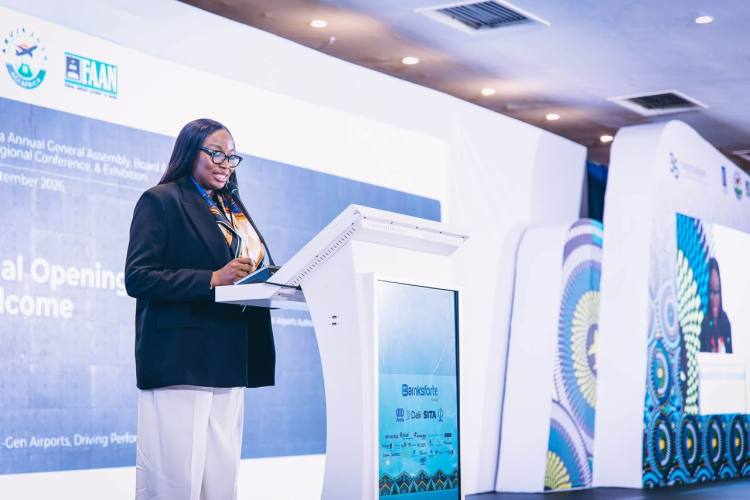










Nigeria ranked as Africa鈥檚 fourth-largest aviation market in 2025, recording more than 18.8 million domestic and international passenger movements, the Federal Airports Authority of Nigeria (FAAN) has said.
FAAN鈥檚 Managing Director, Mrs Olubunmi Onabanjo-Kuku, disclosed this at the Airports Council International Africa Regional Conference and Exhibition 2026 in Abuja.
The conference, being hosted by FAAN from September 19 to 25, brings together airport operators, aviation regulators, policymakers and other industry stakeholders under the theme, “Next-Gen Airports: Driving Performance and Resilience.”
Onabanjo-Kuku said the growth in Nigeria鈥檚 aviation market was part of a broader recovery in African air transport, although she noted that significant gaps remained between the continent鈥檚 current traffic levels and its potential.
She also cited recent growth in scheduled airline capacity in Nigeria.
According to data from aviation analytics company OAG, Nigerian airlines and carriers serving the country scheduled about 1.19 million departing seats in September 2026, representing a 37.4 per cent increase from the 864,100 seats recorded in September 2025.
OAG said Nigeria recorded the fastest percentage growth among Africa鈥檚 10 largest country markets during the period.
Lagos also recorded the fastest growth among Africa鈥檚 10 largest airports, with scheduled capacity increasing by 24.1 per cent year-on-year to about 470,000 seats in September.
Nigeria鈥檚 domestic scheduled capacity rose by 44.8 per cent year-on-year to about 877,000 seats, according to the data.
Onabanjo-Kuku attributed the increase in capacity to developments in the aviation sector, including currency reforms, new aircraft leasing arrangements and increased confidence among airlines.
She said the growth was occurring against the backdrop of rising passenger demand across Africa, citing International Air Transport Association figures showing that international passenger demand for African airlines increased by 6.4 per cent year-on-year in July 2026.
鈥淲hile global international demand actually declined by 0.1 per cent during the same period, Africa was expanding,鈥� she said.
Onabanjo-Kuku added that overall passenger demand across Africa increased by 5.2 per cent during the period.
Despite the growth, Onabanjo-Kuku said Africa still accounted for only about one per cent of global air traffic, despite being home to about 18 per cent of the world鈥檚 population.
In Nigeria, she said more than 220 million people generated about 19.5 million passenger movements annually across 28 airports.
鈥淭he potential is vast, but the gap between where we are and where we could be remains substantial,鈥� she said.
Onabanjo-Kuku said FAAN had undertaken several projects since 2023 to improve airport infrastructure and enhance passenger experience.
She listed runway rehabilitation at the Murtala Muhammed International Airport in Lagos, terminal refurbishment and airfield lighting upgrades among the projects.
According to her, the projects were carried out while flight operations continued.
She also listed the establishment of a Passenger Experience Hub, deployment of automated e-passport gates, improvements to check-in processes and the use of passenger data analytics as part of efforts to improve airport services.
Onabanjo-Kuku added that FAAN obtained ISO 9001:2015 certification for quality management and ISO 14001:2015 certification for environmental management in January 2026.
She said more than 3,500 FAAN personnel had also been trained and certified through programmes organised by the International Civil Aviation Organisation (ICAO) and ACI.
The FAAN boss said the authority had further strengthened its Directorate of Cargo Development Services to support regional trade.
Despite the increase in passenger numbers and airline capacity, Onabanjo-Kuku identified high operating costs, infrastructure gaps and limited access to capital as major challenges facing African aviation.
She said addressing the challenges would require airports to become more financially sustainable while investing in technology, infrastructure, human capital and operational resilience.
The FAAN MD identified five areas as critical to developing resilient airport infrastructure across Africa: financial sustainability, intelligent infrastructure, operational resilience, human capital development and strategic partnerships.
Onabanjo-Kuku also called for greater use of regional initiatives, including the African Continental Free Trade Area (AfCTA) and the Single African Air Transport Market, to strengthen connectivity and trade.
She urged African governments and financial institutions to establish predictable and commercially sustainable frameworks for airport infrastructure investment.
鈥淚 call upon governments across Africa to establish predictable, long-term, and commercially disciplined frameworks for airport infrastructure investment,鈥� she said.
She added that clearer mandates and greater commercial autonomy would enable airport operators to invest in infrastructure and improve services as demand for air travel continues to increase.