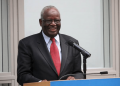










A conversation intended to set in motion a thinking process to birth an agenda in the intersection of theory and practice or academic and professionalism commenced somewhat on the 20th of November, 2018 at the Lead City University, Ibadan. This was at my post-inaugural lecture dinner that featured the seminal interrogation of the subject titled 鈥淪cholars-Practitioners Model as Game Changer in University Education鈥�. With Prof. Toyin Falola as chair, the seminar featured speakers that included the poet, Odia Ofeimun, Bishop Matthew Hassan Kukah and Profs. Akin Mabogunje, Pat Utomi, Femi Mimiko, Ayo Olukotun and Siyan Malomo. Prof. Toyin Falola had set the tone for the seminar in his article titled 鈥淧rofessor Tunji Olaopa: Broadening the Career Paths to the Academy鈥� published in Premiumtimes of November 8, 2018. What this article therefore sets out to do is to lay out some dimensions of the thoughts that will crystallize the public administration reform agenda component which was the subject of my inaugural lecture.
The point for me is that becoming a professor for all that it is worth, as a non-mainstream academic, is not an end in itself. It is not supposed to be a mere title or sinecure. This is not to say that this is necessarily a bad thing. However, I have conceived of the professorship as a much more demanding academic and life endeavor. A professorship speaks to a unique understanding of what teaching, mentoring, researching and university education require. If an average professorship possesses such a significance at these levels, what then do we say about a professorship of public administration at the juncture of theory and practice, and of academics and professionalism? What do we say about a professorship that comes with a lot of expectations that border on governance and institutional reforms as well as the role of the public service in the consolidation of democratic governance, especially in Nigeria?
This is specifically where I am coming from. The origin of this professorship was crafted in the furnace of the struggle for the institutional reform of the public service and of public administration scholarship and professionalism in Nigeria. Indeed, when I joined the public service in the 1980s, I was confronted with a host of dysfunctional dynamics which my doctoral dissertation later revealed as a series of process, capacity, resource, policy and performance gaps that support a workforce structure in which too many people do too little, too few people do too much, and too many do nothing. Institutional reform was a challenge foisted on me, and it is a challenge I have been grappling with since I came to a full grasp of its implication for democratic governance in Nigeria and the entire African continent.
I have had the good privilege of being at the very center of the theory-practice dynamics since I joined the Nigerian public service in 1988. From that time till now, and despite my retirement, I have been drawn into the robust and energetic public administration scholarship and professional practice whose foundation was laid by worthy administrators and scholars like Chief Simeon Adebo, Chief Jerome Udoji, Alhaji Sule Katagum, Mr. Allison Ayida, Prof. Adebayo Adedeji, Prof. Ladipo Adamolekun, Prof. Jide Balogun, and many more like them. Even though I was a very reluctant inductee into the Nigerian administrative vortex of the 80s, I have benefitted immensely through the dysfunction and achievements of this most resilient of all administrative systems. My insertion point into the public service system was a very active period in its evolution when administrators in Nigeria were concerned with the rhetoric, dynamics and implications of policy implementation as the basis for establishing solid governance framework for Nigeria, and for undermining what has come to be referred to as the 鈥淏ig Bad Bureaucracy鈥� that had limited the governance gains of the Nigerian state. This energetic implementation research focused on how both the context and factors affecting the implementation of policies and programmes of government enable us to understand the 鈥渨hat,鈥� 鈥渨hy,鈥� and 鈥渉ow鈥� policy interventions work in real and complex settings. It also enables the deployment of problem-solving techniques to improve the outcomes of such implementation programmes.
Apart from the initial diagnosis of the dysfunctional state of the public service, what followed was a series of further observations, which eventually molded my theory-practice meshing. One of these was that the ongoing administrative conversation at the time I was introduced to administrative professionalism was more of a revisionist longing for the notion of the glorious public service from the 60s to 1975. What was missing was a vibrant public administration interface that explores the complex relationship between theory and practice of the public service especially within a politically charged administrative context like Nigeria. This was my initial intellectual diagnosis. The administrative diagnosis came from my observation while I led the education sector analysis project and strategy work in the Federal Ministry of Education from 1999 to 2002. I confronted a reality which demanded an urgent public service system-wide rejigging of the policy architecture as well as the dynamics of rules and regulations as touching of human resource and financial management as definers of MDAs鈥� operating system. This is because implementation of policies and programmes within an integrated service with a service-wide single framework of rules, standards and regulations would always give the lie to any desire for change management.
These are in part the burdens that this professorial elevation is carrying. And these are the reasons why it cannot just be the usual sinecure that earns without giving back to the system and the community. Becoming a professor, the way I see it, simply means arriving at a different but related level of furthering the public administration agenda whose fundamental essence for me is governance and institutional reform. However, a professor is also not just a floating entity. On the contrary, the professorship is an institutional position that comes with its own responsibility in terms of research, pedagogy and mentorship. And these are the immediate point of my duties at the Lead City University (LCU). Thus, whatever agenda I need to unfold must cascade outward in a series of concentric cycles of responsibilities from the University outward to other communities of practice and then eventually to the public service system itself as the focal point of reform convergence and transformation.
In the first instance, therefore, my professorial agenda is hinged on the founding of a unique understanding of university education foregrounded on a scholar-practitioner model that pulls the rug from under a pedagogy that is essentially too academic and theoretical. This new understanding of pedagogy will require a large transdisciplinary research framework, first within the Faculty of Management and Social Sciences that will serve as the hub for the cross-fertilization of ideas and the interrogation of ideas and insights concerning public administration scholarship and the wide range of ideas underpinning my reform models and paradigms. My reform and administrative scholarship has been founded on three levels of issues: (a) The first level is the material/infrastructural or the macroeconomic reform level which include the system of production, distribution, consumption and exchange; (b) The second level comprises of the institutional dimension involving the system of institutions, organisations, the procedural mechanisms underlying democracy and so on; and finally, (c) The third, super-structural level involving social relations, culture, values, beliefs and attitudinal orientation of the people. Interventions at these three levels demand the rigorous exchanges at both the academic and the professional levels that bring together academics, intellectuals, scholars and professionals in a unique way that enable the Faculty of Management and Social Sciences and I to commence the building of a community of theory, service and practice that leverages on vast national, regional, continental and global networks, collaborations and experiences as a means of engaging with the three levels of reflective, intellectual and professional thinking about Nigerian and her democratic experiment.
This transdisciplinary approach is very cogent because of the increasing presence of an anti-intellectual attitude especially among pubic administrators and public policy practitioners. There is a kind of a mutual resentment within the public policy space and the academia, which puts an unnecessary divide between the academics and the practitioners in the understanding of the dynamics of public administration or any other professional or disciplinary domain. It is exactly this lacuna that constitute part of the inaugurating agenda for the Ibadan School of Government and Public Policy (ISGPP). In bringing together academics, professional, scholars and practitioners, the ISGPP has the objective of building a large community of practice that will enable it reinvent the framework of a mutually engaging, productive and rewarding collaborative partnership that the old administrative pioneers like Udoji and Adebo explored with immense benefits for public administration and the public service. This partnership is the essence of town-and-gown research-policy partnership that will form the base of my pedagogic and research intervention at LCU.
There is a critical dimension of this transdisciplinary framework that remains dear to my heart. And this is the humanities-social sciences (HSS) relevance question which disconnect the fields from the entire issue of national development in Nigeria. All over the world, and especially in North America, development curriculum is now configured in terms of the STEM (Science, Technology, Engineering and Mathematics). The dysfunctional and development limiting rendering of the STEM curriculum seems to render the HSS irrelevant in the development equation. The transdisciplinary dynamics enables the Faculty of Management and the Social Science to weigh into this issue in terms of collaborative researches and interventions in the national development matters.
It is inevitable that the scholar-practitioner model give birth to several other collaborations. The first that I envision is the LCU-ISGPP graduate programme that will be truly radical in the reinvention of especially public administration curricula and graduate studies. The scholar-practitioner model is basically an operational model which is founded on the practical and pragmatic application and implication of the knowledge generated by scholars and in scholarly institutions. The important point behind this model is that knowledge is not relevant for its own sake. Its relevance derives from its deployment as a problem-solving rubric. The dominant feature of this model is that it relates research with significant practical experience in a way that transforms how we think about clinical psychology and its practices. The model encourages an increasing professionalization of the existing curriculum and pedagogical dynamics. This models will enable the graduate programme incorporate the vast package of professional and practitional experience that those who have served the public could bring to bear on what we learn about public administration in theories.
The final item on the professorial agenda I have is to reconnect public administration back into the dynamics of a community of practice in Nigeria and Africa. And the center-point of this reconnection is the rehabilitation of the National Association of Public Administration and Management (NAPAM). This association has remained comatose for many years. And hence it has failed to, first, to serve its original objective as the gatekeeper of the public administration scholarship in Nigeria; and second, it has also failed benefit from a growing associational capital that ought to have linked it to other associations and community of practice across the continent: Centre Africaine de Formation et de Recherch茅 Administrative Pour le Development (CAFRAD), Commonwealth Associations for Public Administration and Management (CAPAM), African Associations for Public Administration and Management (AAPAM), the African Capacity Building Foundation (ACBF), and so on. NAPAM has the capacity to serve as the engagement space that facilitates the interaction between theory and practice, and between academics and professionals. Indeed, NAPAM is critical to the urgent need for the re-professionalization of the public service in Nigeria. And beyond this, it is indispensable to the need to take public administration scholarship to the next level that will connect it with the global and continental academic practice.
There is a daunting task ahead that is necessitated in itself by the enormity of the dysfunction at the levels of professional practice and academic scholarship on public administration. On the other hand, the excitement and enthusiasm, for me, derives from the immense possibilities that comes from exploring the dynamics of institutional reform from a different dimension. And my excitement comes from the fact that I now have available to me as a professor of public administration a multilevel support and resource structure that promises to yield more for realizing the vision of institutional reform that Nigerian requires to become a real democratic nation.
Prof. Tunji Olaopa is Executive Vice-Chairman, Ibadan School of
Government &Public Policy (ISGPP) Ibadan
[email protected], [email protected]