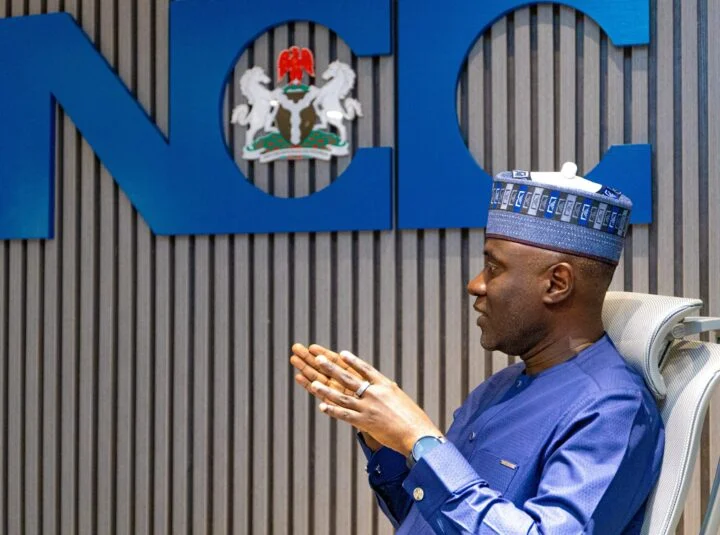
The Federal Ministry of Works (FMoW), Federal Ministry of Communications, Innovation, and Digital Economy (FMoCIDE), and Nigerian Communications Commission (NCC) have established a Joint Standing Committee on the Protection of Fiber Optic Cables to address the persistent issue of fiber optic cuts and damages caused by road construction and rehabilitation activities.
This was contained in a statement issued on Monday by NCC’s spokesperson, Dr Reuben Muoka.
He noted that these disruptions have had a significant negative impact on telecommunications services across Nigeria.
According to Muoka, the Joint Standing Committee on Protection of Fiber Optic Cables was inaugurated on Tuesday聽 February 18, at the boardroom of the FMoW, by the Permanent Secretary,聽Engr. Olufunso Adebiyi; his counterpart at the FMoCIDE, Engr Farouk Yusuf, and the Executive Vice Chairman (EVC)/Chief Executive Officer (CEO) of the NCC, Dr. Aminu Maida.
The committee is comprised of key staff from the two ministries and the NCC.
“The main assignment of the joint Standing Committee is to聽establish and maintain clear communication/co-ordination channels between the two ministries and the NCC in order to limit and prevent damage to telecommunications fiber optic cables during road constructions or rehabilitation activities,” the statement read.
While inaugurating the Committee, Adebiyi directed it to establish modalities to ensure the reduction of damage to deployed fiber optic cables resulting from road construction and maintenance activities, as well as vandalism which has caused severe incidences of service disruption across the country.
He said the Committee will serve as a coordinating body for all issues pertaining to the protection of fiber optic cables, before, during and after the completion of road constructions or maintenance activities, and will meet on a regular basis to discuss identified problems, agree on industry-wide solutions, set standard engagement processes and procedures, as well as share monthly performance reports.
鈥淭hey are also expected to develop an instant communication mechanism to facilitate prompt communication and dissemination of information amongst all stakeholders,鈥� he added.
The permanent secretary assured that going forward, the ministry will ensure that the placement of fiber cables will be considered in the planning, design and construction of the country鈥檚 road networks, and would include providing for ducts during constructions.
He further stated that the committee will work closely with all Federal Controllers of Works (FCW) to give attention to the task of protecting this sensitive infrastructure聽during the聽planning and implementation stages of projects across the roads in the country, while aligning with the telecoms operators on all ongoing and future projects.
Yusuf, in his remarks, highlighted the significance of fiber optics cables to the country鈥檚 economy, stating that fiber networks are the backbone of Nigeria鈥檚 digital economy, enabling the seamless delivery of both fixed and mobile broadband services essential for nationwide connectivity, economic growth, and technological innovation.
He noted that the committee鈥檚 work is crucial to ensuring that telecoms services are not hampered by the work of construction companies.
The EVC/CEO of聽NCC, Maida, emphasised the significance of the committee鈥檚 mandate, noting that it has the potential to significantly reduce service disruptions across Nigeria鈥檚 telecoms industry.
鈥淭his is a pivotal moment for the telecommunications industry and its customers. Fiber networks are the foundation of Nigeria鈥檚 broadband ecosystem, providing the essential high-capacity backhaul required to deliver ultra-fast 4G and 5G speeds, as these next-generation mobile technologies rely on fiber infrastructure to ensure low latency, high reliability, and seamless data transmission.
鈥淟ast year, we experienced over 50,000 fiber cuts incidents across the country, of which around 30,000 were attributed to federal and state road construction activities. In the extreme, some of these incidents had led to major network outages like the February 2024 nationwide MTN network outage.
鈥淎 key contributor to the increasing number of fiber cuts attributed to road construction activities is the lack of an efficient handshake mechanism between road construction companies and operators of the fiber infrastructure.
鈥淚 am optimistic that the work of this committee will lead to a significant reduction in fiber cuts attributed to road construction, which would then reduce network outages, avoid unnecessary expenditure on repair works and reduce the need to put redundant routes in place to serve as alternatives whenever there are outages due to fiber cuts.
鈥淭his initiative is not just for the benefit of the telecommunications industry but for all Nigerians. Every time a fiber cut occurs, consumers experience service disruptions. The industry is forced to invest in costly redundancy measures, but if we can prevent these avoidable disruptions, operators can redirect resources towards network expansion and infrastructure improvement,” Maida stated.