






By Oyeyinka Fabowale
* As nationwide strike looms on campuses amid FG’s intransigence
Home-bored undergraduates and prospective freshmen may have longer to wait to resume or enjoy seamless studies unless the Federal Government urgently meets the demands of the Academic Staff Union of Universities (ASUU) to avert a planned strike by the university teachers in barely a week’s time.
Already, ASUU has begun mobilising its members across the nation for the long-drawn work boycott, amid government’s alleged continued snubbing of the resolutions of its National Executive Council (NEC) meeting on September 28 in Abuja which reviewed and ratified the outcome of a plebiscite and the decision of its branches nationwide to go on strike.
The teachers had voted strike as the inevitable option to force the government to honour outstanding commitments and core provisions of its agreement with the union on staff welfare, funding and improved conditions of service for sustainable university system.
Although the pact was signed in 2009, successive government failed to implement them faithfully, stirring occasional industrial unrest and disrupting academic activities on the campuses.
ASUU leaders are disappointed that the situation has not changed under President Bola Tinubu, despite his promises while seeking election to decisively address the concerns. If anything, the official nonchalance and contempt seemed to have grown worse, complained the Chairman of ASUU, Obafemi Awolowo University, Ile Ife, Prof Tony Odiwe.
The ASUU boss said the strike notice communicated by the Union’s National President, Prof. Christopher Piwuna, was the climax of a series of efforts to resolve the industrial dispute but which were consistently spurned by the government.
He cited series of committees raised to negotiate the modalities of implementing the agreement聽 culminating in the submission of a report in February this year by the last one headed by Yayale Ahmed. He, however, regretted that despite the panel reportedly meeting for months, the government refused to act on its recommendations.
Odiwe further聽disclosed that a few Nigerians had intervened and tried to stave off the imminent crisis but that the Federal Government had remained recalcitrant.
The ASUU leader said the union had so far been patient, understanding shown restraint, aware of the disruptive consequences any industrial action would have on the system, students and their parents, especially in the present dire economic condition.
But government, he regretted, has not reciprocated the gesture.
“Since February nothing was done. Instead, the government has tried to blackmail ASUU. They kept on lying that they have met all our demands.
“We kept on waiting and waiting, giving the authorities the benefit of the doubt. But we realized that they were insincere and since we cannot continue to suffer and watch the conditions of the work environment deteriorate than it has, we gave them a three-week ultimatum which lapsed on September 25. This was also treated with levity, hence the referendum. Now, here we’re. Three weeks have聽 become one month,” he said.
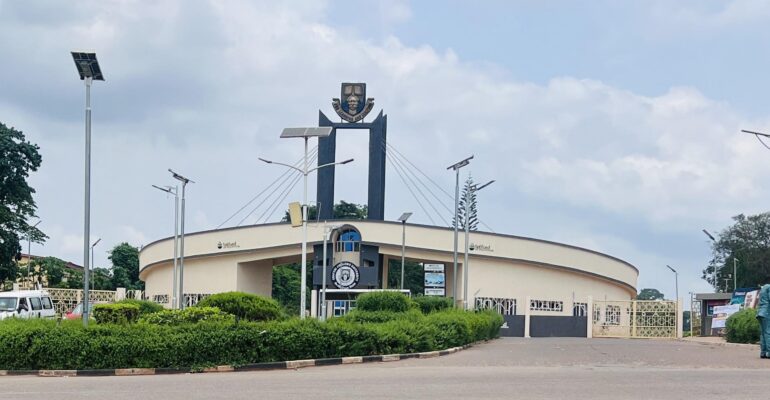
OAU main gate
Quoting a document, Strike Bulletin Number 1, issued on Sunday by its national executive, the president said although ASUU decision to embark on a strike was promptly communicated to relevant government including the Education Minister and the Nigeria Labour Congress (NLC), there has been 鈥渘o meaningful development deserving of any consideration to be reported.”
The ASUU boss said ASUU members’ forbearance was over after eight years of fruitless negotiations and government’s indifference to their plight.
As the deadline for the strike to commence shrinks to barely few days hence, Odiwe, a Professor of Botany said that the Federal Government must be held responsible for any disruption of peace and academic activities in the universities in the coming week.
“It must be said that ASUU is not a strike monger, we’re not desperate or interested in going on strike. We have only been forced to recourse to this option because we too are human beings and deserve to be treated as such. We’re citizens of this country, we’re stakeholders and deserve decent wages and conducive working conditions to keep the system running.
“If Nigeria wants to develop, it needs to pay adequate attention and care to the university system where ideas for its development are incubated and where the needed manpower is grown. We have lost many of our colleagues, brilliant scholars to the brain-drain. They are out there using their expertise which is more needed here in Nigeria to further develop other countries which are already developed. The least that could be done is to encourage those of us left or who chose to stay back with reasonable remuneration. The salary of Nigerian lecturer ranges between $300 and $350 making it one of the lowest in Africa,” he said.
Prof Odiwe also criticised perceived aloofness of the average Nigerian parents on the issue which is crucial to effective training and future of their children and wards. According to him, they are hardly interested in the conditions under which their children learn, how adequate the infrastructure and learning facilities not to talk of the welfare of lecturers who impart knowledge to them.
“Many tend to forget that we are parents too. I have two children I’m training at UNILAG (University of Lagos) and I also want the best for them too,” Prof Odiwe added.
He charged them to show greater concern and join in the appeal and effort to prevail on government to do the needful to save and advance the universities.
The looming strike, if not timely checked, could once again throw Nigeria鈥檚 public tertiary academic institutions into a tailspin, reigniting the recurring industrial crises that have continued to plague the education sector and eroded the worth and global competitiveness of the nation’s graduates.