





Akinwande Soji-Ojo
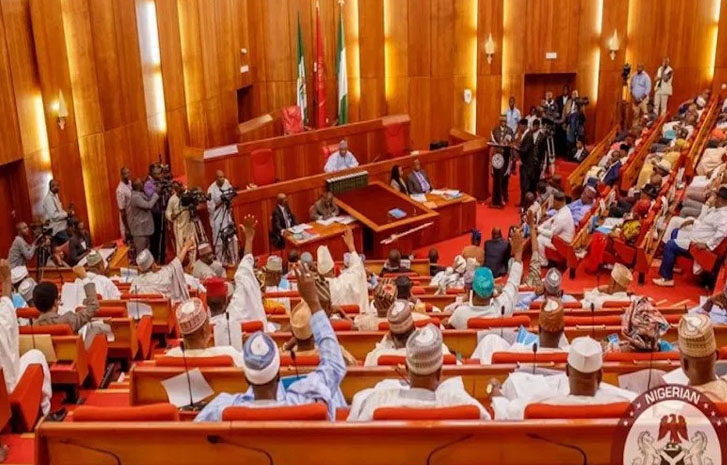
The Senate on Wednesday passed the Constitution Alteration Bill seeking to establish state police across the federation, marking a significant milestone in Nigeria’s long-running debate on decentralising the country’s policing structure to tackle worsening insecurity.
The landmark legislation was approved after a clause-by-clause consideration of the bill and a manual voting process in which more than two-thirds of senators voted in support.
Senate President, Godswill Akpabio, announced the passage of the bill during plenary after lawmakers overwhelmingly backed the proposal.
The upper chamber approved the legislation after considering the report of the Senate Committee on the Review of the Constitution, presented by Deputy Senate President and Committee Chairman, Barau Jibrin.
The bill was first considered at the Committee of the Whole before lawmakers adopted its provisions and proceeded to a final vote.
Leading debate on the legislation, Senate Leader, Opeyemi Bamidele, urged senators to support what many lawmakers described as a critical reform aimed at strengthening internal security and improving responses to local threats.
The bill seeks to establish a state policing framework that will operate alongside the existing federal police system, effectively ending the Federal Government’s exclusive control of policing.
A key provision of the proposed constitutional amendment empowers state governors to appoint Commissioners of Police for their respective states, subject to confirmation by their Houses of Assembly.
Under Clause 17 of the bill, “while the Federal Police Service will continue to be headed by the Inspector-General of Police, each State Police Service shall be headed by a Commissioner of Police appointed by the governor and confirmed by the legislature of the state.”
The legislation also defines the relationship between governors and state police commands.
Section 17(6) states that “a governor may issue lawful written directives of a general policy nature to the Commissioner of Police on matters relating to the maintenance of public safety and public order within the state.”
To address concerns that state police could be abused by governors for political purposes, lawmakers incorporated safeguards aimed at protecting political freedoms and civil liberties.
Section 17(7) provides that “a state Commissioner of Police shall not arrest, detain, investigate or deploy force against any person, political party or group merely for criticising the government except in accordance with the law.”
The provision is intended to prevent state police formations from being used against political opponents, activists, journalists and dissenting voices, while ensuring that all actions comply with due process and existing laws.
The bill was passed shortly after the Senate abandoned plans to use an electronic voting system for constitutional amendment proposals, including the state police bill.
Lawmakers instead adopted a manual voting process following concerns that technical glitches affecting some voting devices could disenfranchise senators and undermine the integrity of the exercise.
Bamidele moved the motion for manual voting, arguing that every senator should be given an equal opportunity to participate in what he described as a historic vote.
Akpabio supported the proposal, saying an open voting system would guarantee full participation and allow Nigerians to know where their representatives stood on key constitutional issues.
Following the adoption of the motion, senators were called individually to publicly declare their votes during the consideration of the constitutional amendment bills.
Several top government officials witnessed the proceedings, including Kaduna State Governor, Uba Sani; Ogun State Governor Dapo Abiodun; Ondo State Governor, Lucky Aiyedatiwa; and President Bola Tinubu’s Chief of Staff, Femi Gbajabiamila.
The successful passage of the state police bill is regarded as one of the most significant constitutional reforms undertaken by the 10th National Assembly and is expected to reshape Nigeria’s security architecture if it secures the required approval of state Houses of Assembly and completes other constitutional processes.
Supporters of state policing have long argued that the country’s centrally controlled police structure is overstretched and unable to effectively tackle challenges such as banditry, terrorism, kidnapping, communal clashes and other forms of criminality.
However, critics have consistently warned that state police could be used by governors to intimidate political opponents and suppress dissent.
With the Senate’s approval, Nigeria has crossed a major legislative hurdle in its quest to establish state-controlled police services operating alongside the federal police system.