





Akinwande Soji-Ojo
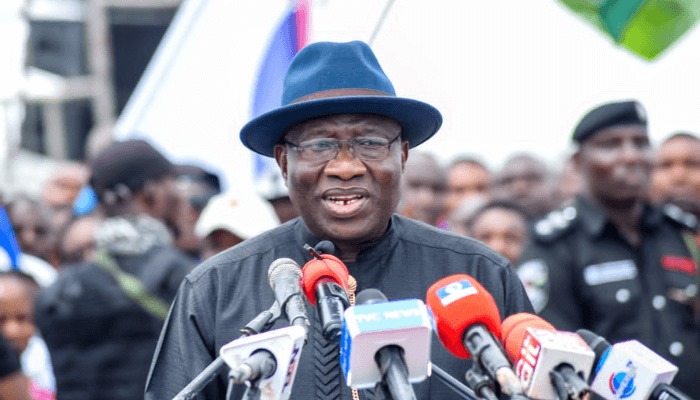
Former President Goodluck Jonathan has said Nigeria was not getting accurate vote counts during elections due to the involvement of those he described as “ghost voters.”
Jonathan stated this at the YIAGA Africa Reflection Conference on Democratic Elections in West Africa, held in Abuja, on Tuesday.
He said it is better and more honourable for the chairman and other officials of the Independent National Electoral Commission (INEC) to resign rather than yield to pressure to manipulate elections.
According to the former president, the nation鈥檚 electoral system will continue to grapple with a credibility crisis, until there are men of integrity in INEC, who will rather resign than succumb to pressure to rig polls.
鈥淚n Nigeria, you can鈥檛 get an accurate count of votes because I believe that we have too many ghost voters.
鈥淲e must have credible people. From what (ex-INEC Chairman, Attahiru) Jega said, political leaders who are so domineering will pressurise you to do what is wrong; you should be able to resign and leave. You should be able to resign and walk away, please.
鈥淚f we don鈥檛 have this kind of people, then we are in trouble. And I don鈥檛 want any INEC official to say I was pressurised. If you are accepting to be chairman of INEC or to be a commissioner of INEC, then you should be ready to say, 鈥榠f I鈥檓 pressurised to do what is wrong, I will take care of the democratic people and walk away.鈥�
And if we don鈥檛 have such people managing our electoral management bodies, if what we have are people who will continue to go in a circle, we will not get what we want,鈥� he said.
Jonathan emphasised that without strong and ethical leadership in electoral management, the electoral system would remain flawed.
He called for a robust electoral system that works to ensure credible elections.
鈥淲hen both parties are strong, and the system cannot be manipulated, only real human beings will cast and their votes will count,鈥� he affirmed.
The former president also criticised the regionalisation of the electoral process, stating that it is a major hindrance to Nigeria鈥檚 desire to elect capable leaders.
He noted that regionalisation has deeply infiltrated the system, affecting all facets, including religious groups.
鈥淪ometimes, if I listen to the prediction by religious men and women and so on, their predictions tend to go towards the regional interest. So, when the electoral process is so regionalised, we are going to have issues. And that will be controlled by de-emphasising sort of key areas.
“If our systems of electing our leaders are not fine-tuned to the level that the voter card will work, then what will be so great about democracy? 鈥渇 our systems for electing leaders are not fine-tuned, then what is the point of democracy?鈥� Jonathan queried.
He stressed the importance of improving the voter registration system and electoral processes to ensure that democracy functions effectively.
Jonathan added that Nigeria must set an example by conducting clean and peaceful elections as a country wielding so much influence in the West African sub-region.
He recalled the logistical issues, delayed voting in some areas, violence and technical glitches that marred the 2023 general elections despite the introduction of the Bimodal Voter Accreditation System and the Results Viewing Portal by INEC to enhance transparency.
The former president also pointed to the challenges confronting elections in Sierra Leone and Senegal, where allegations of irregularities, including voter intimidation, ethnic tensions and controversial results undermined the polls.
鈥樷�橪ate last year, Ghana conducted general elections which were indeed successful, despite the application of limited technology. The country, with a reputation of being one of Africa鈥檚 most stable democracies, lived up to this billing by conducting peaceful polling and smooth transfer of power.
“The Electoral Commission of Ghana and the security authorities played a crucial role in ensuring the elections were free, fair, and transparent, thereby demonstrating that Ghana鈥檚 democratic institutions and processes have continued to be resilient, even with limited technology.
鈥淭wo other countries, Liberia and Senegal also conducted general elections with limited deployment of technology. In these countries, the processes were generally peaceful, transparent and credible with a high voter turnout.
鈥樷�橧n the case of Liberia, incumbent President George Weah conceded defeat to the opposition candidate, Joseph Boakai, after a closely contested runoff, setting a positive example for democratic transitions in the region.
鈥樷�橳he pre-election period in Senegal was notably marred by protests, arrests of opposition figures, and concerns about the independence of the judiciary. However, it was pleasing to observe that once the election process kicked in, the polling processes progressed without hitches, resulting in a free and fair outcome,” he said.
He noted that the high voter turnout in Liberia, Senegal and Ghana as well as a peaceful transition of power in these countries demonstrated public enthusiasm for democratic participation and consolidation.
鈥樷�橧t is instructive that in countries where more technology was deployed, like Nigeria and Sierra Leone, the electoral process threw up more agitations, legal battles and political tensions.
鈥樷�橳his development, therefore, underscores the place of the human element in deepening the roots of democracy. It shows that the deployment of technology, no matter how elaborate or sophisticated, may not deliver the desired outcomes without the proven will of the authorities and the citizens to do the right thing,鈥欌�� the former president said.
Jonathan advocated robust youth participation in the electoral process, strong and independent electoral institutions and electoral reforms as well as efficient use of technology.