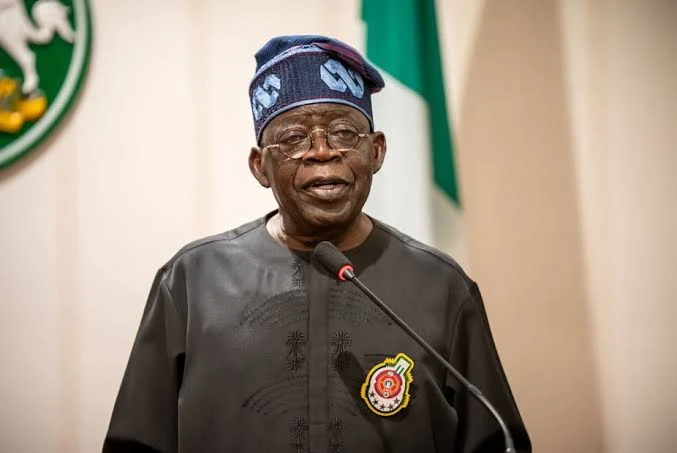
Nigeria’s Permanent Representative to the United Nations, Jimoh Ibrahim, has defended President Bola Tinubu’s absence from the 81st session of the United Nations General Assembly (UNGA), saying the president should not travel to New York merely to deliver a 15-minute speech.
Ibrahim spoke on Beyond The Headline, a Television Continental (TVC) programme, on Thursday.
His comments followed criticism of Tinubu’s decision to stay away from the high-level session for the third consecutive year.
Minister of Information and National Orientation, Mohammed Idris, had said Tinubu would not attend the 81st UNGA because he was on annual leave.
Idris said Tinubu had mandated Vice President Kashim Shettima to lead Nigeria’s delegation to the high-level session in New York, United States.
Former vice president and presidential candidate of the African Democratic Congress (ADC), Atiku Abubakar, had criticised Tinubu’s absence from the gathering.
Atiku questioned the president’s decision to stay away from the general debate for the third consecutive year, saying Tinubu’s “persistent avoidance� of the United States raised questions.
The former vice president also questioned why Tinubu did not attend after Ibrahim reportedly said arrangements had been made for the president to sit close to US President, Donald Trump, during the general assembly.
Atiku further linked Tinubu’s absence to his past legal history in the US and asked: “Is Tinubu afraid that he could become Donald Trump’s next Nicolás Maduro?�
However, Ibrahim said Tinubu’s absence should not be considered a major issue, noting that many presidents of other countries also did not attend the gathering in person.
“What do you think President Tinubu is coming to do?
“The presidents are allowed in the UN under UNGA for 15 minutes. Is that the reason why he should board the flight and be here for 15 minutes?� he asked.
Ibrahim said Shettima had represented Tinubu at high-level meetings and had also met with Nigerians in the diaspora, describing the engagements as appropriate.
“This is the kind of engagement we want, not that the president will just be inside the plane and be coming to UNGA for a 15-minute speech. What is the meaning of that? We don’t want that,� Ibrahim said.
The envoy, who was appointed chairman of the Budget and Administration Committee for the UNGA’s Fifth Committee in June, said 60 per cent of those on the speaking list at the gathering were foreign affairs ministers and vice presidents.
“As permanent representative of Nigeria to the United Nations, if I’m to do a memo to the president at the last minute of boarding the plane to go to UNGA, do you think I will recommend the president to be on his way when 60 per cent of the speaking list of 193 countries are ministers and vice-presidents representing their countries?� he asked.
Ibrahim added: “There are exigencies. If the speaking list is 90 presidents, maybe, of course, the president can come. I don’t think the president should come and be where his equivalent is a minister of foreign affairs of another country.�
Ibrahim also said Nigeria occupied a prominent position at UNGA, arguing that Tinubu’s physical presence was not necessary for the country to make an impact.
“I promise that Nigeria will be on the front-row seat at UNGA. Are we not on the front-row seat? Nigeria is sitting at number eight seat in the UN under UNGA and America is at number 26th seat at the back of Nigeria’s seat.
“And you know, Donald Trump didn’t go to sit on his own seat. He came in to give a lecture at the UNGA and went back from there.
“Are you saying that Nigeria is not making the impact it is supposed to make globally? Must we have President Tinubu here before we can make the impact?� the envoy said.
Speaking on the composition of the speaking list, Ibrahim said reforms were being planned to increase the impact of the United Nations on member-states.
“That is the reform we are taking on effective from October 1st. When I chair the budget and administrative committee, 90 per cent of UN resources is spent at the headquarters, while 10 per cent goes to member-states.
“So legitimacy is reduced because member-states are not seeing impacts of the United Nations. We are going to reverse that,” he said.