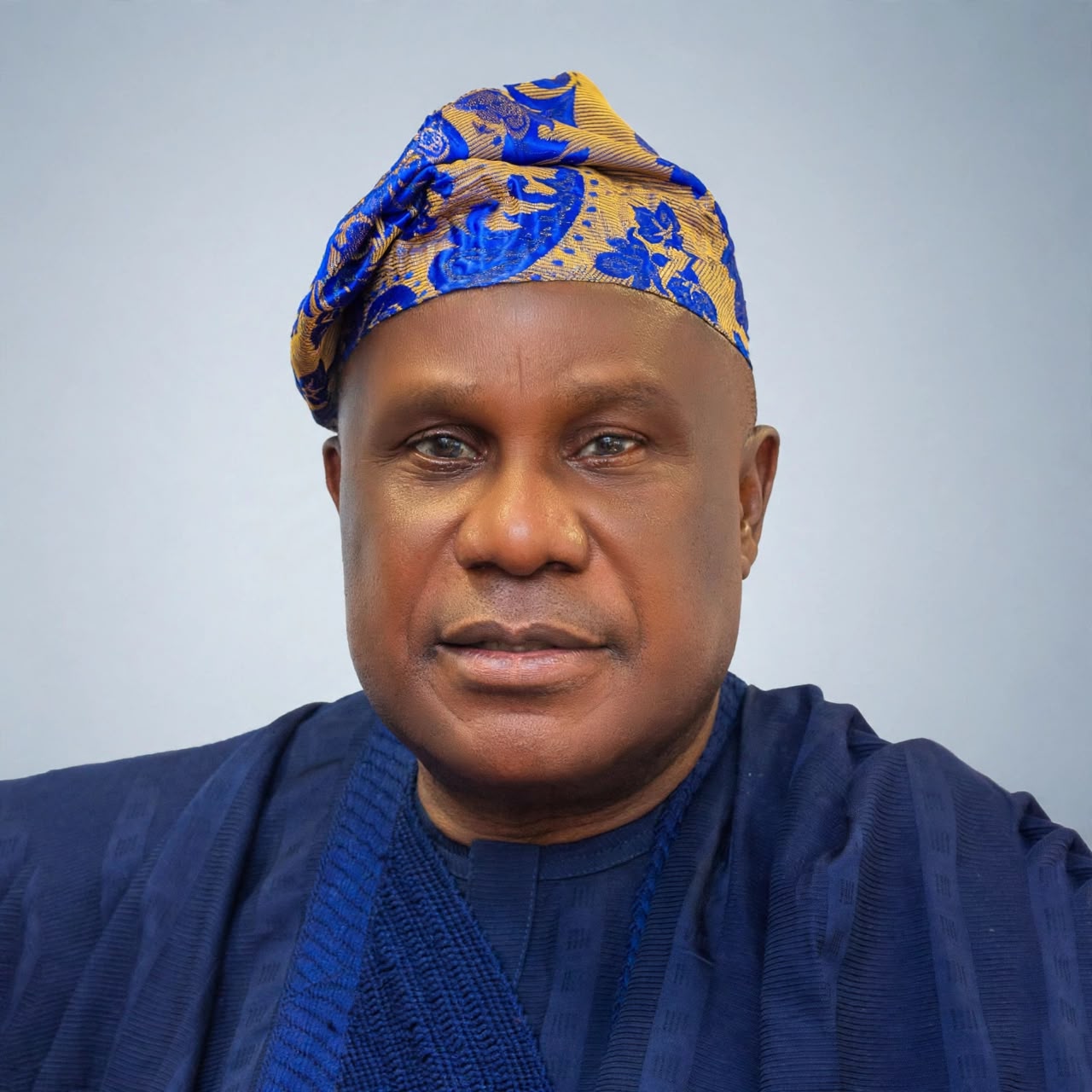
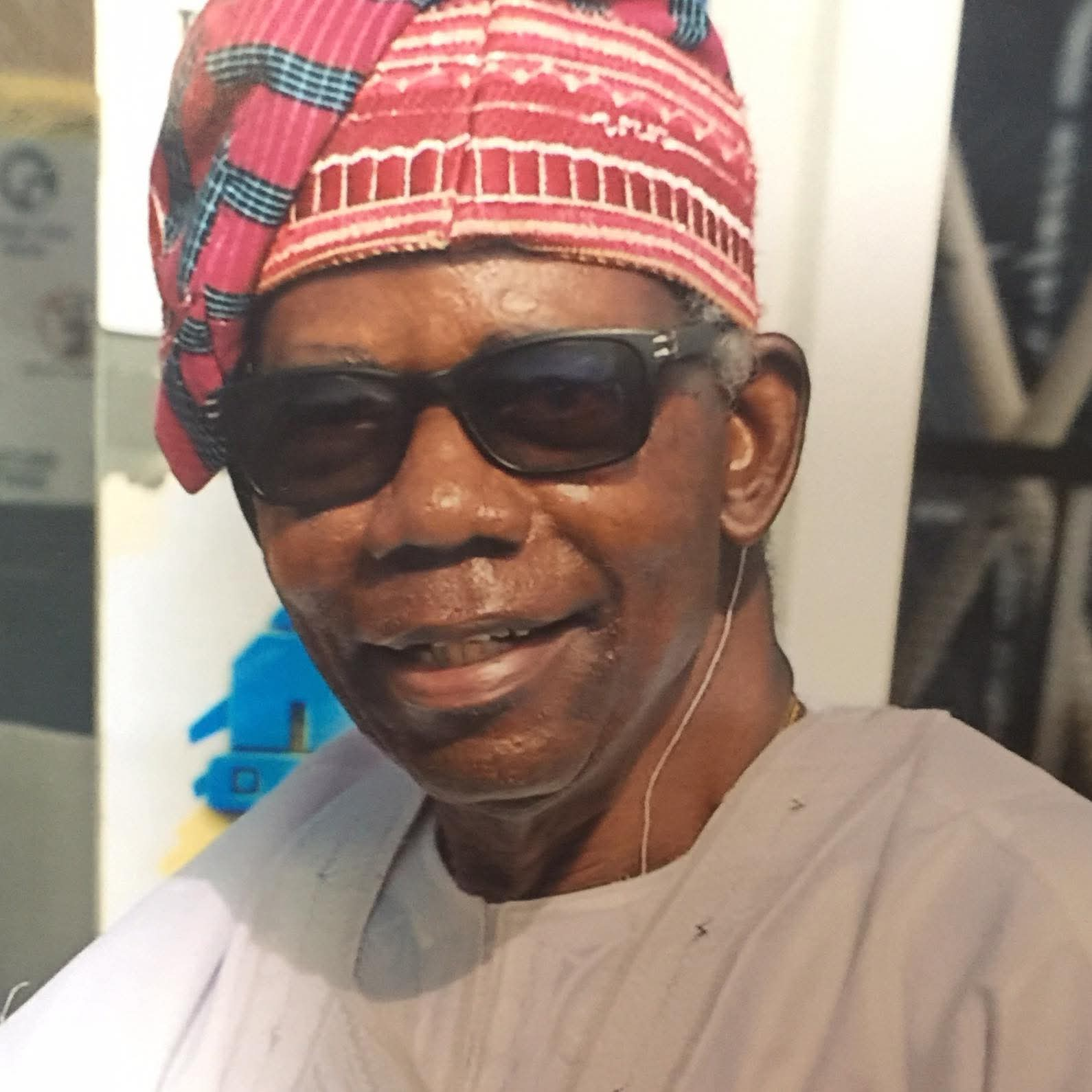
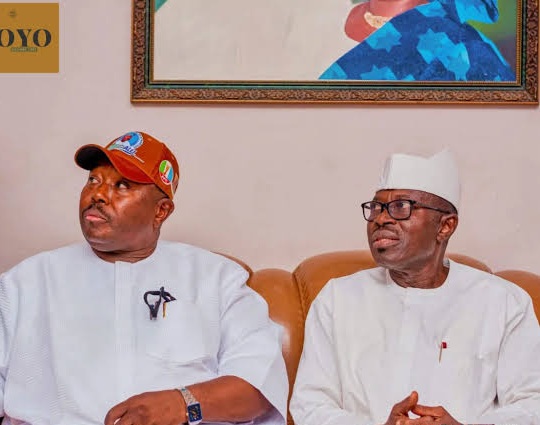
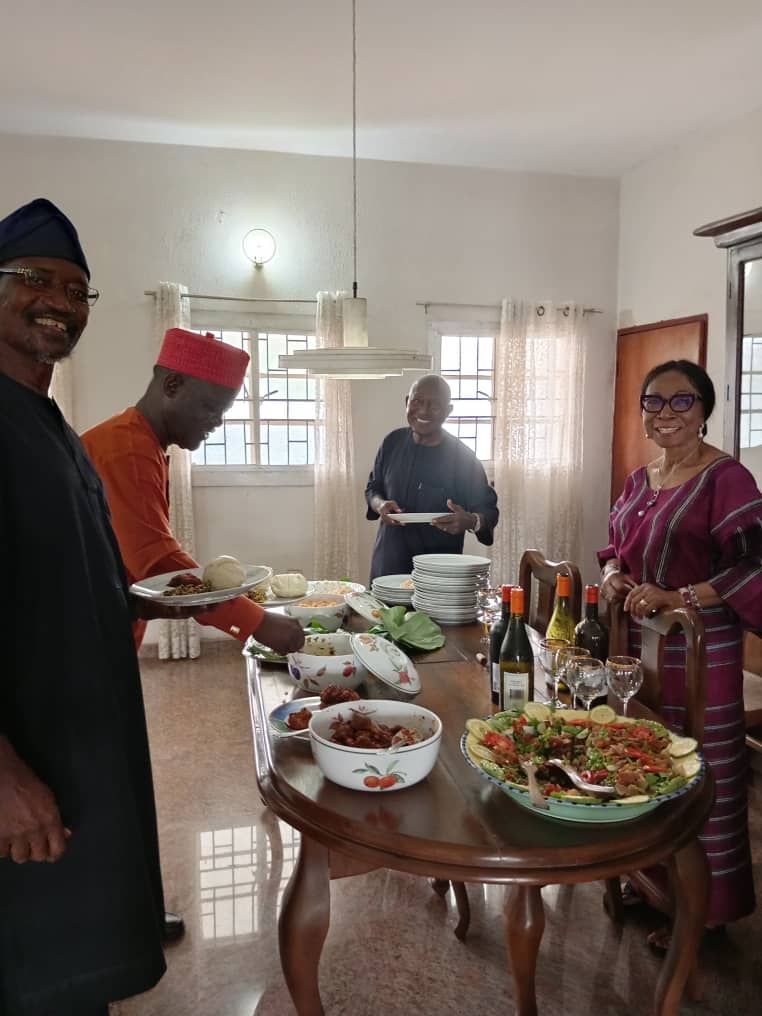
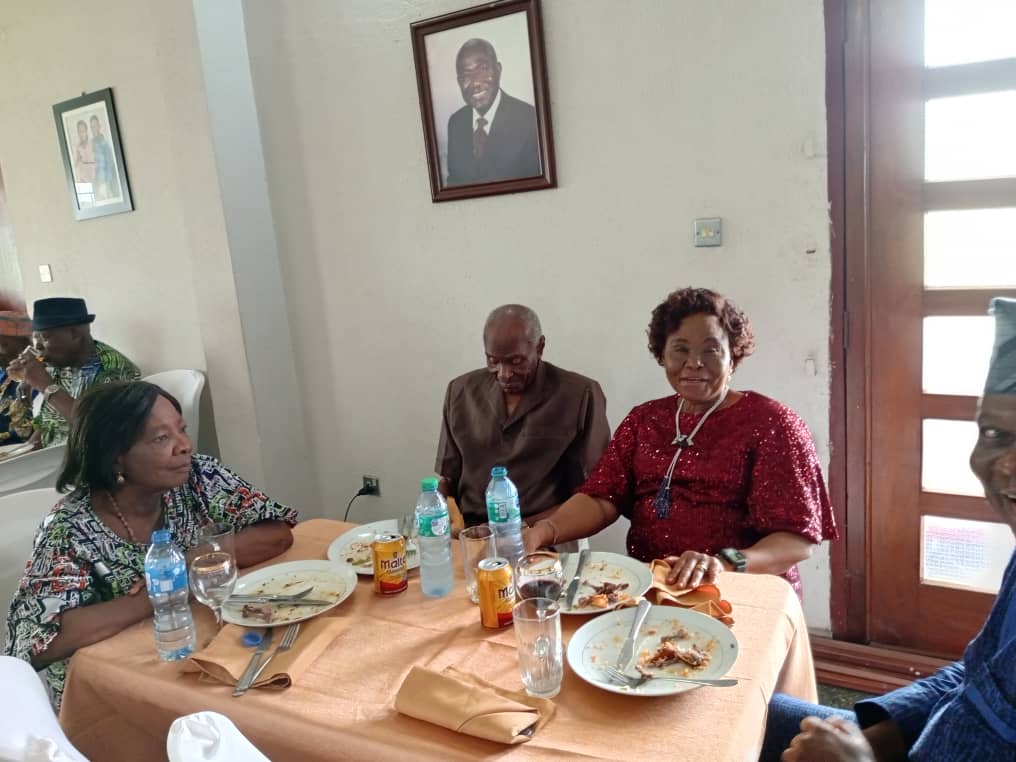
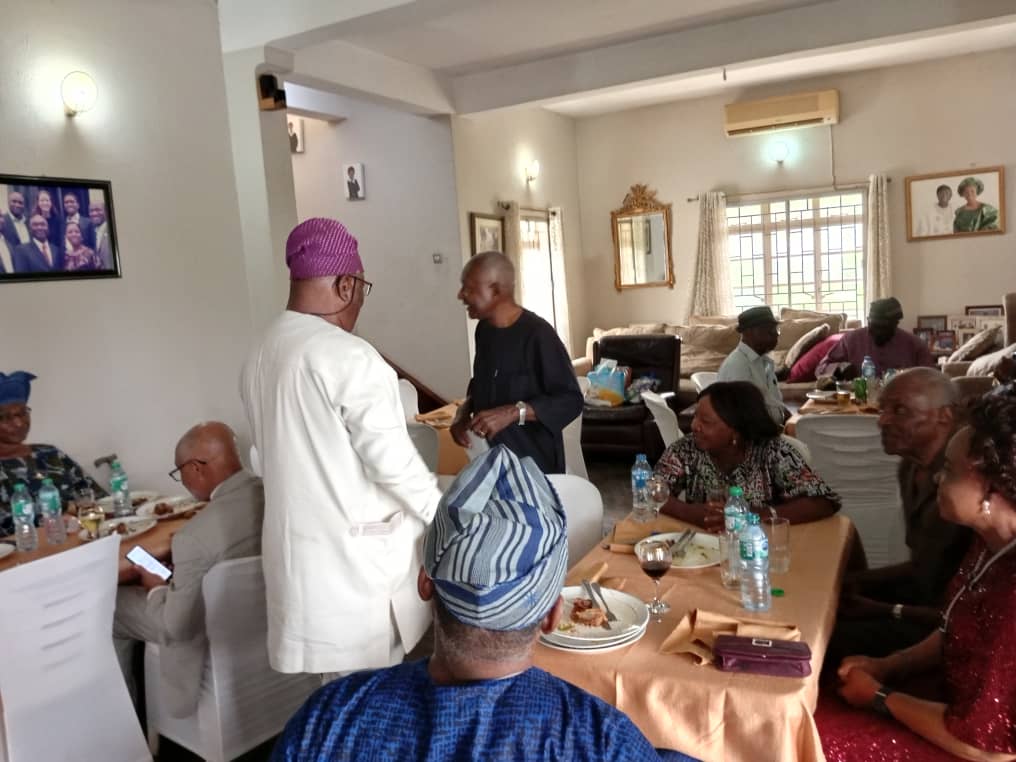
Dr. Stephen Lawani, author, scholar, newspaper columnist and founding Director of Information Services at the International Institute of Tropical Agricultural (IITA), recently turned 80 and true to his character marked the event by hosting few friends and family members to a luncheon at his Jericho home in Ibadan.
The low keyed celebration was attended by intellectuals, professionals, past and present top government officials and industry players who extolled Dr. Lawani”s personal qualities and contributions not only in his field of information science, but also in the literary arts and spiritual enlightenment.
The list of the guests included: foremost agronomist and IITA Scientist, Dr. Christian Fatokun; medical icon, Prof Desalu; Prof Nwaogu; former Head of Department of Agricultural Extension, University of Ibadan, Prof Gbenga Adekoya; former Director in Oyo State Government Civil Service, Mrs. Bose Olutogun, Fellow, Pharmaceutical Society of Nigeria, Dr Kayode Olunuga; Arc. Olumuyiwa Omitowoju; Public health expert, Dr. Sunday Ojewale and the celebrant’s wife, Mrs. Ayoka Lawani, a lawyer, woman and political activist.
Today, Saturday, July 13, again, the prolific writer and enigma who writes under the pseudonym, Stephen Lampe, is being feted to a grander celebration organized by his family. This time in lagos.
Dr Lawani, who also had a stint as a Manager at the World Bank after his tour of duty at IITA, reminisces on his personal life, profession, convictions, relationships and sundry issues in the past eight decades.
He submits that there’s no one-fits- all prescription for a successful life as no life is exactly like another.
His advice , therefore is for man to seek his purpose on earth and earnestly strive to fulfill it, taking every experience in his stride as lessons and tool to grow the more.
Excerpts:
Did you ever hope to get to where you are today?
A: I’m most grateful to the Almighty Father, I have had a very, very fortunate life. I was the last born of my mother, and before me, there were three older sisters. The very oldest of us was male. So, I was pampered, really pampered. I enjoyed a beautiful childhood. I can’t even now think of having a better childhood, although my children would tell me that they had a better childhood because they grew up in the environment of IITA. The oldest of them was about four years old when we moved to IITA. And they lived there until they went to boarding school, secondary school. A beautiful, free environment where they could ride their bicycles all over the place, there were swimming pools, everything. So, they have a point but what gave me satisfaction at that time is not describable in those physical terms. In the circumstances I grew up, there were many educated people in the area and education was taken for granted. Unfortunately for me, I went to what I still consider, at least for that time, one of the best, the very best secondary school in Nigeria, Christ School at Ado-Ekiti. At Christ School, the principal, Canon L.D. Mason, took quite some interest in me, I suppose because I was one of the youngest in my class and also, I came from a relatively far place, from Igarra, in Akoko-Edo, in Benin-Delta Province. It’s the headquarters of present-day Akoko-Edo. In those days, most of the students were from Ekiti area or their parents were Ekiti, but I wasn’t from Ekiti, so he looked after me and I had an excellent time. The school also was influential in my choice of career. They had the tradition that if you are one of the very the top students academically and had the best result in English Language when you were in Form 3, going to Form 4, you were qualified to work in the library. So, working in the library was a privilege, it was a distinguished place to work. While others were cutting the grass and sweeping the roads, you were in the library. So, after obtaining the best result in chemistry in my class at UI and getting a university scholarship to do a Ph.D, I chose to go into librarianship. Other people saw the library profession as something not really important, they thought it was for only those who studied English or for women who don’t really have any other opportunities. I had the university scholarship and chose to do a project in theoretical chemistry, which even most of my teachers didn’t understand.They already found a place for me in Canada to go and do a Ph.D under a distinguished theoretical chemist. But then I said, if I can’t do a subject or choose a profession that I can discuss with anybody, one that even the brilliant chemists don’t understand, is that what I’m going to do for life? Since I like books, I like a wide range of subjects, I opted to do librarianship. In fact, the decision was so unusual that I couldn’t tell many of my friends. When my head of department heard about it from the head of the Institute of Librarianship – they were both expatriates, he called and bullied me. He said: “It is rubbish, you’re not going to do it.â€� So, I avoided him until they called me from the Institute of Librarianship and asked, “Are you really serious that you are coming or you are just playing games?â€� I said I was coming. So they said, “If you are coming, you will have to arrange your university scholarship for Ph.D, because the one you have doesn’t cover this one.â€� I said I knew. They said they would arrange scholarship for me. They got the Rockefeller Foundation to give me a scholarship. The Rockefeller Foundation promised to give me a scholarship but on the condition that when I completed one year here, I would have to go to the United States for further studies in librarianship, and that they hoped I would be interested in working on a project they were developing called the International Institute of Tropical Agriculture. They also expressed the hope that I would be coming there to work. So, that gave me further strength and I daresay I have been very fortunate and kindly guided in my choice of career.
Q: Aside information and record keeping management and your training as a scientist, you have also had a rainbow of career having had a stint at the World Bank as manager and also as a writer and publisher. full-blown book writing and publishing. How did that all come about?
A: Well, again, after being interviewed at the Rockefeller Foundation headquarters in New York City I directly came to work at the IITA where I was given the responsibility to establish the Library and Documentation Centre. So, I recruited everybody. As I told you, the Rockefeller Foundation said they would want me to further my studies in the United States, and so, they arranged for my admission to Columbia University in New York. Columbia University has a reputation of having one of the oldest library schools in the world and the most prestigious.After finishing from there, they seconded me to another place. They said Nigeria, where the IITA is based, is a relatively poor country and that the resources that were available in New York that I had been exposed at Columbia University and things like that, need not necessarily apply. So, they sent me to a more rural area in the United States. They happened to be working on projects in East Africa. I spent six months there and learned the things that would be realistic to do in Nigeria. I then I came home and took charge of the whole Library and Documentation Centre. This was in June 1969, and from June 1969 to 1983, I was in charge of the Library and Documentation Centre. The highlight of that was really that it became the best agricultural library in the country. Also, the place where people want to come and have experience in how modern libraries should be organized. Moreover, we computerized the whole library. The first fully computerized library in Africa, and that tradition has kept improving. Today, the library is completely digital. If you go there now, all you will see are tables with computers. Everything was digitalized. In 1983, I was promoted to be in charge of not just the Library and Documentation Centre but all public affairs, information and publications. I moved away from the library into the central administration and got designated as Director of Information Services which included being in charge of both editorial and printing of publications, audiovisuals, everything. That’s what I did for almost 10 years until it became almost routine. There was nowhere else to go since I was not in agricultural research and I couldn’t be the deputy director general. Since there was no higher rung to climb, I decided to take an early retirement in 1996. But while there, I tried to link up with the media in a structured way. I established what we called at that time Media Forum for Agriculture. I got grants from the International Development Research Centre of Canada so that I could bring journalists to introduce them to what agricultural research is really about. Not just IITA, but of course, naturally, for the promotion of IITA, but also generally to educate journalists on agriculture and to get them interested in reporting agriculture. Since I had external funding for it, the Media Forum for Agriculture was not subject to the limitations of IITA’s budget. By 1996, I felt that I needed to make a change. Meanwhile, I have always had an interest in doing research. So, at some point in 1979, the Rockefeller Foundation had a consultant who had known me from the time I was in West Virginia. who said since I enjoyed doing research in information and library science, why don’t I go and get a Ph.D? He pointed out that the Rockefeller Foundation had my records and that they had the highest regards for me and that I should just ask for sabbatical leave, and the Foundation would take care of the rest. And that’s exactly what happened. But this time, I chose Florida State University in Tallahassee. A very nice place. They had a nice alumni village where children could play around. I took a one year sabbatical, did all the coursework required, and then came home to finish the research. In 1980, I defended the research and was awarded a Ph.D in library and information science. The American Society for Information Science at that time had a programme whereby libraries, schools, and universities with libraries and information science departments could compete with their dissertations. Anyone that wins would get what they called the Doctoral Fulham Award. By 1981, Florida State University had never competed for that award. They had never submitted any dissertation because they never felt they had one that could win. But they submitted my own and it was among the four awarded in 1981. it’s still in the record of the American Society for Information Science that I was one of the four winners of the Doctoral Fulham Award. My dissertation had to do with cancer research. I was trying to find correlation between high-quality cancer research and the frequency with which they were subsequently cited in scientific literature. That whole field, I had been writing about it before then, before even I did my dissertation. It’s now called Bibliometrics. That is the application of statistics to bibliographical work. So today many people know me for my work on Bibliometrics, and students have done their own Ph.D based on my work. Today, you will find many references to my work. It’s something that I’m quite proud of and it’s on the basis of my research, published research, that in 1990, I was made a Fellow of the African Academy of Sciences, which is based in Nairobi. It’s based primarily on my work, although they take into account your career too.
Q: Stint at the World Bank?
A: By 1996, it just happened that there was an opening at the World Bank for what they call division chief at the corporate headquarters, a division chief for the executive director’s offices. That unit was responsible for archives of the whole World Bank. It was also responsible for providing information research support to all the executive directors. Unlike most companies, the World Bank has residential executive directors. The executive directors represent groups of countries or single countries, but they are resident, they are there permanently and they had to be supported with the needed research. Each time there is a project that they need to discuss, they need to ask for information – the resource to do it and also the archives. The archive is controlled by the division chief for that unit. Later on, the designation of division chief was changed to manager. So, I became the manager for that division. I found that the people, the executive directors from different parts of the world, would come in and nobody would know of their existence. So, coming from an information background at IITA and the media and with the media forum exposure, I decided that I would be writing about each of the executive directors, especially when they joined the World Bank newly. At that time, we already had a website, but it was just a video, a visual website. So, we promoted the whole unit and at the time we had maybe more than nine nationalities working under me. I was happy at the level of harmony I created within the division. I found that people from Mauritius, the United States, Uruguay, and many East European countries got along very well and I felt very proud of that. Then you found different nationalities like that, even people you would ordinarily consider arrogant, would come to seek your advice. The World Bank has very firm policies regarding retirement. So, when I turned 62, I had to retire in 2006. I was glad to retire at that time because I still had a lot of energy to do writings about the things that I considered of lasting value.
Q: Which, I believe , are spiritual matters that are the focus of your books and writings for which you’re known?
A: As a matter of fact, I have written more on bibliometrics, information science and library science. But mostly in scientific journals. I have more than 60 publications in scientific journals. Even now, years after I’ve left the corporation, many of my articles are cited, and interestingly, it’s all over the world, even journals whose languages I don’t understand. In fact, the first time I would write outside non-technical, non-scientific work and publish it was in 1987. At that time, I was still at the IITA. I was there from 1969 to 1996. By 1987, I had come across this work, In the Light of Truth, The Grail Message. Having come across it, in my own reflections on the work, I felt that you can only believe, you can only fully accept, logically accept the work, if you believe. The author, of course, says you must be personally, individually convinced about his work. He says, “I offer, I do not solicit,â€� and he says, you’re wasting your time if you don’t fully accept it, understand it, and then decide to live by it. In my own reflection, I resolved that one must believe in reincarnation. That if you don’t believe in reincarnation, the whole system, as I understood it could not be true. So, I did a special reading on reincarnation, including especially the Bible since I was aware that some Christians, not all, do believe in reincarnation. But it turns out that there were quite some Christians who did not believe in reincarnation, and therefore those people would not find the Grail Message convincing, they would not understand it. So, I wrote the book. I wrote drafts and drafts and rewrote it. By 1987, I was ready to publish it. I gave it to many major publishers in Ibadan and also to some other people outside Nigeria. And in each case, they were willing and anxious to publish it, but they would say, you should tone this down, rewrite this chapter to make it acceptable to the readers. I told myself that I was not going to compromise my views in order that the publisher may accept it. So, I decided to establish a publishing house, and I formed Millennium Press. But before getting to the publishing, the printing and distribution, I must mention that I had a problem with what the author’s name should be. Working for an international research organization dealing with agriculture and holding a rather significant position in the organization, I thought it might be odd for me to publish a book on reincarnation, a deeply religious philosophy. So, I decided I was going to use a pseudonym. I recall I was driving to town from the IITA campus where I lived. I went to a part of town and on my way back, I remember it was around UI gate area, the name Lampe just flew in my mind. I knew enough German at that time to know that Lampe means light. I said since I was throwing light on a subject, that would be a good name to adopt. But as I was driving home towards IITA, I began wondering whether human beings bear Lampe. As a librarian, I knew that there are ways of checking in the the catalogue of names, and you will find it there if it is a real name. I got there, and of course, I saw many Lampes. That’s why I adopted Lampe but also retained my personal names.
Q: You went into self-publishing. How rewarding has that been in terms of readers’ patronage and in material terms?
A: The story of my getting involved in this kind of writing has nothing to do with looking for money. I had an excellent job, well paid. Indeed, I was paid in dollars, and that was because I was part of the international staff recruited in the U.S. It also meant that I was being very heavily taxed, but that was in dollars. So, money was not a consideration.
Q: You were a columnist with the defunct The Comet, The Nation and The Guardian at some time , can you assess the quality and adequacy of public affairs analysis and commentaries in today’s newspapers in terms of capability to understanding what the issues are and how to solve them?
A: You’re right. I started with The Guardian on Sunday and the column was called Millennium Wisdom shortly before I left IITA. Again, this is where my name, Lampe, became useful. I couldn’t have been writing as Lawani when I was still at IITA at that time. I don’t recall getting paid anything. I did it for free. I was writing the column completely out of interest, and the objective was to bring the knowledge, the wisdom in the Grail Message to bear on current affairs issues. That was the whole point. When my contacts at The Guardian then – Lade Bonuola, the Managing Director, and Femi Kusa, the Director of Publications at The Guardian newspapers established The Comet, by which time I was already at the World Bank, I decided to shift the column to The Comet and I continued with The Comet until it became The Nation. At that point, I coincidentally decided not to continue the column because I wanted to face my spiritual writings full time. I didn’t think I would have time for a weekly column.
There are so many columnists. Some columnists you just admire and you read everything they write. Some other columnists, you can see they are struggling. You can see they’re not writing from deep within, and they’re somewhat superficial. But I think one general point one can make is that if you want to be a columnist, you have to choose a subject in which you are personally very much interested, and a subject that you would be reflecting on, even if you are not a columnist. In other words, you should be inwardly-driven as you pursue your subject. And when you are inwardly-driven, you are likely to have commitment to your ideas. You are not likely to write superficially. You are also likely to put your very best into each piece you disseminate. That’s the way I look at it. You can say standards are falling generally, but there are still very good writers, obviously very knowledgeable, very committed to the messages they are trying to communicate.
Q: You wrote from a spiritual insight in explaining what the issues were and proferring solutions. With the conventional approaches to viewing secular affairs today, how would you expect people to understand and accept your standpoint as valid?
A: I think, first of all, regardless of what subject one is looking at, one must be logical. You have to know that what you’re writing makes sense, that it is objective, it’s not something emotional. It’s something that any serious thinker can see the logic, the objectivity in it. And one of the most privileged positions one can be in, is to have a source of knowledge that you know is comprehensive in terms of applicability to every subject or field, that it is completely logical, and therefore, one can proudly and honestly defend any position deriving from it. That’s the beauty of the Grail Message. So for me, it’s a fascinating piece of work. I should say that while I was writing the column, after writing the Christian Reincarnation, I wrote a book about building future societies.The title was Building Future Societies, the Spiritual Principles. In fact, The Guardian newspaper took excerpts of it and published it over a period. That kind of popularized the work and gave it a lot of exposure.
After I retired from the World Bank, the first assignment I gave myself was to revise the Christian Reincarnation and call it Legacy Edition. But even then, even now, I still find that I will still need to rewrite some portions of the so-called Legacy Edition. I think that is the nature of human beings. Human beings seek perfection, which, quite often, is not achievable. But then, the volition is to be perfect, and therefore, I’m not surprised if any writer, after years chooses to rewrite his work.
Q: How do you mean?
A: When you set out to leave a legacy of your work, sometimes it’s because you want to re-frame or rephrase certain aspects. Not that they’re are wrong, but they may not be completely appropriate for your audience, or, maybe, not sufficiently simple, or probably unduly sophisticated. So, you would think that any worthwhile author would want to change his or her work if he or she wishes to make them part of his or her legacy. After revising the Christian and Reincarnation, I then wrote the work Thinking About God, Reflections on Conceptions and Misconceptions. I felt that it is a waste of time to think that we are religious if we don’t have clarity about our conception of God, the Almighty, the Creator. And of course, it’s obvious that there are so many different conceptions as well as misconceptions. So, I took my time to write about it. I would easily say that, that’s the book I’m most proud of, of my work. Of course, there’s the loftiness, the sublimity of the subject as well as the effort I took in trying to write it.
After that, I wrote on how the world operates on certain perfect Laws. Nothing happens by chance. Of course, it would be difficult for people to understand that there’s no arbitrariness in creation. We know that the sun always rises from the so-called East and sets in the West. But many things are like that, those kinds of regularities at work. There’s order in creation, and there are laws of the Almighty which arose with even the beginning of creation to ensure this order, to ensure that everything grows and that one thing develops after another; that nothing can goes outside of this order and that you cannot beat or manipulate these laws. You can only apply them, try to understand them and apply them. So, wrote this very small book. I called it, The Primordial Laws of Creation, explaining these laws and how human laws should derive from them.
The last book I wrote has the title, The Spirit of Truth Brings the Everlasting Testament. This book seeks to alert the reader to the fact that, contrary to what he or she thinks, the Bible is not the last word and that the Lord Jesus Christ himself is the authority for that. You know, he said he would send the Spirit of Truth to remind us of His teachings. He also said there are many things he would have liked to tell us but we could not understand at His time but the Spirit of Truth would remind us of his teachings and would bring new teachings. In this book, I try to show why I find new teachings are required; that there are problems with the Bible as it is, and that it is natural that there should be progression. We had the First Testament, the Old Testament, the Second Testament, the New Testament, and what I call the Everlasting Testament and how these things, that the Lord Jesus Christ already pointed out, have been met in the Everlasting Testament. How the inadequacies that the Lord Jesus Christ had already pointed out are being addressed in the Everlasting Testament.
Q: Writers are supposedly seers and healers, why and how did we find ourselves in the sorry pass we are in today as a country, no, humanity and what’s the way out?
A: I think that the problem of Nigeria is not unique. You look around the world today and it’s hard to find a country that stands out in peace, being well governed, being peaceful, looking for peace. It’s really a model, a model of what our deep inner selves would want. In short, one can see that humanity has a common problem, common challenges, and I think it is spiritual, that we don’t even know that we, human beings, are actually human spirits wearing physical clothes. And that these physical clothes, which some people do anything to satisfy, to please, to kill, to steal, to dispossess whole societies, just to satisfy the ego of this physical body, that is completely wrong-headed. That’s why human beings are developing wrong civilizations, wrong cultures. We develop bad traditions and we don’t want to drop those bad traditions.
The solution, to me, is to ‘know thyself,’ know that you are a human spirit, know that you are just a creature of the Almighty, know as a creature of the Almighty, how you are supposed to live, and know that only in living within the perfect laws I told you about, that is, only in living in accordance with those primordial laws I told you about, shall we have a fulfilled life, a peaceful life, and altogether find harmony and happiness within ourselves.
Q: But that’s what all religions try to teach men to do?
A: But we know that it is so obvious these days that many of them even have a wrong conception of the Almighty, for one thing. You think He is arbitrary, that you can go and beg Him to kill your enemy! Some days ago, somebody sent me a post in which some people carried pestles and cutlasses and went to a church. They said they were killing their enemies. This is a Christian sect, yet they must know that Jesus said, “love your enemies.” The point I’m making is that most people don’t even understand what they are supposed to believe. They just follow the masses, they just follow their leadership. Even the leaders themselves know that they are in it for business, for the money. They are not thinking about any high values. They have no conception of life after death. Some of them imagine that they are going to sit with the Almighty – just to show you how ignorant people are. So, we have to educate people about spirituality, non-religious spirituality, not going to churches to sing and clap and then think that you have arrived in heaven. And then the jihadists, even by the very fact of being a jihadist that you go out to kill an enemy shows that you cannot be doing what is right, to kill fellow creatures, because they don’t share your views. That was not the teaching of Prophet Muhammad, Peace be unto him.
Q: What’s your attitude to politics?
A: Politics simply means the art of bringing people together for a common purpose, which means that we must know that this common purpose is really to live aright in the world. So, there should be nothing wrong with politics except that our philosophy of politics must be right. We must practice politics in accordance again with the laws of creation. So, you know if it is the will of the Almighty that we create harmony and peace on earth, then our politics must be such as is protective of peace and harmony and justice and love.
Q: Yes, but I was actually wondering whether or not you are you involved in politics, partisan politics?
A: No.
Q: You have a wife who is active in partisan politics. How do you accommodate one another, in particular, her interest with, if you like, what one can call your own disposition to how the game is practiced in these parts?
A: All politicians are not the same. Some politicians may be practising politics in a way that you admire. So, it does not mean that a non-politician and a politician cannot get along. They may, in fact, share common views on some issues.
Q: Now, how are you able to blend and have a harmonious married life, being both erudite scholars and very busy career persons?
A: To me, it seems very simple. If two or more people are committed in different directions, as long as those directions are valid and swing in the Will of the Almighty, in accordance with the primordial laws of creation, there should be no conflict. It just means that energies are directed differently.
Q: As a book person, please permit me to use that word…
A: I feel proud to be a lover, extreme lover of books.
Q: I want to know, which is the most interesting and most important book you have ever read?
A: Obviously from our conversation so far, the book that I can say has made the greatest impact on me, and that has really touched me, with which there’s no comparison, is In the Light of Truth, The Grail Message by Abdu-rushin. Why do I consider it so?
For me, it is logical. It hits me as true. It hits me as a revelation. It answers the key questions of life that I’ve always had. Why are we on earth? Where do we go after death? We talk about the Kingdom of the Almighty. What is this kingdom? Is it just one single entity? Does it consist of many planes? As they say somewhere in the Bible, my Father’s house has many mansions. Does this mean that the father’s house is really creation and that the many mansions are the planes in this creation? Is that what it means? Those are questions that I always ask myself. In The Grail Message, I found answers.
Q: Dr. Lawani, share the secrets for a fulfilling, happy life?
A: I can understand your question, and it happens to be a valid question for most people. But in reality, there is no advice that can be valid for everybody. Each human being comes to the earth with, you might say, different baggages, with different abilities, with different disabilities, both physical, spiritual. Therefore, depending on which ones are most pressing for attention, a person who is ill, needs a doctor immediately. Somebody who is not, doesn’t need a doctor. The fundamental understanding of oneself is important to how you need to respond to yourself. I spoke about reincarnation. Nobody, no a single human being is on earth today for the first time. We have been here many, many times before, some have been on earth up to 50 times before. In the process, on account of the law that what you sow, you must reap. Many who are here on earth today are having to reap what they sowed in past lives, and it becomes a compulsion. People who are enslaved and worked and worked and worked genuinely hard for their masters, for their difficult slave masters, may happen to be on earth now reaping the harvest of the underpayment that they were owed. It’s like they were owed a debt in the past and somehow the payment now comes to them. So it is not necessarily what you are doing today that makes up for everything. Some are harvests from the past. Also, no one must rejoice that because he has successfully, and quite, legally, can manipulate the judiciary, think he can get away with what he is doing now. He will not get away with it. Sooner or later in this earth life or in future earth life, he will have to pay. So, it then boils down to a need to understand life completely. Why we are on earth, how the earth is governed, and of course it’s not surprising that that’s how religions came into being. The necessity to know all these things gave rise to religion, which of course has been bastardized. But it should be knowledge for application, for use, not to bandy around. So, if a person were to approach me with a specific problem, I would have to ask about the person’s specific circumstance. What is that person’s specific circumstance? It may well be that in my own experience, I have something to share with him or her. It may be that I have no response.
Q: Yes, I understand an individual’s experience may not be universally valid, still can we gain from how you navigates through life. Can’t we?
A: I think that at every point in time, I have been fortunate. I told you about my childhood, being the last born. In some cases, the last born may be neglected simply because the parents are tired of taking care of children. But my own case was clearly the opposite. Everybody pampered me. I had sisters who were fond of me. My mother, you know, paid attention. So it was a happy youth, and I thank the Lord that I deserved that kind of happy youth. I also told you that in secondary school, I was lucky to have a principal who showed interest in me, and I thank the Lord that I had the right intellect to impress some people which I was able to nurture. So, yes, my advice will be, do the best you can. Also, always try to work as hard as you can, and, of course, with regard to also the laws of creation and balance, they say all work and no play makes Jack a dull boy. So, balance between work and rest and work and pray. Prayer is real.
Q: Did you ever have to deal with difficult people, difficult relationships?
A: Of course, yes.
Q: How did you manage such?
A: You start by doing your best to be objective and put yourself into that person’s position and see whether you might find that difficult position less difficult than if you were in that person’s position. It doesn’t mean that there are no difficult people. There are naturally. In fact, there must be more difficult people in the world today than there are people who are not difficult because we have all gone so far astray. People who have gone astray are more likely to fight one another than the reverse, and sometimes, if one thinks one is suffering from the hands of a difficult person, you must ask yourself, maybe there are people to whom you are more difficult – they may be your staff, a casual person that you just dismiss without a caring word. So the thing is, one should start by putting oneself into the other person’s position and presuming that maybe nobody is difficult for every minute or for every second of his life. So, it may be that there is something in you that may be drawing out the difficulty.