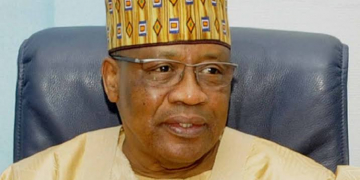










In the annals of contemporary Nigerian history, former head of state, General Ibrahim Badamasi Babangida (IBB), played a most significant role.
Indeed, the history of modern Nigeria will be incomplete without a gesture to how his acts of commission and omission contributed to the structuring of the Nigerian state and its political landscape.
With some sense of accuracy, IBB was nicknamed the evil genius by the observant creativity of the vibrant Nigerian media. In Nigeria鈥檚 political history, IBB has become infamously synonymous with the annulment of the June 12, 1993 general election that was adjudged to have been won by MKO Abiola. And that annulment demonstrated how a single negative act could undermine the legacy of any pubic figure.
However, and not to put too much of a spin on a bad act of political misjudgment, the June 12 saga aptly brought into bold relief the fact鈥攁 reiteration鈥攖hat there certainly was no love lost among the different 鈥渨arring鈥� nationalities in Nigeria, and that Nigeria has not moved significantly away from being a 鈥渕ere geographical expression.鈥�
As IBB clocks 80, we are drawn, willy-nilly, into a reflection about a man who has done a lot to structure and restructure the Nigerian project in ways that generate both approval and opprobrium in equal measures. While so many of the existing structural additions to the Nigerian governance dynamics鈥攖he decrees that bought into existence many institutions, from NDLEA and Federal Road Safety Corps, community banks, ECOMOG, MAMSER/NOA to the national planning commission and many other educational structures鈥攁re due to the policy insights of his regime, the singular annulment of the June 12 presidential election became the single most damning incidence that overwhelmed every other good that IBB facilitated.
In a recent interview with Arise TV, IBB opened up on a series of issues concerning his role in the definition of where we are now as a country and how we can transcend the predicament in order to move forward into national greatness. But there is an aspect of that governance legacy that surprisingly was not touched upon. Let me open it up as a means by which I could make some points about the reform of Nigeria鈥檚 governance dynamics through the perspective of leadership and political will.
For the sake of full disclosure, I have a dog in this game. Unknown to many, it was IBB that enabled my first time and momentous entry into the federal civil service of Nigeria. With what I later learnt to be his uncanny capacity to fish out talents, IBB had been brought to notice me through my Op-Ed pieces in the newspaper in the late 1980s. This is a passion that I had developed and sustained from secondary school which had grown while I was trying to make sense of what career direction I needed to make.
It was as if Providence was working through IBB to invite me to the Presidency as part of his speech writing and policy analysis team in January 1992. The rest, as we say, is history. This narrative does not however obviate some fundamental questions. Even in the face of IBB鈥檚 critical intervention in my career positioning, why must I risk the suspicion and aspersion that would certainly be cast on any celebratory effort to whitewash one of Nigeria鈥檚 most derided and enigmatic figures? And do I even qualify to engage the trajectory of IBB’s actions in the annals of Nigeria’s political unfolding? These are legitimate questions.
Since I had been there from the commencement of what the Nigerian press dubbed IBB鈥檚 deft political maneuvers, I have been given the retrospective opportunity as an insider to assess IBB the man and the politician. And I have never failed to be amazed at how both IBB and the Nigeria he supervised as military president missed significant opportunity to transform each other.
The Arise interview convinces me again about the deep humanity of IBB as someone who not only understand the significance of social relations, but refuses to instrumentalize it. IBB knows how to sacrifice in ways that demonstrate his love for his friends. The late Prof. Ojetunji Aboyade had such a story to tell about how IBB saved his life in 1988. I have such a story to tell too, and many dozens, if not hundreds or thousands, more. But this piece is not just about personal narratives.
My concern here is motivated by my interest as a policy analyst, a development worker and a student of governance in Nigeria. I have reflected on how IBB鈥檚 place in Nigeria鈥檚 history could be bent towards a retrieval of some significant elements in governance excellence and policy professionalism.
As an 鈥渁ccidental civil servant,鈥� I was brought face to face not only with IBB鈥檚 loyalty to people, but also his status as a president with a huge governance credentials, as well as a high-end policy intelligence and technical capacity that enabled a technocratic-administrative space within which the Nigerian state could have transcended its own dysfunctions and live out its post-independence promises and potentials. Of course, we all lament that failed opportunity now.
So, for me, the issue is neither to praise or to blame IBB, to parody the Shakespearean Cassius at the burial of Julius Caesar. While the evil that men do live after them, and the 鈥渆vil鈥� of IBB still hang on his neck like an albatross, fundamental legacies should not be interred with their bones. And this is all the more significant with IBB and policy implications of his governance profile and dynamics.
This is my hypothesis: IBB鈥檚 administration consisted of the most technocratically competent assemblage of Nigerians in governance ever in Nigerian history. And if Nigeria had gone beyond his 鈥渟ins鈥� and bashing to incorporate his talent for talent hunting and mobilization for governance, Nigeria鈥檚 governance profile might have been transformed. Is there a way that the persona and the administration of IBB allows us to question how the Nigerian state has denigrated meritocracy, professionalism and even humaneness in the context of state and party politics to the extent that Nigeria鈥檚 political destiny has been sidelined?
We are where we are now because it seems that the absence of a professional and technocratic space, the like created by IBB, has sent professionals and statesmen into a 鈥渟iddon look鈥� cynicism that paved the way for all sorts of opportunists, rent seekers, political buccaneers, and sycophants to invade the governance space in ways that decimate the capacity of any political elite to achieve genuine transformation.
There is a dimension of IBB leadership style that took research-based, meritocratic policymaking dynamics to a level that would likely not be reinvented in the Nigerian policy space for a long time. IBB helps us to push to the fore the question of whether policy and policy analysis can be saved from politics. Policy science presents us with the problematic of how to juxtapose between the need for independent expertise and pressures for politicization of policy formulation in the service of democratic accountability and good governance.
Given the orientation demanded by the evolution of policy analysis, there is the pervasive technicist notion that public policy problems are technical questions that are resolvable by technical-rationalism and the application of specialized policy intelligence and technical expertise in a dynamic that exclude political interference.
Unfortunately, such an idea remains wishful thinking because public policy exists in the context of politics from which it is impossible to extricate. And it is right within this simultaneously constricting and enabling context that policy analysis must strive to achieve research intelligence and creativity.
Policymaking is the very essence of the government. It is the means by which the intention of government is communicated on how it wants to facilitate infrastructural development that will improve the welfare of the citizens. And that process is unabashedly competitive, with significant bargaining involved that demands prioritization and opportunity lost and gained. In other words, policy preferences of one group are maximized against others i.e. no one group or constituent can be made better off without others being made worse.
Thus, some interests are inevitably more satisfied than others, and whoever is most satisfied depends on who has most political clout and lobbying capacity. This therefore implies that the government must be concerned with how the policymaking process can be properly outlined in line with the aspirations of the politicians. Policymakers as bureaucrats are not left out of this mix because policymaking itself is a value-laden context, and so technical-rationalism does not immune technical experts from value and political biases that could sway policy decisions one way rather than the other.
So, what I consider the IBB legacy is a leadership template that allow us to bring to mind, and critically consider, the policy analysis challenge that demand that we find a relative balance between policy intelligence and political farsightedness that will allow the policy skills and competences that bureaucrats deploy in policy design the motivation for politicians to pursue cogent governance agenda and objectives with the most minimum of crippling politicization.
The tragedy of the IBB administration is that with all the bright minds at his disposal, politics in its darkest form eventually trump policy analysis. The future of the Nigerian state is to find a means by which politicians will come to respect sound policy intelligence for the sake of Nigerians.
Prof. Tunji Olaopa is a retired Federal Permanent Secretary & Professor of Public Administration/Public Policy,
National Institute For Policy and Strategic Studies (NIPSS), Kuru, Jos
[email protected]