









Akinwande Soji-Ojo
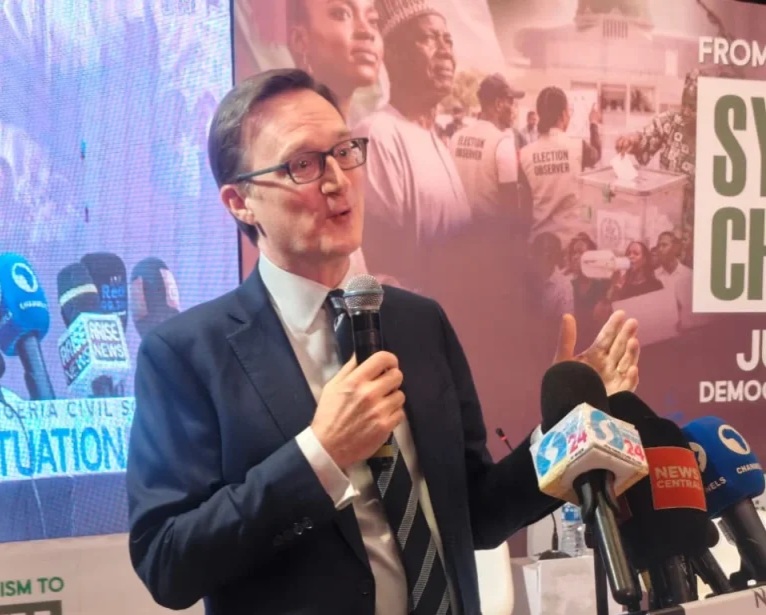
The British High Commissioner to Nigeria, Richard Montgomery, has said Nigeria must conduct credible, peaceful and inclusive elections in 2027 to sustain public confidence in its democratic process and maintain its leadership role across Africa.
Montgomery made the remarks on Friday in Abuja during the Nigeria Civil Society Situation Room’s June 12 Democracy Day Dialogue and Photo Exhibition.
He stressed that the credibility of the next general elections would be critical to Nigeria’s democratic future, adding that civil society organisations would play a central role in ensuring transparent and inclusive polls.
“The credibility of the next elections will be vital for public confidence in the democratic process and for Nigeria’s continued progress, and indeed for its leadership across Africa and beyond.
“Ensuring that they are credible, peaceful and inclusive will require the collective efforts of many, and civil society organisations will be absolutely central to this,” he said.
The British envoy also called for greater participation by women, youths, persons with disabilities and other marginalised groups in the electoral process.
“As the President said in his Democracy Day speech this morning, democracy fails when citizens doubt the process. We strongly believe that civil society organisations have key roles to play in holding the electoral process to account and making it more inclusive.
“The meaningful participation of women, younger people, persons with disabilities and other marginalised groups is important. This inclusion will determine whether citizens trust or doubt electoral outcomes,” Montgomery added.
He pledged the United Kingdom’s continued support for efforts aimed at strengthening Nigeria’s democratic institutions, promoting transparency and advancing credible electoral processes.
“We will work with you in the coming months and years in championing credible electoral processes, strengthening democratic institutions and supporting organisations working for more inclusive processes and outcomes,” he said.
Reflecting on the significance of June 12, Montgomery described the date as a lasting symbol of Nigeria’s democratic struggle, noting that democracy requires continuous commitment from both citizens and institutions.
“June 12 remains such a powerful symbol of your struggle to shape your democratic future. It represents a milestone, but it is also an enduring reminder that democracy is built through courage, resilience and persistence by individuals who choose to act and support the democratic process,” he said.
He further described democracy as an ongoing process rather than a single event.
“We strongly believe that democracy, despite all its flaws, is the best system for enabling people to shape the decisions that affect their lives. For such a huge, complicated and diverse country as Nigeria, democracy is incredibly important for your stability and prosperity going forward,” he stated.
Also speaking, the Executive Director of the Policy and Legal Advocacy Centre and Convener of the Situation Room, Clement Nwankwo, expressed concern over developments in Nigeria’s electoral process ahead of the 2027 general elections.
He warned against allowing the gains of June 12 to be eroded by shortcomings in the electoral system.
“We do not want January 16 to become a defeat of June 12. The signals we are getting are not good enough. It is not encouraging,” Nwankwo said.
He urged civil society organisations to closely monitor developments and hold relevant institutions accountable.
Former member of the House of Representatives, Abdul Oroh, also called on young Nigerians to actively participate in politics, saying increased youth involvement is essential to strengthening the country’s democracy.
“Don’t wait until you are 30 to start. You can join any political party today. Even though some of the parties we see now look like special purpose vehicles, you will learn from them. Start, interact with other Nigerians and other young people, mobilise and participate. If you don’t participate, you will remain on the sidelines,” he said.
June 12 is observed annually as Nigeria’s Democracy Day in honour of the annulled June 12, 1993 presidential election, widely regarded as the freest and fairest in the country’s history, which was won by the late Chief MKO Abiola. The day commemorates the sacrifices of pro-democracy activists and Nigeria’s return to democratic rule in 1999.