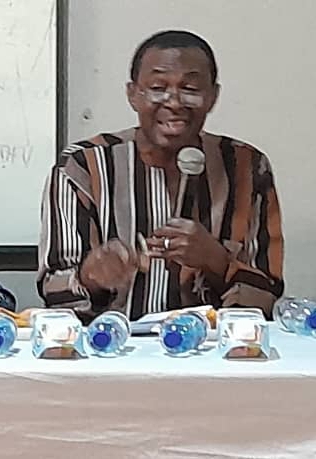







By Emmanuel Adeleke
A Professor of History, Akin Ogundiran, has described the relationship between Ife and Oyo as that of a father to his last born, stressing that it requires little debate.
Ogundiran, the Cardiss Collins Professor of Arts and Sciences at Northwestern University, Evanston, USA, made this remark while delivering the Faculty Distinguished Alumnus Lecture at the University of Ibadan, on Tuesday.
Speaking on the topic 鈥淎ncient History for the Present: The Challenge of Ancestral Yoruba Cosmopolitanism to Postcolonial Nigeria,鈥� the historian explained that Ile-Ife, the 鈥渉ome of abundance,鈥� is the ancestral land that continues to define Yoruba kingship.
鈥淲e cannot personalise history and reduce it to the personalities of two individuals who happen to occupy the royal stools of their ancestors.
“The relationship between Oyo and Ife is like that between a father and his last born. Oyo was the last of the major kingdoms that emerged from Ife, so the relationship does not require much debate,” he said.
According to him, Ile-Ife not only laid the political foundation but also developed the economic, religious, intellectual, and philosophical basis of Yoruba kingship as far back as the 11th century AD.
Ogundiran, who has studied the Oyo Empire for over two decades, added that history shows clearly that Ife predates Oyo.
鈥淭here was an older Ife empire that lasted between 1200 and 1420. The Oyo Empire emerged about 150 years after its collapse,鈥� he noted.
The historian emphasised that Yoruba monarchy has never been based on one person, but on a shared structure involving kings, advisers, princes, and princesses.
鈥淭he office of Ooni exists, and whoever occupies it has legitimacy, just as the office of Alaafin does. The focus should be on the institution, not personal rivalries,鈥� he stressed.
Describing the recent disputes between the Ooni of Ife and the Alaafin of Oyo as 鈥渁n unfortunate distraction,鈥� Ogundiran urged monarchs to invest in research, create museums, and support the preservation of Yoruba history instead of trading supremacy claims.
鈥淭here is no Alaafin of Yoruba land and no Ooni of Yoruba land. There is only the Alaafin of Oyo and the Ooni of Ife.
鈥淭he Yoruba identity, when first written in the 17th century, referred to all Yoruba-speaking people, stretching from present-day Nigeria into Benin Republic and Togo,鈥� he stated.