Sahara Reporters is a Nigerian online news outlet created for the business of journalism — a practice that ordinarily should be in strict adherence to the ethical principles guiding the noble profession.
Sadly and tragically, this outlet has become a laughingstock, a comic relief platform, and a fake news hub where falsehood, scandals, sensationalism, mischief, and predatory journalism thrive. If you doubt my judgment, simply type into any Artificial Intelligence (A.I.) app on your smartphone: Nigeria’s most untruthful and controversial news outlet. Sue me if Sahara Reporters does not top the list.
The platform has become a replica of its owner and publisher, Mr. Omoyele Sowore, who has transformed into a so-called “sophisticated political thug,� shamelessly mouthing dirty political slogans and waging needless wars against responsible leaders of the country — all in a desperate attempt to seek relevance and mislead unsuspecting Nigerian youths into supporting his perpetually doomed presidential ambition.
We professionals in journalism are embarrassed by the gross disregard Mr. Sowore allows Sahara Reporters to display against our noble profession, especially whenever we read its poorly handled and shoddily edited publications churned out daily on its digital platform.
One such recent disgraceful outing was the publication titled: “EXCLUSIVE: Nigeria’s Federal University Oye-Ekiti Pro-Chancellor, Suspended VC Accused Of Manipulating Recruitment, Bending Rules To Favour Loyalists�, published on August 18, 2025.
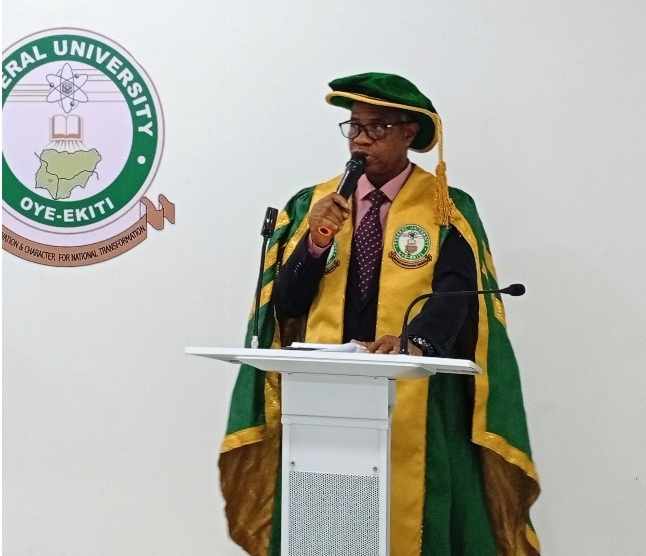
That publication was nothing but a show of shame and a dirty slap on journalism. It fell grossly short of what professionals in the field would recognize as a balanced report — one devoid of bias, witch-hunt, and smear campaigns. It was full of falsehood, yellow journalism, sensationalism, and baseless allegations against the Chairman of the Governing Council of the Federal University Oye-Ekiti (FUOYE) and the substantive Vice-Chancellor, Prof. Abayomi Sunday Fasina, who is currently on research leave as approved by the Governing Council, ably led by the respected statesman, Senator Victor Ndoma-Egba, SAN.
Sahara Reporters’ recent sustained attack on FUOYE is not surprising. The outlet is notorious for launching predatory media assaults on decent Nigerians. A quick check online would reveal the countless legal suits against its malpractices — many of which Sahara Reporters has shamefully lost.
One wonders if Sahara Reporters has lost every sense of decency and ethical norm. After failing to convince the public with its false claim that Prof. Fasina was suspended (when, in reality, he merely proceeded on a well-deserved accumulated research leave approved by Council), the platform still launched another attack, this time aligning itself with recalcitrant elements desperate to seize the Vice-Chancellorship by all illegitimate means.
The content of that publication testifies to how Sahara Reporters has reduced itself to a willing tool for political shenanigans, weaponizing media trials to smear individuals.
But pray, which credible sources did Sahara Reporters cite for its allegations? One of journalism’s core ethics is clarity and balance. The headline and content of that report fell grossly short of those principles that make journalism a noble profession and affirm it as the fourth estate of the realm.
Let us now address the lies one after another.
First, Sahara Reporters labelled Prof. Fasina as a “suspended VC.� But where is the purported suspension letter? A genuine suspension would have required such a document — which, unsurprisingly, they failed to produce.
Second, Sahara Reporters alleged that both Senator Ndoma-Egba and Prof. Fasina manipulated recruitment processes. Yet, it failed to state categorically from whom such allegations originated. Ideally, such weighty accusations should have come directly from the Acting Vice-Chancellor, Prof. Olubunmi Shittu — but no such statement exists. Clearly, unscrupulous elements scripted the lies, with Sahara Reporters acting as their megaphone.
Thankfully, the University’s Public Relations Officer, Mr. Foluso Ogunmodede, punctured Sahara Reporters’ claims, stating:
“Contrary to the lies in Sahara Reporters’ trending report, accusing the Pro-Chancellor, Senator Victor Ndoma-Egba, SAN, and the Vice-Chancellor, Prof. Abayomi Sunday Fasina, of manipulating recruitment and bending rules to favour loyalists — both had no role to play in such appointments. The recent appointments were the exclusive preserve of the university management led by the Acting Vice-Chancellor, Prof. Olubunmi Shittu.�
Ogunmodede further exposed Sahara Reporters’ pitiable gaffe by clarifying that the eligibility criteria for FUOYE’s Vice-Chancellorship were set by the Minister of Education, Dr. Tunji Alausa, not the Pro-Chancellor or Prof. Fasina.
He quoted Dr. Alausa:
“The policy became necessary following a pattern of undue advantage observed over the years, where officers serving in acting capacities often leveraged their positions to influence outcomes… The policy ensures fairness, transparency, and institutional governance.�
Clearly, Sahara Reporters lied — again.
If anyone, after reading these rebuttals, still chooses to believe Sahara Reporters’ pathological lies, then something is fundamentally wrong with such a person.
Truth is: the recent appointments at FUOYE were duly made, staff members welcomed them, and the officers have since assumed duty. Peace reigns on campus, contrary to the chaos Sahara Reporters wished to create.
The Governing Council remains the highest authority in any federal university, and FUOYE is no exception. Its decisions are democratic, peculiar to its circumstances, and cannot be compared to those of other universities. Sahara Reporters’ attempt to compare is nothing but a deliberate disruption.
Finally, Sahara Reporters has already been dragged to court for its lies against Prof. Fasina and FUOYE. Rather than waste time on smear campaigns, it should focus on defending itself against the myriad of charges it faces.
Enough is enough!
Alabi, a public affairs analyst, writes from Lagos.