






Akinwande Soji-Ojo
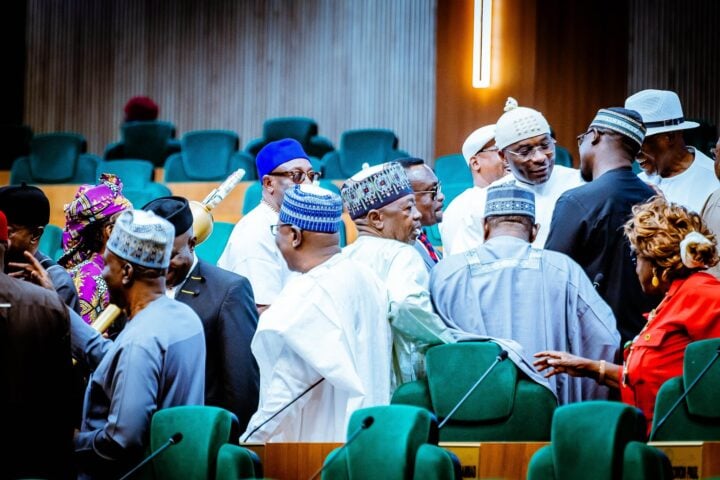
Opposition lawmakers in the House of Representatives staged a walkout during plenary on Tuesday over the Electoral Act amendment bill.
The lawmakers exited the chamber after their attempt to make electronic transmission of election results mandatory, without allowing manual collation as a fallback in cases of technological failure, was unsuccessful.
The fresh amendment to Section 60(3) provides that: 鈥淭he Presiding Officer shall electronically transmit the results from each polling unit to the IReV portal, and such transmission shall be done after the prescribed Form EC8A has been signed and stamped by the Presiding Officer and/or countersigned by the candidates or polling agents where available at the polling unit.
“Provided that if the electronic transmission of the result fails as a result of communication failure and it becomes impossible to transmit the result contained in Form EC8A signed and stamped by the Presiding Officer and countersigned by the candidates or polling agents where available at the polling unit, the Form EC8A shall remain the primary source of collation and declaration of the result.鈥�
However, opposition lawmakers insisted that the provision should end after the first paragraph, effectively removing the clause that allows manual collation in the event of electronic transmission failure.
The lower legislative chamber had in December 2025 amended the Electoral Act and adopted a proposal mandating the real-time transmission of election results to the Independent National Electoral Commission (INEC) result viewing portal (IReV).
The approved clause states that: 鈥淭he Presiding Officer shall electronically transmit the results from each polling unit to the IReV portal in real time, and such transmission shall be done after the prescribed Form EC8A has been signed and stamped by the Presiding Officer and/or countersigned by the candidates or polling unit agents, where available at the polling unit.鈥�
Earlier this month, the Senate passed the Electoral Act amendment bill but initially rejected the proposal for real-time electronic transmission of election results, a move that sparked protests and calls for lawmakers to reverse the decision.
Last week, the upper legislative chamber rescinded its decision and approved the electronic transmission of election results to IReV, with a clause that manual collation should serve as a fallback if technology fails.
During Tuesday鈥檚 plenary, the chamber turned rowdy as lawmakers disagreed over a motion seeking to rescind the passage of the Electoral Act amendment bill.
Francis Waive, Chairman of the House Committee on Rules and Business, moved a motion for the chamber to reverse its earlier decision on the bill, which was passed in December.
When Rt. Hon. Tajudeen Abbas, Speaker of the House, put the motion to a voice vote, the 鈥渘ays鈥� were louder than the 鈥渁yes,鈥� but he ruled in favour of the 鈥渁yes.鈥�
The ruling triggered protests from lawmakers, who began shouting in objection.
Abbas subsequently called for an executive session, but the proposal was also rejected.
Despite the resistance, the Speaker moved the House into an executive session.