






Akinwande Soji-Ojo
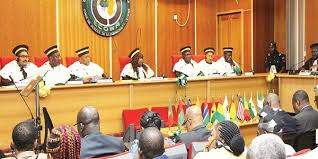
The Economic Community of West African States聽(ECOWAS) Court聽of Justice sitting in Abuja, has rejected a request to order the transfer of a Nigerian convicted of fraud in the United States to complete his jail time in Nigeria.
The court, in a judgement delivered on Thursday, said it lacked jurisdiction to grant the Nigerian, Richard Ugbah鈥檚 request.
The court鈥檚 communication unit disclosed this while highlighting the key issues decided on Thursday.
Ugbah, a Nigerian citizen and resident in the US, was convicted by the District Court for the Western District of Wisconsin after he pleaded guilty to one count of wire fraud on February 14, 2017.
Additionally, he pleaded guilty to another count of conspiracy to commit fraud on November 15, 2017, and judgement was entered on November 22, 2017.
He was subsequently sentenced to 12 years鈥� imprisonment.
Ugbah had approached the ECOWAS court claiming that he had already served eight of his 12 years jail term, adding that he was due for release on May 8, 2026.
The convict told the court to order his transfer to Nigeria, explaining that he had satisfied the requirements for such a transfer.
He urged the court to issue the order for his transfer to Nigeria to complete his jail term, having, according to him, satisfied the necessary conditions in line with the provision of the United Nations Office on Drugs and Crime Handbook on the International Transfer of Sentenced Persons.
Ugbah also maintained that the transfer of sentenced persons is considered to be an important means of cooperation to prevent and combat crimes.
He said crimes combatting and preventing are the main purposes of the United Nations Convention against Illicit Traffic in Narcotic Drugs and Psychotic Substances of 1998, the United Nations Convention against Corruption and the United Nations Convention against Transnational Organised Crime.
The applicant further argued that all three conventions cited refer to the possibility of concluding agreements to facilitate the transfer of persons convicted abroad for the offences covered by the conventions to another state to complete their sentence.
However, the Nigerian government, which is the first defendant, opposed the suit. The government filed a preliminary objection, contending that the applicant鈥檚 initiating application was incompetent by virtue of Articles 9 and 10 of the Supplementary Protocol (A/SP./01/05).
It added that the Ministry of Justice sued as the second respondent, is neither a Community Institution nor a signatory to the ECOWAS Treaty to be competent to be sued before the court.
The government further claimed that the court lacked the jurisdiction to entertain the suit. It, therefore, urged the court to strike out the notice of registration for want of jurisdiction and lack of cause of action.
Delivering judgement, the three-member panel of Justices Dupe Atoki (presiding), Ricardo Cla煤dio Monteiro Gon莽alves (member) and Sengu Koroma (member) declared that the court lacked jurisdiction to hear the suit.
Koroma, the Judge Rapporteur who read the judgement, upheld the preliminary objection raised by the Federal Republic of Nigeria,, declaring the applicant鈥檚 claims as 鈥渦nfounded and without legal basis.”
The judge also ruled that Nigeria鈥檚 Ministry of Justice, sued as the second respondent in the case, was not a proper party before it.
The court struck out the second respondent鈥檚 name as a party in the suit, based on the agreement reached by both sides in the suit.
Koroma went on to rule that the applicant failed to show a valid reason for his complaint against the respondent.
Additionally, the court found that the matter of competence is a legal issue and the argument presented by the applicant had no legal basis vesting the court with the authority to hear and determine the case. As a result, it dismissed the claim and upheld the respondent鈥檚 preliminary objection.
The court consequently dismissed all the prayers of the applicant.