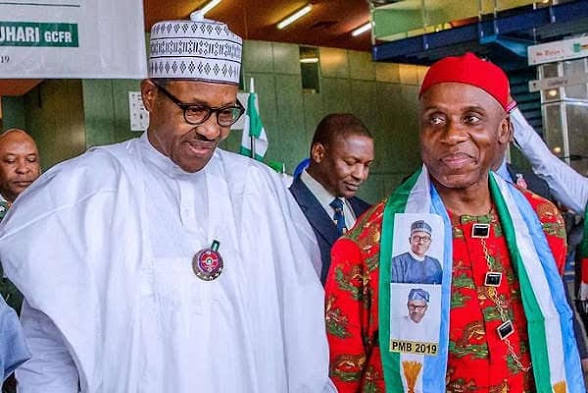
President Muhmmadu Buhari has described former United States (U.S.) Ambassador to Nigeria, Walter Carrington as a 鈥渓ong-time friend of Nigeria, an astute and courageous diplomat.鈥�
He mourned the death of the top diplomat in a statement issued by his Senior Special Assistant on Media and Publicity, Garba Shehu.
In a tribute, Buhari praised the late ambassador whom he said 鈥渙penly supported the people of this country when they fought for the return of democracy following the annulment of the June 12, 1993 presidential elections won by the late Moshood Abiola.鈥�
The President said the story of the Nigerian democracy under the Fourth Republic would not be complete without mentioning the heroic roles of the likes of Ambassador Carrington.
The statement said: 鈥淥n behalf of my family, the government and people of Nigeria, I commiserate with the family of the deceased, his friends and admirers as well as the government and people of the United States.鈥�
Carrington, a former US Ambassador to Nigeria and Senegal, died on Wednesday at the age of 90. His wife,聽 Arese, made the announcement in a statement.
Born 1930, the American diplomat was trained at the prestigious Harvard University and appointed ambassador to Nigeria in 1993 by President Bill Clinton, where he served for four years. He had earlier been appointed as ambassador to Senegal between 1981 and 1982 by President Jimmy Carter. A Democrat by political affiliation, he had and sustained deep ties to Nigeria,culminating in him marrying a Nigerian lady, Arese.
His Nigerian-born wife, Arese, is a medical doctor and a public health specialist. The two of them were joint recipients of聽 the 2014 City of Newton Lifetime Human Rights Achievement Award. Both governments of Nigeria and Senegal聽 conferred on him national honours while the diplomatic enclave in Lagos, on which the American聽 and a dozen other consulates are located, was renamed Walter Carrington Crescent.
The highlight of his official duties in Nigeria was standing shoulder to shoulder with pro-democracy activists during the聽 oppressive regime of General Sani Abacha, defending and supporting human rights and genuine democracy. Carrington was a member of the Council on Foreign Relations, the Council of American Ambassadors, Association of Black American Ambassadors and Alpha Phi Alpha fraternity.
His career intersected with diplomacy, academia, government, politics, law, civil and human rights,and civil society聽 organisations. A book on his speeches promoting human rights and democracy, 鈥淎 Duty to Speak,鈥� was published in聽 Nigeria in 2010. It was announced recently that he was writing his memoir and a book on Nigeria under military rule.
The United States consulate established a youth fellowship in his honour (Carrington Youth Fellowship Initiative 鈥撀� CYFI). His academic teaching and administrative experience included Visiting Professorships at the Massachusetts Institute of Technology (M.I.T.), Simmons College, Washington College and Marquette University, where he taught聽 courses on US Foreign Policy, Islam in Africa and African Politics.
At Howard University, he created and developed the Department of International Affairs which oversaw the university鈥檚 international endeavours. Upon the establishment of the Peace Corps in 1961, Carrington was appointed as one of its first overseas country directors and his 10-year service included directing programmes in Sierra Leone, Tunisia and Senegal.
Before becoming one of President Bill Clinton鈥檚 early diplomatic appointments, Ambassador Carrington was a senior advisor on Africa to the Clinton transitional team. In 1994, Ambassador Carrington was selected by the Boston Globe Sunday Magazine as one of the 100 most distinguished living graduates of Massachusetts鈥�.