






Akinwande Soji-Ojo
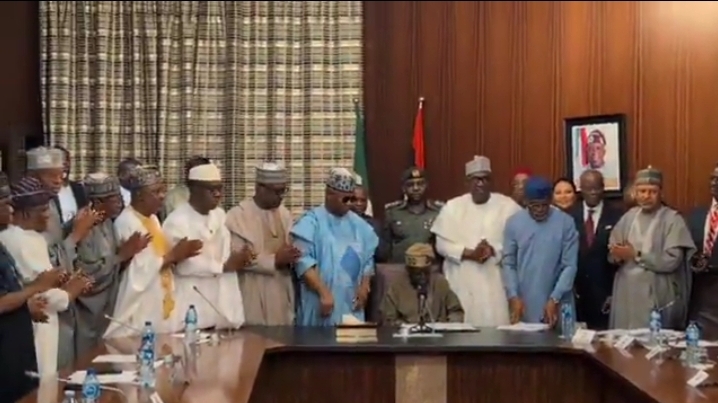
President Bola Tinubu has signed into law four tax reform bills on key areas of Nigeria鈥檚 fiscal and revenue framework.
Tinubu signed the bills at a ceremony held at the Presidential Villa, Abuja, on Thursday afternoon.
The four bills include: the Nigeria Tax Bill, the Nigeria Tax Administration Bill, the Nigeria Revenue Service (Establishment) Bill, and the Joint Revenue Board (Establishment) Bill.
They were passed by the National Assembly after months of consultations with various interest groups and stakeholders.
鈥淲hen the new tax laws become operational, they are expected to significantly transform tax administration in the country, leading to increased revenue generation, improved business environment, and a boost in domestic and foreign investments,鈥� presidential spokesperson, Bayo Onanuga, said.
The presidential assent to the bills was witnessed by the Senate President, Speaker of the House of Representatives, Senate Majority Leader, House Majority Leader, Chairman of the Senate Committee on Finance, and his House of Representatives counterpart.
The Chairman of the Nigeria Governors Forum and Kwara State Governor, Abdulrahman Abdulrazaq; the Chairman of the Progressives Governors Forum and Imo State Governor, Hope Uzodinma; Minister of Finance and Coordinating Minister of the Economy, Wale Edun; and the Attorney General of the Federation, Lateef Fagbemi (SAN), also attended the ceremony.
One of the four bills is the Nigeria Tax Bill (Ease of Doing Business), which aims to consolidate Nigeria鈥檚 fragmented tax laws into a harmonised statute.
鈥淏y reducing the multiplicity of taxes and eliminating duplication, the bill will enhance the ease of doing business, reduce taxpayer compliance burdens, and create a more predictable fiscal environment,鈥� Onanuga said in a statement on Wednesday night.
The second bill, the Nigeria Tax Administration Bill, will establish a uniform legal and operational framework for tax administration across federal, state, and local governments.
The Nigeria Revenue Service (Establishment) Bill, the third bill, repeals the current Federal Inland Revenue Service Act and creates a more autonomous and performance-driven national revenue agency鈥� the Nigeria Revenue Service (NRS).
It defines the NRS鈥� expanded mandate, including non-tax revenue collection, and lays out transparency, accountability, and efficiency mechanisms.
The fourth bill is the Joint Revenue Board (Establishment) Bill.
It provides for a formal governance structure to facilitate cooperation between revenue authorities at all levels of government. It introduces essential oversight mechanisms, including establishing a Tax Appeal Tribunal and an Office of the Tax Ombudsman.






