





Akinwande Soji-Ojo
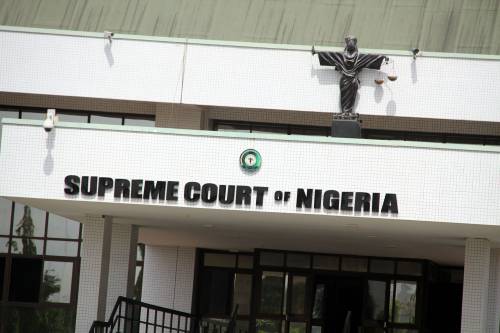
The Supreme Court, on Thursday, invalidated the national convention of the Peoples Democratic Party (PDP) held in Ibadan, Oyo State, on November 15 and 16, 2025, deepening the leadership crisis rocking Nigeria鈥檚 main opposition party ahead of the 2027 general elections.
In a split judgement delivered by a five-member panel of the apex court, three justices held that the appeal filed by a faction of the party led by former Minister of Special Duties, Tanimu Turaki (SAN), lacked merit and affirmed the concurrent decisions of the Federal High Court and the Court of Appeal nullifying the convention.
Justice Stephen Adah, who delivered the lead judgement in the appeal, held that the appellants acted in flagrant disobedience of a subsisting order of the Federal High Court restraining them from proceeding with the planned convention pending compliance with earlier directives of the court.
鈥淭he disobedience of the court order is not disputed,鈥� Justice Adah held, adding that what transpired amounted to 鈥渁 threat to the administration of justice in Nigeria.鈥�
The apex court consequently dismissed both the appeal and cross-appeals and ordered the parties to bear their respective costs.
The dispute arose from the controversial Ibadan convention organised by the Turaki-led faction of the PDP despite pending court orders and unresolved disputes over congresses conducted in several states.
Aggrieved party members had approached the Federal High Court in Abuja, arguing that the organisers failed to comply with statutory requirements under the Electoral Act and the party鈥檚 constitution before proceeding with the convention.
The trial court subsequently restrained the party from holding the convention pending compliance with its directives.
However, despite the order, the convention went ahead in Ibadan and produced a factional leadership structure, triggering fresh litigation and accusations of forum shopping within the party.
In its judgement, the Supreme Court strongly condemned what it described as a deliberate attempt by political actors to undermine judicial authority by securing conflicting orders from courts of coordinate jurisdiction.
Justice Adah said that instead of obeying the order of the Federal High Court or pursuing lawful appellate remedies, the appellants allegedly approached another High Court in Ibadan to obtain orders that enabled them to proceed with the convention.
鈥淭he appellant did not go on appeal but went to another High Court, where they secured orders overriding the existing order of the Federal High Court and carried on with the party convention,鈥� the judge held.
The apex court described the conduct as 鈥渁n unparalleled abuse of court process鈥� that struck 鈥渁t the very roots of the administration of the justice system.鈥�
Justice Adah warned that continued disregard for judicial orders by politicians posed grave dangers to constitutional democracy and the rule of law.
鈥淭he rule of law is not an ornament to be revoked, destroyed, or discarded in practice. It is the fundamental architecture on which the legitimacy of governance rests,鈥� he held.
He added that once political actors begin to treat lawful judicial processes as optional, 鈥渢he very essence of constitutional democracy is imperilled.鈥�
The court further held that political parties, though voluntary associations, derive their legal existence and authority from the Constitution and must therefore operate within constitutional and judicial limits.
Relying on Sections 221, 222, and 229 of the 1999 Constitution, the apex court held that political parties remain constitutional institutions established for the purpose of participating in governance and elections and are therefore bound by lawful court orders.
Justice Adah noted that the Federal High Court, being a superior court of record vested with judicial powers under the Constitution, could not be ignored merely because a political party considered its orders inconvenient.
The apex court also upheld the findings of the lower courts that abuse of court process had been established following the move by the PDP faction to obtain what was described as a counter-order from a court of coordinate jurisdiction in Ibadan.
The Court of Appeal had, in its March 9 judgement, affirmed the earlier decision of the Federal High Court and held that the convention was conducted in violation of subsisting judicial orders and contrary to established legal procedures.
Dissatisfied with the appellate court鈥檚 decision, the Turaki-led faction proceeded to the Supreme Court, seeking five principal reliefs and one general relief, including orders setting aside the judgements of the lower courts and validating the Ibadan convention.
However, the apex court rejected the appeal in its entirety.
The Supreme Court had reserved judgement in the appeal after hearing arguments from the parties on April 22.